Please select a subject first
Advertisements
Advertisements
Find the value of x so that (–2)3 × (–2)–6 = (–2)2x – 1
Concept: undefined >> undefined
Find the value of x so that (2–1 + 4–1 + 6–1 + 8–1)x = 1
Concept: undefined >> undefined
Advertisements
Find the value of x–3 if x = (100)1 – 4 ÷ (100)0.
Concept: undefined >> undefined
By what number should we multiply (–29)0 so that the product becomes (+29)0.
Concept: undefined >> undefined
By what number should (–15)–1 be divided so that quotient may be equal to (–15)–1?
Concept: undefined >> undefined
Find the multiplicative inverse of (–7)–2 ÷ (90)–1.
Concept: undefined >> undefined
If `5^(3x - 1) ÷ 25 = 125`, find the value of x.
Concept: undefined >> undefined
Find x so that `(2/9)^3 xx (2/9)^-6 = (2/9)^(2x - 1)`
Concept: undefined >> undefined
By what number should `((-3)/2)^-3` be divided so that the quotient may be `(4/27)^-2`?
Concept: undefined >> undefined
Find the value of n.
`6^n/6^-2 = 6^3`
Concept: undefined >> undefined
Find the value of n.
`(2^n xx 2^6)/2^-3 = 2^18`
Concept: undefined >> undefined
`(125 xx x^-3)/(5^-3 xx 25 xx x^-6)`
Concept: undefined >> undefined
`(16 xx 10^2 xx 64)/(2^4 xx 4^2)`
Concept: undefined >> undefined
If `(5^m xx 5^3 xx 5^-2)/5^-5 = 5^12`, find m.
Concept: undefined >> undefined
A new born bear weighs 4 kg. How many kilograms might a five year old bear weigh if its weight increases by the power of 2 in 5 years?
Concept: undefined >> undefined
The cells of a bacteria double in every 30 minutes. A scientist begins with a single cell. How many cells will be there after 12 hours?
Concept: undefined >> undefined
The cells of a bacteria double in every 30 minutes. A scientist begins with a single cell. How many cells will be there after 24 hours?
Concept: undefined >> undefined
Planet A is at a distance of 9.35 × 10⁶ km from Earth and planet B is 6.27 × 10⁷ km from Earth. Which planet is nearer to Earth?
Concept: undefined >> undefined
An insect is on the 0 point of a number line, hopping towards 1. She covers half the distance from her current location to 1 with each hop. So, she will be at `1/2` after one hop, `3/4` after two hops, and so on.
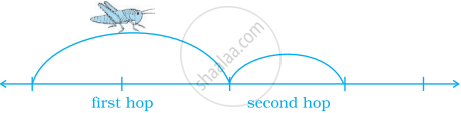
- Make a table showing the insect’s location for the first 10 hops.
- Where will the insect be after n hops?
- Will the insect ever get to 1? Explain.
Concept: undefined >> undefined
An insect is on the 0 point of a number line, hopping towards 1. She covers half the distance from her current location to 1 with each hop. So, she will be at `1/2` after one hop, `3/4` after two hops, and so on.
Where will the insect be after n hops?
Concept: undefined >> undefined
