Advertisements
Advertisements
Question
An insect is on the 0 point of a number line, hopping towards 1. She covers half the distance from her current location to 1 with each hop. So, she will be at `1/2` after one hop, `3/4` after two hops, and so on.
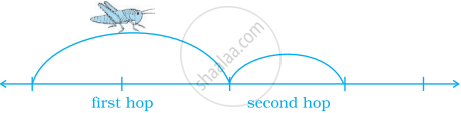
- Make a table showing the insect’s location for the first 10 hops.
- Where will the insect be after n hops?
- Will the insect ever get to 1? Explain.
Advertisements
Solution
a. On the basis of given information in the question, we can arrange the following table which shows the insect’s location for the first 10 hops.
| Number of hops | Distance covered | Distance left | Distance covered |
| 1. | `1/2` | `1/2` | `1 - 1/2` |
| 2. | `1/2(1/2) + 1/2` | `1/4` | `1 - 1/4` |
| 3. | `1/2(1/4) + 3/4` | `1/8` | `1 - 1/8` |
| 4. | `1/2(1/8) + 7/8` | `1/16` | `1 - 1/16` |
| 5. | `1/2(1/16) + 15/16` | `1/32` | `1 - 1/32` |
| 6. | `1/2(1/32) + 31/32` | `1/64` | `1 - 1/64` |
| 7. | `1/2(1/64) + 63/64` | `1/128` | `1 - 1/128` |
| 8. | `1/2(1/128) + 127/128` | `1/256` | `1 - 1/256` |
| 9. | `1/2(1/256) + 255/256` | `1/512` | `1 - 1/512` |
| 10. | `1/2(1/512) + 511/512` | `1/1024` | `1 - 1/1024` |
b. If we see the distance covered in each hops
Distance covered in 1st hop = `1 - 1/2`
Distance covered in 2nd hops = `1 - 1/4`
Distance covered in 3rd hops = `1 - 1/8`

Distance covered in n hops = `1 - (1/2)^n`
c. No, because for reaching `1, (1/2)^n` has to be zero for some finite n which is not possible.
APPEARS IN
RELATED QUESTIONS
The value of 35 ÷ 3–6 is ______.
Which of the following is equal to `(- 3/4)^-3`?
On dividing 85 by ______ we get 8.
The value of [3–1 × 4–1]2 is ______.
The value of [2–1 × 3–1]–1 is ______.
(–4)–4 × (4)–1 = (4)5
`(2/3)^-2 xx (2/3)^-5 = (2/3)^10`
A new born bear weighs 4 kg. How many kilograms might a five year old bear weigh if its weight increases by the power of 2 in 5 years?
Use the properties of exponents to verify that statement is true.
`4^(n - 1) = 1/4(4)^n`
If a = – 1, b = 2, then find the value of the following:
ab × ba
