Advertisements
Advertisements
Question
Find the value of x so that (2–1 + 4–1 + 6–1 + 8–1)x = 1
Advertisements
Solution
We have, (2–1 + 4–1 + 6–1 + 8–1)x = 1
Using law of exponents,
`a^-m = 1/a^m` ...[∵ a is non-zero integer]
Then, `(1/2 + 1/4 + 1/6 + 1/8)^x = 1`
⇒ `((12 + 6 + 4 + 3)/24)^x = 1` ...[∵ LCM of 2, 4, 6 and 8 = 24]
⇒ `(25/24)^x = 1`
This can be possible only if x = 0. Since, a0 = 1. ....[Law of exponents]
APPEARS IN
RELATED QUESTIONS
Simplify :
(– 4)5 × (– 4)-10
The value of (–2)2×3 – 1 is ______.
If y be any non-zero integer, then y0 is equal to ______.
[2–1 + 3–1 + 4–1]0 = ______.
Find the value of x–3 if x = (100)1 – 4 ÷ (100)0.
By what number should (–15)–1 be divided so that quotient may be equal to (–15)–1?
`(16 xx 10^2 xx 64)/(2^4 xx 4^2)`
Find a single machine that will do the same job as the given hook-up.
a (× 599) machine followed by a (5–100) machine.
Find a single repeater machine that will do the same work as hook-up.
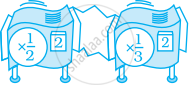
By what number should (–15)–1 be divided so that the quotient may be equal to (–5)–1?
