Please select a subject first
Advertisements
Advertisements
Visit a green house if there is one near your place. Observe how they grow plants. Find out how they regulate the amount of light, water and carbon dioxide to grow the plants.
Concept: undefined >> undefined
Collect information about the types of fuels used for cooking in your area. Discuss with your teachers/parents/others which fuels are less polluting and why.
Concept: undefined >> undefined
Advertisements
Set up the circuit shown in Figure again. Move the key to ‘ON’ position and watch carefully in which direction the compass needle gets deflected. Switch ‘OFF’ the current. Now keeping rest of the circuit intact, reverse the connections at the terminal of the cell. Again switch ‘on’ the current. Note the direction in which the needle gets deflected. Think of an explanation.
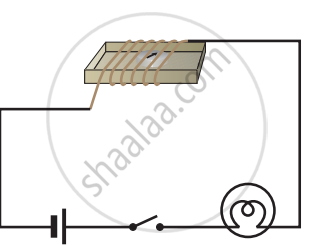
Concept: undefined >> undefined
Then and now: Talk to your grandparents and other elderly people in the neighbourhood. Find out the sewage disposal systems available to them. You can also write letters to people living in far off places to get more information. Prepare a brief report on the information you collected.
Concept: undefined >> undefined
Visit a sewage treatment plant.
It could be as exciting and enriching as a visit to a zoo, a museum, or a park. To guide your observation here are a few suggestions.
Record in your notepad:
Place ______ Date ______ Time ______
Name of the official at the plant ______ Guide/Teacher ______
- The location of the sewage plant.
- Treatment capacity.
- The purpose of screening as the initial process.
- How is air bubbled through the aeration tank?
- How safe is the water at the end of the treatment? How is it tested?
- Where is the water discharged after treatment?
- What happens to the plant during heavy rains?
- Is biogas consumed within the plant or sold to other consumers?
- What happens to the treated sludge?
- Is there any special effort to protect nearby houses from the plant?
- Other observations.
Concept: undefined >> undefined
You must be familiar with the given nursery rhymes
Baa baa black sheep, have you any wool.
Answer the following:
Which parts of the black sheep have wool?
Concept: undefined >> undefined
You must be familiar with the following nursery rhymes:
Mary had a little lamb, whose fleece was white as snow
Answer the following:
What is meant by the white fleece of the lamb?
Concept: undefined >> undefined
Which of the following does not yield wool?
Concept: undefined >> undefined
What is meant by term Rearing?
Concept: undefined >> undefined
What is meant by term Shearing ?
Concept: undefined >> undefined
What is meant by term Sericulture?
Concept: undefined >> undefined
Given below is a sequence of steps in the processing of wool. Which are the missing steps? Add them
Shearing, __________, sorting, __________, __________, __________
Concept: undefined >> undefined
Given below is a crossword puzzle based on this lesson. Use hints to fill in the blank spaces with letters that complete the words.
Down
(D) 1: Thorough washing
2 : Animal fibre
3 : Long thread like structure
Across
(A) 1 : Keeps warm
2 : Its leaves are eaten by silkworms
3 : Hatches from egg of moth

Concept: undefined >> undefined
Is the distilled water acidic/basic/neutral? How would you verify it?
Concept: undefined >> undefined
Sodium hydroxide turns blue litmus red.
Concept: undefined >> undefined
Indicator is a substance which shows different colours in acidic and basic solutions.
Concept: undefined >> undefined
Three liquids are given to you. One is hydrochloric acid, another is sodium hydroxide and the third is a sugar solution. How will you identify them? You have only turmeric indicator.
Concept: undefined >> undefined
Blue litmus paper is dipped in a solution. It remains blue. What is the nature of the solution? Explain.
Concept: undefined >> undefined
- Both acids and bases change colour of all indicators.
- If an indicator gives a colour change with an acid, it does not give a change with a base.
- If an indicator changes colour with a base, it does not change colour with an acid.
- Change of colour in an acid and a base depends on the type of the indicator.
Which of these statements are correct?
Concept: undefined >> undefined
