Please select a subject first
Advertisements
Advertisements
A card sheet divided into squares each of size 1 mm2 is being viewed at a distance of 9 cm through a magnifying glass (a converging lens of focal length 9 cm) held close to the eye.
- What is the magnification produced by the lens? How much is the area of each square in the virtual image?
- What is the angular magnification (magnifying power) of the lens?
- Is the magnification in (a) equal to the magnifying power in (b)? Explain.
Concept: undefined >> undefined
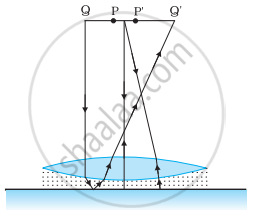
Figure shows an equiconvex lens (of refractive index 1.50) in contact with a liquid layer on top of a plane mirror. A small needle with its tip on the principal axis is moved along the axis until its inverted image is found at the position of the needle. The distance of the needle from the lens is measured to be 45.0 cm. The liquid is removed and the experiment is repeated. The new distance is measured to be 30.0 cm. What is the refractive index of the liquid?
Concept: undefined >> undefined
Advertisements
A parallel beam of light of wavelength 500 nm falls on a narrow slit and the resulting diffraction pattern is observed on a screen 1 m away. It is observed that the first minimum is at a distance of 2.5 mm from the centre of the screen. Find the width of the slit.
Concept: undefined >> undefined
In deriving the single slit diffraction pattern, it was stated that the intensity is zero at angles of nλ/a. Justify this by suitably dividing the slit to bring out the cancellation.
Concept: undefined >> undefined
Calculate the momentum of the electrons accelerated through a potential difference of 56 V.
Concept: undefined >> undefined
Calculate the de Broglie wavelength of the electrons accelerated through a potential difference of 56 V.
Concept: undefined >> undefined
What is the
(a) momentum,
(b) speed, and
(c) de Broglie wavelength of an electron with kinetic energy of 120 eV.
Concept: undefined >> undefined
The wavelength of light from the spectral emission line of sodium is 589 nm. Find the kinetic energy at which
(a) an electron, and
(b) a neutron, would have the same de Broglie wavelength.
Concept: undefined >> undefined
What is the de Broglie wavelength of a bullet of mass 0.040 kg travelling at the speed of 1.0 km/s?
Concept: undefined >> undefined
What is the de Broglie wavelength of a ball of mass 0.060 kg moving at a speed of 1.0 m/s?
Concept: undefined >> undefined
What is the de Broglie wavelength of a dust particle of mass 1.0 × 10⁻⁹ kg drifting with a speed of 2.2 m/s?
Concept: undefined >> undefined
An electron and a photon each have a wavelength of 1.00 nm. Find
(a) their momenta,
(b) the energy of the photon, and
(c) the kinetic energy of electron.
Concept: undefined >> undefined
For what kinetic energy of a neutron will the associated de Broglie wavelength be 1.40 × 10⁻¹⁰ m?
Concept: undefined >> undefined
Find the de Broglie wavelength of a neutron, in thermal equilibrium with matter, having an average kinetic energy of `(3/2)` kT at 300 K.
Concept: undefined >> undefined
Show that the wavelength of electromagnetic radiation is equal to the de Broglie wavelength of its quantum (photon).
Concept: undefined >> undefined
What is the de Broglie wavelength of a nitrogen molecule in air at 300 K? Assume that the molecule is moving with the root-mean square speed of molecules at this temperature. (Atomic mass of nitrogen = 14.0076 u)
Concept: undefined >> undefined
Crystal diffraction experiments can be performed using X-rays, or electrons accelerated through appropriate voltage. Which probe has greater energy? (For quantitative comparison, take the wavelength of the probe equal to 1 Å, which is of the order of inter-atomic spacing in the lattice) (me = 9.11 × 10⁻³¹ kg).
Concept: undefined >> undefined
Obtain the de Broglie wavelength of a neutron of kinetic energy 150 eV. As you have an electron beam of this energy is suitable for crystal diffraction experiments. Would a neutron beam of the same energy be equally suitable? Explain. (mn= 1.675 × 10⁻²⁷ kg)
Concept: undefined >> undefined
Obtain the de Broglie wavelength associated with thermal neutrons at room temperature (27°C). Hence explain why a fast neutron beam needs to be thermalised with the environment before it can be used for neutron diffraction experiments.
Concept: undefined >> undefined
Find the typical de Broglie wavelength associated with a He atom in helium gas at room temperature (27°C) and 1 atm pressure, and compare it with the mean separation between two atoms under these conditions.
Concept: undefined >> undefined
