Advertisements
Advertisements
Consider the arrangement shown in the figure. By some mechanism, the separation between the slits S3 and S4 can be changed. The intensity is measured at the point P, which is at the common perpendicular bisector of S1S2 and S2S4. When \[z = \frac{D\lambda}{2d},\] the intensity measured at P is I. Find the intensity when z is equal to
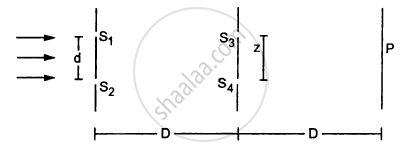
(a) \[\frac{D\lambda}{d}\]
(b) \[\frac{3D\lambda}{2d}\] and
(c) \[\frac{2D\lambda}{d}\]
Concept: undefined >> undefined
Solve the previous problem if the paperweight is inverted at its place so that the spherical surface touches the paper.
Concept: undefined >> undefined
Advertisements
The charge on a proton is +1.6 × 10⁻¹⁹ C and that on an electron is −1.6 × 10⁻¹⁹ C. Does it mean that the electron has 3.2 × 10⁻¹⁹ C less charge than the proton?
Concept: undefined >> undefined
Can a gravitational field be added vectorially to an electric field to get a total field?
Concept: undefined >> undefined
Why does a phonograph record attract dust particles just after it is cleaned?
Concept: undefined >> undefined
In some old texts it is mentioned that 4π lines of force originate from each unit positive charge. Comment on the statement in view of the fact that 4π is not an integer.
Concept: undefined >> undefined
When the separation between two charges is increased, the electric potential energy of the charges
Concept: undefined >> undefined
The electric field at the origin is along the positive x-axis. A small circle is drawn with the centre at the origin, cutting the axes at points A, B, C and D with coordinates (a, 0), (0, a), (−a, 0), (0, −a), respectively. Out of the points on the periphery of the circle, the potential is minimum at
Concept: undefined >> undefined
If a body is charged by rubbing it, its weight
Concept: undefined >> undefined
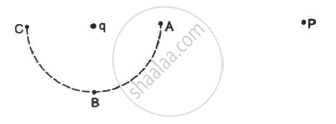
Consider the situation in the figure. The work done in taking a point charge from P to Ais WA, from P to B is WB and from P to C is WC.
Concept: undefined >> undefined
A point charge q is rotated along a circle in an electric field generated by another point charge Q. The work done by the electric field on the rotating charge in one complete revolution is
Concept: undefined >> undefined
The electric field and the electric potential at a point are E and V, respectively.
Concept: undefined >> undefined
Electric potential decreases uniformly from 120 V to 80 V, as one moves on the x-axis from x = −1 cm to x = +1 cm. The electric field at the origin
(a) must be equal to 20 Vcm−1
(b) may be equal to 20 Vcm−1
(c) may be greater than 20 Vcm−1
(d) may be less than 20 Vcm−1
Concept: undefined >> undefined
Which of the following quantities does not depend on the choice of zero potential or zero potential energy?
Concept: undefined >> undefined
The electric field in a region is directed outward and is proportional to the distance rfrom the origin. Taking the electric potential at the origin to be zero,
Concept: undefined >> undefined
Two resistors A and B have resistances RA and RB, respectively, and RA < RB. The resistivities of their materials are ρA and ρB.
Concept: undefined >> undefined
A wire of length 1 m and radius 0.1 mm has a resistance of 100 Ω. Find the resistivity of the material.
Concept: undefined >> undefined
A uniform wire of resistance 100 Ω is melted and recast as a wire whose length is double that of the original. What would be the resistance of the wire?
Concept: undefined >> undefined
What length of a copper wire of cross-sectional area 0.01 mm2 will be needed to prepare a resistance of 1 kΩ? Resistivity of copper = 1.7 × 10⁻⁸ Ωm
Concept: undefined >> undefined
A 10-cm long rod carries a charge of +50 μC distributed uniformly along its length. Find the magnitude of the electric field at a point 10 cm from both ends of the rod.
Concept: undefined >> undefined
