Advertisements
Advertisements
A sinusoidal voltage of peak value 283 V and frequency 50 Hz is applied to a series LCR circuit in which R = 3 Ω, L = 25.48 mH, and C = 796 µF, then the power dissipated at the resonant condition will be ______.
Concept: undefined >> undefined
In a pure semiconductor crystal of Si, if antimony is added then what type of extrinsic semiconductor is obtained. Draw the energy band diagram of this extrinsic semiconductor so formed.
Concept: undefined >> undefined
Advertisements
Is the momentum conserved when charge crosses a junction in an electric circuit? Why or why not?
Concept: undefined >> undefined
The relaxation time τ is nearly independent of applied E field whereas it changes significantly with temperature T. First fact is (in part) responsible for Ohm’s law whereas the second fact leads to variation of ρ with temperature. Elaborate why?
Concept: undefined >> undefined
- Consider circuit in figure. How much energy is absorbed by electrons from the initial state of no current (ignore thermal motion) to the state of drift velocity?
- Electrons give up energy at the rate of RI2 per second to the thermal energy. What time scale would one associate with energy in problem (a)? n = no of electron/volume = 1029/m3, length of circuit = 10 cm, cross-section = A = (1mm)2

Concept: undefined >> undefined
When an AC voltage of 220 V is applied to the capacitor C ______.
- the maximum voltage between plates is 220 V.
- the current is in phase with the applied voltage.
- the charge on the plates is in phase with the applied voltage.
- power delivered to the capacitor is zero.
Concept: undefined >> undefined
A device ‘X’ is connected to an a.c source. The variation of voltage, current and power in one complete cycle is shown in figure.
- Which curve shows power consumption over a full cycle?
- What is the average power consumption over a cycle?
- Identify the device ‘X’.

Concept: undefined >> undefined
Explain why the reactance provided by a capacitor to an alternating current decreases with increasing frequency.
Concept: undefined >> undefined
In the LCR circuit shown in figure, the ac driving voltage is v = vm sin ωt.
- Write down the equation of motion for q (t).
- At t = t0, the voltage source stops and R is short circuited. Now write down how much energy is stored in each of L and C.
- Describe subsequent motion of charges.

Concept: undefined >> undefined
The conductivity of a semiconductor increases with increase in temperature because ______.
Concept: undefined >> undefined
Why are elemental dopants for Silicon or Germanium usually chosen from group XIII or group XV?
Concept: undefined >> undefined
Sn, C, and Si, Ge are all group XIV elements. Yet, Sn is a conductor, C is an insulator while Si and Ge are semiconductors. Why?
Concept: undefined >> undefined
Suppose a ‘n’-type wafer is created by doping Si crystal having 5 × 1028 atoms/m3 with 1 ppm concentration of As. On the surface 200 ppm Boron is added to create ‘P’ region in this wafer. Considering n i = 1.5 × 10¹⁶ m–3, (i) Calculate the densities of the charge carriers in the n and p regions. (ii) Comment which charge carriers would contribute largely for the reverse saturation current when diode is reverse biased.
Concept: undefined >> undefined
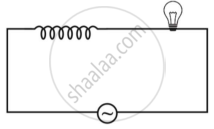
An iron cored coil is connected in series with an electric bulb with an AC source as shown in figure. When iron piece is taken out of the coil, the brightness of the bulb will ______.
Concept: undefined >> undefined
The figure shows a piece of pure semiconductor S in series with a variable resistor R and a source of constant voltage V. Should the value of R be increased or decreased to keep the reading of the ammeter constant, when semiconductor S is heated? Justify your answer

Concept: undefined >> undefined
An a.c. source generating a voltage ε = ε0 sin ωt is connected to a capacitor of capacitance C. Find the expression for the current I flowing through it. Plot a graph of ε and I versus ωt to show that the current is ahead of the voltage by π/2.
Concept: undefined >> undefined
Two crystals C1 and C2, made of pure silicon, are doped with arsenic and aluminium respectively.
Identify the extrinsic semiconductors so formed.
Concept: undefined >> undefined
| A ray of light travels from a denser to a rarer medium. After refraction, it bends away from the normal. When we keep increasing the angle of incidence, the angle of refraction also increases till the refracted ray grazes along the interface of two media. The angle of incidence for which it happens is called critical angle. If the angle of incidence is increased further the ray will not emerge and it will be reflected back in the denser medium. This phenomenon is called total internal reflection of light. |
A ray of light travels from a medium into the water at an angle of incidence of 18°. The refractive index of the medium is more than that of water and the critical angle for the interface between the two media is 20°. Which one of the following figures best represents the correct path of the ray of light?
Concept: undefined >> undefined
| A ray of light travels from a denser to a rarer medium. After refraction, it bends away from the normal. When we keep increasing the angle of incidence, the angle of refraction also increases till the refracted ray grazes along the interface of two media. The angle of incidence for which it happens is called critical angle. If the angle of incidence is increased further the ray will not emerge and it will be reflected back in the denser medium. This phenomenon is called total internal reflection of light. |
For which of the following media, with respect to air, the value of critical angle is maximum?
Concept: undefined >> undefined
Name the extrinsic semiconductors formed when pure germanium is doped with a trivalent impurity. Draw the energy band diagram of extrinsic semiconductors so formed.
Concept: undefined >> undefined
