Advertisements
Advertisements
Question
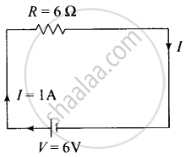
- Consider circuit in figure. How much energy is absorbed by electrons from the initial state of no current (ignore thermal motion) to the state of drift velocity?
- Electrons give up energy at the rate of RI2 per second to the thermal energy. What time scale would one associate with energy in problem (a)? n = no of electron/volume = 1029/m3, length of circuit = 10 cm, cross-section = A = (1mm)2

Advertisements
Solution
a. Relation between current and drift velocity is given by I = ne Avd, where vd is the drift speed of electrons and n is the number density of electrons.

According to the Ohm's law current in the circuit
I = V/R
I = 6 V/6 Ω = 1 A
But, I = ne Avd
or vd = `I/("ne A")`
On substituting the values,
For, n = number of electrons/volume = 1029/m3
Length of circuit = 10 cm, cross-section = A = (1 mm)2
`v_d = 1/(10^29 xx 16 xx 10^-19 xx 10^-6)`
= `1/1.6 xx 10^-4` m/s
Therefore, the energy absorbed in the form of KE is given by
Total KE = KE of 1 electron × no. of electrons
KE = `1/2 m_e v_d^2 xx n Al`
= `1/2 xx 9.1 xx 10^31 xx 1/2.56 xx 10^-8 xx 10^29 xx 10^-6 xx 10^-1`
= `2 xx 10^-17 J`
b. Ohmic loss (power loss) is `P = I^2R = 6 xx 1^2 = 6 W = 6 J/s`
Since, the energy dissipated per unit time is the power dissipated.
So, `P = E/t`
Therefore, `E = P xx t`
or `t = E/P = (2 xx 10^17)/6 = 10^17 s`
Important point: The energy dissipated per unit time is the power dissipated `P = (ΔW)/(Δt)`
The power across a resistor is P = I2R.
APPEARS IN
RELATED QUESTIONS
Define the term drift velocity.
Write its (‘mobility’ of charge carriers) S.I. unit
The number density of free electrons in a copper conductor is 8.5 × 1028 m−3. How long does an electron take to drift from one end of a wire 3.0 m long to its other end? The area of cross-section of the wire is 2.0 × 10⁻⁶ m2 and it is carrying a current of 3.0 A.
(a) drift speed
(b) current density
(c) electric current
(d) electric field
Why alloys like constantan and manganin are used for making standard resistors?
Define relaxation time of the free electrons drifting in a conductor. How is it related to the drift velocity of free electrons? Use this relation to deduce the expression for the electrical resistivity of the material.
When a current is established in a wire, the free electrons drift in the direction opposite to the current. Does the number of free electrons in the wire continuously decrease?
A current of 1.0 A exists in a copper wire of cross-section 1.0 mm2. Assuming one free electron per atom, calculate the drift speed of the free electrons in the wire. The density of copper is 9000 kg m–3.
Consider the following statements.
(A) Free-electron density is different in different metals.
(B) Free-electron density in a metal depends on temperature.
Thomson Effect is caused _______________ .
Obtain the expression for the current flowing through a conductor having number density of the electron n, area of cross-section A in terms of the drift velocity vd .
At room temperature, copper has free electron density of 8.4 × 1028 per m3. The copper conductor has a cross-section of l0−6 m2 and carries a current of 5.4 A. The electron drift velocity in copper is:
The drift velocity of a free electron inside a conductor is ______
Explain how free electrons in a metal at constant temperature attain an average velocity under the action of an electric field. Hence, obtain an expression for it.
What is the average time interval between two successive collisions of a free electron with the ions of the metallic lattice called?
Which expression gives the drift velocity in terms of electric field \[E\], relaxation time \[\tau\], electronic charge \[e\], and electron mass \[m\]?
What is the net current in a conductor in the absence of an electric field?
Which relation expresses the macroscopic form of Ohm’s law used to identify conductivity?
With what do electrons continuously collide in a conductor?
