Advertisements
Advertisements
प्रश्न
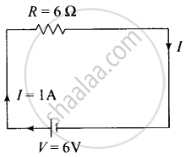
- Consider circuit in figure. How much energy is absorbed by electrons from the initial state of no current (ignore thermal motion) to the state of drift velocity?
- Electrons give up energy at the rate of RI2 per second to the thermal energy. What time scale would one associate with energy in problem (a)? n = no of electron/volume = 1029/m3, length of circuit = 10 cm, cross-section = A = (1mm)2

Advertisements
उत्तर
a. Relation between current and drift velocity is given by I = ne Avd, where vd is the drift speed of electrons and n is the number density of electrons.

According to the Ohm's law current in the circuit
I = V/R
I = 6 V/6 Ω = 1 A
But, I = ne Avd
or vd = `I/("ne A")`
On substituting the values,
For, n = number of electrons/volume = 1029/m3
Length of circuit = 10 cm, cross-section = A = (1 mm)2
`v_d = 1/(10^29 xx 16 xx 10^-19 xx 10^-6)`
= `1/1.6 xx 10^-4` m/s
Therefore, the energy absorbed in the form of KE is given by
Total KE = KE of 1 electron × no. of electrons
KE = `1/2 m_e v_d^2 xx n Al`
= `1/2 xx 9.1 xx 10^31 xx 1/2.56 xx 10^-8 xx 10^29 xx 10^-6 xx 10^-1`
= `2 xx 10^-17 J`
b. Ohmic loss (power loss) is `P = I^2R = 6 xx 1^2 = 6 W = 6 J/s`
Since, the energy dissipated per unit time is the power dissipated.
So, `P = E/t`
Therefore, `E = P xx t`
or `t = E/P = (2 xx 10^17)/6 = 10^17 s`
Important point: The energy dissipated per unit time is the power dissipated `P = (ΔW)/(Δt)`
The power across a resistor is P = I2R.
APPEARS IN
संबंधित प्रश्न
Define the term drift velocity.
Estimate the average drift speed of conduction electrons in a copper wire of cross-sectional area 1.0 × 10⁻⁷ m2 carrying a current of 1.5 A. Assume the density of conduction electrons to be 9 × 1028 m−3
Estimate the average drift speed of conduction electrons in a copper wire of cross-sectional area 2·5 × 10−7 m2 carrying a current of 2·7 A. Assume the density of conduction electrons to be 9 × 1028 m−3
(a) drift speed
(b) current density
(c) electric current
(d) electric field
Why alloys like constantan and manganin are used for making standard resistors?
Explain the term ‘drift velocity’ of electrons in conductor. Hence obtain the expression for the current through a conductor in terms of ‘drift velocity’.
When electrons drift in a metal from lower to higher potential, does it mean that all the free electrons of the metal are moving in the same direction?
Amount of charge in coulomb required to deposit one gram equivalent of substance by electrolysis is:-
The identical conductors maintained at same temperature are given potential difference in the ratio 1 : 2. Then the ratio of their drift velocities is ______.
Is the momentum conserved when charge crosses a junction in an electric circuit? Why or why not?
Define relaxation time.
Derive an expression for resistivity of a conductor in terms of the number density of charge carriers in the conductor and relaxation time.
Consider two conducting wires A and B of the same diameter but made of different materials joined in series across a battery. The number density of electrons in A is 1.5 times that in B. Find the ratio of the drift velocity of electrons in wire A to that in wire B.
What is the average time interval between two successive collisions of a free electron with the ions of the metallic lattice called?
Which expression gives the drift velocity in terms of electric field \[E\], relaxation time \[\tau\], electronic charge \[e\], and electron mass \[m\]?
What is the average velocity of electrons when no electric field is present?
Which expression gives the acceleration of an electron in an electric field?
Which relation expresses the macroscopic form of Ohm’s law used to identify conductivity?
