Advertisements
Advertisements
प्रश्न
Derive an expression for drift velocity of free electrons.
Derive an expression for drift velocity of electrons in a conductor. Hence deduce Ohm's law.
Advertisements
उत्तर
(i) Free electrons are in continuous random motion. They undergo change in direction at each collision and the thermal velocities are randomly distributed in all directions.
∴ Average thermal velocity,`u=(u_1+u_2+....+u_n)/n " is Zero".....(1)`
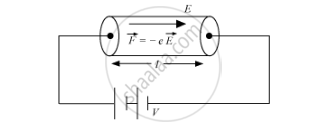
The electric field E exerts an electrostatic force ‘−Ee’.
Acceleration of each electron is,`veca=(-evecE)/m " ......(2)"`
Where,
m → Mass of an electron
e → Charge on an electron
Drift velocity,
`vec(v_d)=(vec(v_1)+vec(v_2)+....+vec(v_n))/n`
`vec(v_d)=((vec(u_1)+vecat_1)+(vec(u_2)+vecat_2)+....+(vec(u_n)+vecat_n))/n`
Where,
`vecu_1,vecu_2->` Thermal velocities of the electrons
`vecatau_1,vecatau_2->` Velocity acquired by electrons
τ1, τ2 → Time elapsed after the collision
`vec(v_d)=((vec(u_1)+vec(u_2)+...+vecu_n))/n+(veca(vec(t_1)+vec(t_2)+...vec(t_n)))/n`
Since `(vec(u_1)+vec(u_2)+....vec(u_n))/n=0`
∴ vd = a τ
Where,`t=(t_1+t_2+t_3....t_n)/n " is the average time elapsed"`
Substituting for a from equation (2),
`vec(v_d)=(-evecE)/mt " ...(4)"`
As, `E=V/l`
From (4) we can write
`v_d=(eV)/(ml)τ`
Also,
`I=An""ev_d`
Therefore,
`I=An""e((eV)/(ml)τ)=(An""e^2τ)/(ml) V`
`or V/I=(ml)/(An""e^2τ)=R` .... (5)
As we can see all the parameter on the R.H.S of the equation 5 are constant given temperature. And it is known as Resistance of the electric conductor.
APPEARS IN
संबंधित प्रश्न
Estimate the average drift speed of conduction electrons in a copper wire of cross-sectional area 2·5 × 10−7 m2 carrying a current of 2·7 A. Assume the density of conduction electrons to be 9 × 1028 m−3
How does drift velocity of electrons in a metallic conductor vary with increase in temperature? Explain.
When electrons drift in a metal from lower to higher potential, does it mean that all the free electrons of the metal are moving in the same direction?
The relaxation time τ is nearly independent of applied E field whereas it changes significantly with temperature T. First fact is (in part) responsible for Ohm’s law whereas the second fact leads to variation of ρ with temperature. Elaborate why?
Define relaxation time.
The potential difference applied across a given conductor is doubled. How will this affect (i) the mobility of electrons and (ii) the current density in the conductor? Justify your answers.
Explain how free electrons in a metal at constant temperature attain an average velocity under the action of an electric field. Hence, obtain an expression for it.
When an electric field \[E\] is applied to a conductor, what force direction does an electron of charge \[-e\] experience?
If \[n\] is the number of free electrons per unit volume and \[A\] is the conductor’s cross-sectional area, which expression gives the current from electron drift?
Which expression gives current density in terms of free electron density, relaxation time, and electric field?
