Advertisements
Advertisements
प्रश्न
Derive an expression for drift velocity of free electrons.
Derive an expression for drift velocity of electrons in a conductor. Hence deduce Ohm's law.
Advertisements
उत्तर
(i) Free electrons are in continuous random motion. They undergo change in direction at each collision and the thermal velocities are randomly distributed in all directions.
∴ Average thermal velocity,`u=(u_1+u_2+....+u_n)/n " is Zero".....(1)`
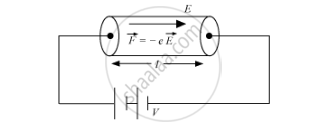
The electric field E exerts an electrostatic force ‘−Ee’.
Acceleration of each electron is,`veca=(-evecE)/m " ......(2)"`
Where,
m → Mass of an electron
e → Charge on an electron
Drift velocity,
`vec(v_d)=(vec(v_1)+vec(v_2)+....+vec(v_n))/n`
`vec(v_d)=((vec(u_1)+vecat_1)+(vec(u_2)+vecat_2)+....+(vec(u_n)+vecat_n))/n`
Where,
`vecu_1,vecu_2->` Thermal velocities of the electrons
`vecatau_1,vecatau_2->` Velocity acquired by electrons
τ1, τ2 → Time elapsed after the collision
`vec(v_d)=((vec(u_1)+vec(u_2)+...+vecu_n))/n+(veca(vec(t_1)+vec(t_2)+...vec(t_n)))/n`
Since `(vec(u_1)+vec(u_2)+....vec(u_n))/n=0`
∴ vd = a τ
Where,`t=(t_1+t_2+t_3....t_n)/n " is the average time elapsed"`
Substituting for a from equation (2),
`vec(v_d)=(-evecE)/mt " ...(4)"`
As, `E=V/l`
From (4) we can write
`v_d=(eV)/(ml)τ`
Also,
`I=An""ev_d`
Therefore,
`I=An""e((eV)/(ml)τ)=(An""e^2τ)/(ml) V`
`or V/I=(ml)/(An""e^2τ)=R` .... (5)
As we can see all the parameter on the R.H.S of the equation 5 are constant given temperature. And it is known as Resistance of the electric conductor.
APPEARS IN
संबंधित प्रश्न
What is its relation with relaxation time?
Write its (‘mobility’ of charge carriers) S.I. unit
On the basis of electron drift, derive an expression for resistivity of a conductor in terms of number density of free electrons and relaxation time. On what factors does resistivity of a conductor depend?
Why alloys like constantan and manganin are used for making standard resistors?
Define relaxation time of the free electrons drifting in a conductor. How is it related to the drift velocity of free electrons? Use this relation to deduce the expression for the electrical resistivity of the material.
A current of 1.0 A exists in a copper wire of cross-section 1.0 mm2. Assuming one free electron per atom, calculate the drift speed of the free electrons in the wire. The density of copper is 9000 kg m–3.
Is the momentum conserved when charge crosses a junction in an electric circuit? Why or why not?
Derive an expression for resistivity of a conductor in terms of the number density of charge carriers in the conductor and relaxation time.
Which relation expresses the macroscopic form of Ohm’s law used to identify conductivity?
With what do electrons continuously collide in a conductor?
