Advertisements
Advertisements
Questions
Derive an expression for drift velocity of free electrons.
Derive an expression for drift velocity of electrons in a conductor. Hence deduce Ohm's law.
Advertisements
Solution
(i) Free electrons are in continuous random motion. They undergo change in direction at each collision and the thermal velocities are randomly distributed in all directions.
∴ Average thermal velocity,`u=(u_1+u_2+....+u_n)/n " is Zero".....(1)`
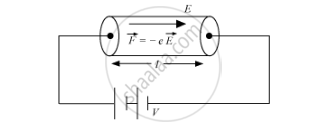
The electric field E exerts an electrostatic force ‘−Ee’.
Acceleration of each electron is,`veca=(-evecE)/m " ......(2)"`
Where,
m → Mass of an electron
e → Charge on an electron
Drift velocity,
`vec(v_d)=(vec(v_1)+vec(v_2)+....+vec(v_n))/n`
`vec(v_d)=((vec(u_1)+vecat_1)+(vec(u_2)+vecat_2)+....+(vec(u_n)+vecat_n))/n`
Where,
`vecu_1,vecu_2->` Thermal velocities of the electrons
`vecatau_1,vecatau_2->` Velocity acquired by electrons
τ1, τ2 → Time elapsed after the collision
`vec(v_d)=((vec(u_1)+vec(u_2)+...+vecu_n))/n+(veca(vec(t_1)+vec(t_2)+...vec(t_n)))/n`
Since `(vec(u_1)+vec(u_2)+....vec(u_n))/n=0`
∴ vd = a τ
Where,`t=(t_1+t_2+t_3....t_n)/n " is the average time elapsed"`
Substituting for a from equation (2),
`vec(v_d)=(-evecE)/mt " ...(4)"`
As, `E=V/l`
From (4) we can write
`v_d=(eV)/(ml)τ`
Also,
`I=An""ev_d`
Therefore,
`I=An""e((eV)/(ml)τ)=(An""e^2τ)/(ml) V`
`or V/I=(ml)/(An""e^2τ)=R` .... (5)
As we can see all the parameter on the R.H.S of the equation 5 are constant given temperature. And it is known as Resistance of the electric conductor.
APPEARS IN
RELATED QUESTIONS
Define the term drift velocity.
Write its (‘mobility’ of charge carriers) S.I. unit
The number density of free electrons in a copper conductor is 8.5 × 1028 m−3. How long does an electron take to drift from one end of a wire 3.0 m long to its other end? The area of cross-section of the wire is 2.0 × 10⁻⁶ m2 and it is carrying a current of 3.0 A.
A conductor of length ‘l’ is connected to a dc source of potential ‘V’. If the length of the conductor is tripled by gradually stretching it, keeping ‘V’ constant, how will (i) drift speed of electrons and (ii) resistance of the conductor be affected? Justify your answer.
When a current is established in a wire, the free electrons drift in the direction opposite to the current. Does the number of free electrons in the wire continuously decrease?
Consider the following statements.
(A) Free-electron density is different in different metals.
(B) Free-electron density in a metal depends on temperature.
Thomson Effect is caused _______________ .
When a current I is set up in a wire of radius r, the drift velocity is vd· If the same current is set up through a wire of radius 2 r, the drift velocity will be:
At room temperature, copper has free electron density of 8.4 × 1028 per m3. The copper conductor has a cross-section of l0−6 m2 and carries a current of 5.4 A. The electron drift velocity in copper is:
The identical conductors maintained at same temperature are given potential difference in the ratio 1 : 2. Then the ratio of their drift velocities is ______.
Explain how free electrons in a metal at constant temperature attain an average velocity under the action of an electric field. Hence, obtain an expression for it.
