Advertisements
Advertisements
प्रश्न
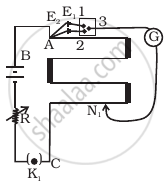
In an experiment with a potentiometer, VB = 10V. R is adjusted to be 50Ω (Figure). A student wanting to measure voltage E1 of a battery (approx. 8V) finds no null point possible. He then diminishes R to 10Ω and is able to locate the null point on the last (4th) segment of the potentiometer. Find the resistance of the potentiometer wire and potential drop per unit length across the wire in the second case.
Advertisements
उत्तर
When emf of the primary cell is less than the potential difference across the wires of potentiometer, only then the null point is obtained.
Equivalent resistance of potentiometer and variable resistor (R = 50Ω) is given by = 50Ω + R'
Equivalent voltage applied across potentiometer = 10V

The current through the main circuit,
`I = V/(50Ω + R^') = 10/(50Ω + R^')`
Potential difference across wire of potentiometer,
Since with 50Ω resistor, null point is not obtained it is possible only when
`(10 xx R^')/(10 + R^') > 8`
⇒ 2R' > 80
⇒ R' > 40
`(10 xx 3/4 R)/(10 + R^') < 8`
⇒ 7.5R' < 80 + 8R'
R' > 160
⇒ 160 < R' < 200
Any R' between 160Ω and 200Ω will achieve.
Since, the null point on the last (4th) segment of the potentiometer, therefore potential drop across 400 cm of wire > 8V.
This imply that potential gradient
k × 400 cm > 8 V
or k × 4 m > 8 V
k > 2 V/m
Similarly, potential drop across 300 cm wire < 8 V.
k × 300 cm > 8 V
or k × 3 m > 8 V
`k > 2 2/3 V/m`
Thus, `2 2/3 V/m > k > V/m`.
APPEARS IN
संबंधित प्रश्न
Figure shows a potentiometer with a cell of 2.0 V and internal resistance 0.40 Ω maintaining a potential drop across the resistor wire AB. A standard cell which maintains a constant emf of 1.02 V (for very moderate currents up to a few mA) gives a balance point at 67.3 cm length of the wire. To ensure very low currents drawn from the standard cell, very high resistance of 600 kΩ is put in series with it, which is shorted close to the balance point. The standard cell is then replaced by a cell of unknown emf ε and the balance point found similarly, turns out to be at 82.3 cm length of the wire.

(a) What is the value ε?
(b) What purpose does the high resistance of 600 kΩ have?
(c) Is the balance point affected by this high resistance?
(d) Is the balance point affected by the internal resistance of the driver cell?
(e) Would the method work in the above situation if the driver cell of the potentiometer had an emf of 1.0 V instead of 2.0 V?
(f) Would the circuit work well for determining an extremely small emf, say of the order of a few mV (such as the typical emf of a thermo-couple)? If not, how will you modify the circuit?
A potentiometer wire of length 1 m has a resistance of 5 Ω. It is connected to a 8 V battery in series with a resistance of 15 Ω. Determine the emf of the primary cell which gives a balance point at 60 cm.
The net resistance of an ammeter should be small to ensure that _______________ .
The net resistance of a voltmeter should be large to ensure that ______________ .
In a potentiometer experiment, the balancing length with a resistance of 2Ω is found to be 100 cm, while that of an unknown resistance is 500 cm. Calculate the value of the unknown resistance.
What are the disadvantages of a potentiometer?
A potentiometer wire has a length of 1.5 m and a resistance of 10 Ω. It is connected in series with the cell of emf 4 Volt and internal resistance 5 Ω. Calculate the potential drop per centimeter of the wire.
If the potential gradient of a wire decreases, then its length ______
A potentiometer wire is 4m long and potential difference of 3V is maintained between the ends. The emf of the cell, which balances against a length of 100 cm of the potentiometer wire is ____________.
A potentiometer wire has length L For given cell of emf E, the balancing length is `"L"/3` from 3 the positive end of the wire. If the length of the potentiometer wire is increased by 50%, then for the same cell, the balance point is obtained at length.
A battery is connected with a potentiometer wire. The internal resistance of the battery is negligible. If the length of the potentiometer wire of the same material and radius is doubled then ______.
In a potentiometer of 10 wires, the balance point is obtained on the 7th wire. To shift the balance point to 9th wire, we should ______.
AB is a wire of potentiometer with the increase in the value of resistance R, the shift in the balance point J will be ______.

1°C rise in temperature is observed in a conductor by passing a certain current. If the current is double then the rise in temperature is approximately.
While doing an experiment with potentiometer (Figure) it was found that the deflection is one sided and (i) the deflection decreased while moving from one end A of the wire to the end B; (ii) the deflection increased. while the jockey was moved towards the end B.
- Which terminal + or – ve of the cell E1, is connected at X in case (i) and how is E1 related to E?
- Which terminal of the cell E1 is connected at X in case (ii)?

Two identical thin metal plates has charge q1 and q2 respectively such that q1 > q2. The plates were brought close to each other to form a parallel plate capacitor of capacitance C. The potential difference between them is ______.
If you are provided a set of resistances 2Ω, 4Ω, 6Ω and 8Ω. Connect these resistances so as to obtain an equivalent resistance of `46/3`Ω.
What will a voltmeter of resistance 200 Ω read when connected across a cell of emf 2 V and internal resistance 2 Ω?
State dimension of potential gradient.
In a potentiometer, a cell is balanced against 110 cm when the circuit is open. A cell is balanced at 100 cm when short-circuited through a resistance of 10 Ω. Find the internal resistance of the cell.
