Advertisements
Advertisements
प्रश्न
In an experiment with a potentiometer, VB = 10V. R is adjusted to be 50Ω (Figure). A student wanting to measure voltage E1 of a battery (approx. 8V) finds no null point possible. He then diminishes R to 10Ω and is able to locate the null point on the last (4th) segment of the potentiometer. Find the resistance of the potentiometer wire and potential drop per unit length across the wire in the second case.
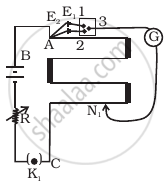
Advertisements
उत्तर
When emf of the primary cell is less than the potential difference across the wires of potentiometer, only then the null point is obtained.
Equivalent resistance of potentiometer and variable resistor (R = 50Ω) is given by = 50Ω + R'
Equivalent voltage applied across potentiometer = 10V

The current through the main circuit,
`I = V/(50Ω + R^') = 10/(50Ω + R^')`
Potential difference across wire of potentiometer,
Since with 50Ω resistor, null point is not obtained it is possible only when
`(10 xx R^')/(10 + R^') > 8`
⇒ 2R' > 80
⇒ R' > 40
`(10 xx 3/4 R)/(10 + R^') < 8`
⇒ 7.5R' < 80 + 8R'
R' > 160
⇒ 160 < R' < 200
Any R' between 160Ω and 200Ω will achieve.
Since, the null point on the last (4th) segment of the potentiometer, therefore potential drop across 400 cm of wire > 8V.
This imply that potential gradient
k × 400 cm > 8 V
or k × 4 m > 8 V
k > 2 V/m
Similarly, potential drop across 300 cm wire < 8 V.
k × 300 cm > 8 V
or k × 3 m > 8 V
`k > 2 2/3 V/m`
Thus, `2 2/3 V/m > k > V/m`.
APPEARS IN
संबंधित प्रश्न
On what factors does the potential gradient of the wire depend?
Would you prefer a voltmeter or a potentiometer to measure the emf of a battery?
How is potential gradient measured? Explain.
What are the disadvantages of a potentiometer?
Distinguish between a potentiometer and a voltmeter.
A potentiometer wire has a length of 1.5 m and a resistance of 10 Ω. It is connected in series with the cell of emf 4 Volt and internal resistance 5 Ω. Calculate the potential drop per centimeter of the wire.
In a potentiometer experiment, when the galvanometer shows no deflection, then no current flows through ____________.
Select the WRONG statement:
A potentiometer wire has length L For given cell of emf E, the balancing length is `"L"/3` from 3 the positive end of the wire. If the length of the potentiometer wire is increased by 50%, then for the same cell, the balance point is obtained at length.
A potentiometer is used to measure the potential difference between A and B, the null point is obtained at 0.9 m. Now the potential difference between A and C is measured, the null point is obtained at 0.3 m. The ratio `E_2/E_1` is (E1 > E2) ______
In the potentiometer experiment, the balancing length with a cell E1 of unknown e.m.f. is 'ℓ1' cm. By shunting the cell with resistance R Ω, the balancing length becomes `ℓ_1/2` cm, the internal resistance (r) of a cell is ______
In a potentiometer experiment, for measuring internal resistance of a cell, the balance point has been obtained on the fourth wire. The balance point can be shifted to fifth wire by ______.
It is observed in a potentiometer experiment that no current passes through the galvanometer when the terminals of the cell are connected across a certain length of the potentiometer wire. On shunting the cell by a 2 Ω resistance, the balancing length is reduced to half. The internal resistance of the cell is ______.
In the experiment of potentiometer, at balance point, there is no current in the ______.
A 10 m long wire of uniform cross-section and 20 Ω resistance is used in a potentiometer. The wire is connected in series with a battery of 5 V along with an external resistance of 480 Ω. If an unknown emf E is balanced at 6.0 m length of the wire, then the value of unknown emf is ______.

Three resistance each of 4Ω are connected to from a triangle. The resistance b / w two terminal is
In a potentiometer circuit, a cell of EMF 1.5 V gives balance point at 36 cm length of wire. If another cell of EMF 2.5 V replaces the first cell, then at what length of the wire, the balance point occurs?
A Daniel cell is balanced on 125 cm lengths of a potentiometer wire. Now the cell is short circuited by a resistance 2 Ω and the balance is obtained at 100 cm. The internal resistance of the Daniel cell is ______.
What is the internal resistance of the cell?
Draw neat labelled diagram of potentiometer as voltage divider.
