Advertisements
Advertisements
Question
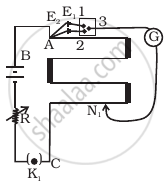
In an experiment with a potentiometer, VB = 10V. R is adjusted to be 50Ω (Figure). A student wanting to measure voltage E1 of a battery (approx. 8V) finds no null point possible. He then diminishes R to 10Ω and is able to locate the null point on the last (4th) segment of the potentiometer. Find the resistance of the potentiometer wire and potential drop per unit length across the wire in the second case.
Advertisements
Solution
When emf of the primary cell is less than the potential difference across the wires of potentiometer, only then the null point is obtained.
Equivalent resistance of potentiometer and variable resistor (R = 50Ω) is given by = 50Ω + R'
Equivalent voltage applied across potentiometer = 10V
The current through the main circuit,
`I = V/(50Ω + R^') = 10/(50Ω + R^')`
Potential difference across wire of potentiometer,
Since with 50Ω resistor, null point is not obtained it is possible only when
`(10 xx R^')/(10 + R^') > 8`
⇒ 2R' > 80
⇒ R' > 40
`(10 xx 3/4 R)/(10 + R^') < 8`
⇒ 7.5R' < 80 + 8R'
R' > 160
⇒ 160 < R' < 200
Any R' between 160Ω and 200Ω will achieve.
Since, the null point on the last (4th) segment of the potentiometer, therefore potential drop across 400 cm of wire > 8V.
This imply that potential gradient
k × 400 cm > 8 V
or k × 4 m > 8 V
k > 2 V/m
Similarly, potential drop across 300 cm wire < 8 V.
k × 300 cm > 8 V
or k × 3 m > 8 V
`k > 2 2/3 V/m`
Thus, `2 2/3 V/m > k > V/m`.
