Advertisements
Advertisements
Question
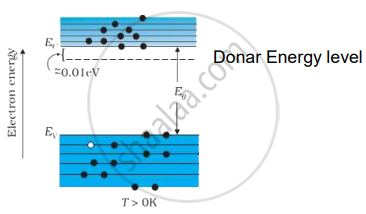
In a pure semiconductor crystal of Si, if antimony is added then what type of extrinsic semiconductor is obtained. Draw the energy band diagram of this extrinsic semiconductor so formed.
Advertisements
Solution
As given in the statement antimony is added to pure Si crystal, then an n-type extrinsic semiconductor would be so obtained Since antimony(Sb) is a pentavalent impurity.
Energy level diagram of n-type semiconductor
APPEARS IN
RELATED QUESTIONS
A donor impurity results in ______.
Why are elemental dopants for Silicon or Germanium usually chosen from group XIII or group XV?
Sn, C, and Si, Ge are all group XIV elements. Yet, Sn is a conductor, C is an insulator while Si and Ge are semiconductors. Why?
Name the extrinsic semiconductors formed when pure germanium is doped with a trivalent impurity. Draw the energy band diagram of extrinsic semiconductors so formed.
With an increase in the temperature, the electrical conductivity of a semiconductor ______.
The majority charge carriers in a P-type semiconductor are ______.
What is the process of adding a suitable impurity to increase a semiconductor's electrical conductivity called?
To which group of the periodic table do silicon and germanium belong?
Which type of dopant is antimony (Sb)?
Which type of dopant is boron (B)?
