Advertisements
Advertisements
प्रश्न
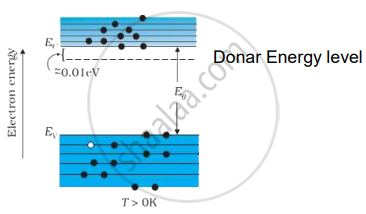
In a pure semiconductor crystal of Si, if antimony is added then what type of extrinsic semiconductor is obtained. Draw the energy band diagram of this extrinsic semiconductor so formed.
Advertisements
उत्तर
As given in the statement antimony is added to pure Si crystal, then an n-type extrinsic semiconductor would be so obtained Since antimony(Sb) is a pentavalent impurity.
Energy level diagram of n-type semiconductor
APPEARS IN
संबंधित प्रश्न
Distinguish between 'intrinsic' and 'extrinsic' semiconductors
Electronic configuration of germanium is 2, 8, 18 and 4. To make it extrinsic semiconductor small quantity of antimony is added. The correct statement is ____________.
Semiconductors formed by doping germanium (Ge) with aluminium (Z = 13) and antimony (Z = 51) are ______.
In p-type semiconductor, ______.
State how a p-type semiconductor will be obtained from a pure crystal of a semiconductor.
Distinguish between n-type and p-type semiconductors.
Suppose a ‘n’-type wafer is created by doping Si crystal having 5 × 1028 atoms/m3 with 1 ppm concentration of As. On the surface 200 ppm Boron is added to create ‘P’ region in this wafer. Considering n i = 1.5 × 10¹⁶ m–3, (i) Calculate the densities of the charge carriers in the n and p regions. (ii) Comment which charge carriers would contribute largely for the reverse saturation current when diode is reverse biased.
The majority charge carriers in a P-type semiconductor are ______.
What is the impurity added to a semiconductor called?
Which type of dopant is aluminium (Al)?
