Advertisements
Advertisements
A capacitor of capacitance 5⋅00 µF is charged to 24⋅0 V and another capacitor of capacitance 6⋅0 µF is charged to 12⋅0 V. (a) Find the energy stored in each capacitor. (b) The positive plate of the first capacitor is now connected to the negative plate of the second and vice versa. Find the new charges on the capacitors. (c) Find the loss of electrostatic energy during the process. (d) Where does this energy go?
Concept: undefined >> undefined
A copper strip AB and an iron strip AC are joined at A. The junction A is maintained at 0°C and the free ends B and C are maintained at 100°C. There is a potential difference between _______________ .
(a) the two ends of the copper strip
(b) the copper end and the iron end at the junction
(c) the two ends of the iron strip
(d) the free ends B and C
Concept: undefined >> undefined
Advertisements
The potential difference across the terminals of a battery of emf 12 V and internal resistance 2 Ω drops to 10 V when it is connected to a silver voltameter. Find the silver deposited at the cathode in half an hour. Atomic weight of silver is 107.9 g mol−1.
Concept: undefined >> undefined
The property of diamagnetism is said to be present in all materials. Then, why are some materials paramagnetic or ferromagnetic?
Concept: undefined >> undefined
Can we have magnetic hysteresis in paramagnetic or diamagnetic substances?
Concept: undefined >> undefined
When a ferromagnetic material goes through a hysteresis loop, its thermal energy is increased. Where does this energy come from?
Concept: undefined >> undefined
A paramagnetic material is placed in a magnetic field. Consider the following statements:-
(A) If the magnetic field is increased, the magnetisation is increased.
(B) If the temperature is increased, the magnetisation is increased.
Concept: undefined >> undefined
A paramagnetic material is kept in a magnetic field. The field is increased till the magnetisation becomes constant. If the temperature is now decreased, the magnetisation ___________ .
Concept: undefined >> undefined
A ferromagnetic material is placed in an external magnetic field. The magnetic domains ______________ .
Concept: undefined >> undefined
The magnetic susceptibility is negative for _____________ .
Concept: undefined >> undefined
The permanent magnetic moment of the atoms of a material is not zero. The material ________________ .
Concept: undefined >> undefined
The permanent magnetic moment of the atoms of a material is zero. The material _________________ .
Concept: undefined >> undefined
When a ferromagnetic material goes through a hysteresis loop, the magnetic susceptibility
(a) has a fixed value
(b) may be zero
(c) may be infinity
(d) may be negative
Concept: undefined >> undefined
A rod is inserted as the core in the current-carrying solenoid of the previous problem. (a) What is the magnetic intensity H at the centre? (b) If the magnetization I of the core is found to be 0.12 A m−1, find the susceptibility of the material of the rod. (c) Is the material paramagnetic, diamagnetic or ferromagnetic?
Concept: undefined >> undefined
Consider an amplifier circuit using a transistor. The output power is several times greater than the input power. Where does the extra power come from?
Concept: undefined >> undefined
An ac circuit consists of a series combination of circuit elements X and Y. The current is ahead of the voltage in phase by `pi /4` . If element X is a pure resistor of 100Ω ,
(a) name the circuit element Y.
(b) calculate the rms value of current, if rms value of voltage is 141V.
(c) what will happen if the ac source is replaced by a dc source ?
Concept: undefined >> undefined
Explain how an unpolarised light gets polarised when incident on the interface separating the two transparent media.
Concept: undefined >> undefined
Distinguish between unpolarized and linearly polarized light.
Concept: undefined >> undefined
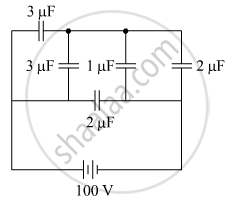
The figure shows a network of five capacitors connected to a 100 V supply. Calculate the total energy stored in the network.
Concept: undefined >> undefined
An ac circuit consists of a series combination of circuit elements X and Y. The current is ahead of the voltage in phase by `pi/4`. If element X is a pure resistor of 100 Ω,
(a) name the circuit element Y.
(b) calculate the rms value of current, if rms of voltage is 141 V.
(c) what will happen if the ac source is replaced by a dc source
Concept: undefined >> undefined
