Advertisements
Advertisements
Question
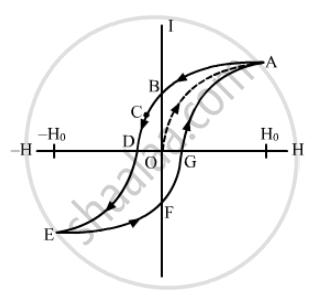
When a ferromagnetic material goes through a hysteresis loop, the magnetic susceptibility
(a) has a fixed value
(b) may be zero
(c) may be infinity
(d) may be negative
Advertisements
Solution
(b) may be zero
(c) may be infinity
(d) may be negative

We know,
Magnetic susceptibility `=I/H`
At point B, the value of H is zero but I is non zero. Magnetic susceptibility is infinity here. At point C, value of magnetic susceptibility will be negative. Here Magnetic field is applied in opposite direction to reduce the intensity of magnetization to zero. The applied field to reduce the residual magnetization to zero is called coercivity. At point D, I is zero but H is not zero so susceptibility of the material will be zero.
APPEARS IN
RELATED QUESTIONS
When a ferromagnetic material goes through a hysteresis loop, its thermal energy is increased. Where does this energy come from?
A paramagnetic material is placed in a magnetic field. Consider the following statements:-
(A) If the magnetic field is increased, the magnetisation is increased.
(B) If the temperature is increased, the magnetisation is increased.
A paramagnetic material is kept in a magnetic field. The field is increased till the magnetisation becomes constant. If the temperature is now decreased, the magnetisation ___________ .
A ferromagnetic material is placed in an external magnetic field. The magnetic domains ______________ .
The magnetic susceptibility is negative for _____________ .
The permanent magnetic moment of the atoms of a material is not zero. The material ________________ .
The permanent magnetic moment of the atoms of a material is zero. The material _________________ .
A rod is inserted as the core in the current-carrying solenoid of the previous problem. (a) What is the magnetic intensity H at the centre? (b) If the magnetization I of the core is found to be 0.12 A m−1, find the susceptibility of the material of the rod. (c) Is the material paramagnetic, diamagnetic or ferromagnetic?
Assertion: The earth¢s magnetic field is due to iron present in its core.
Reason: At a high temperature magnet losses its magnetism.
The primary origin of magnetism lies in ______.
