Advertisements
Advertisements
An electron and a photon each have a wavelength of 1.00 nm. Find
(a) their momenta,
(b) the energy of the photon, and
(c) the kinetic energy of electron.
Concept: undefined >> undefined
For what kinetic energy of a neutron will the associated de Broglie wavelength be 1.40 × 10⁻¹⁰ m?
Concept: undefined >> undefined
Advertisements
Find the de Broglie wavelength of a neutron, in thermal equilibrium with matter, having an average kinetic energy of `(3/2)` kT at 300 K.
Concept: undefined >> undefined
Show that the wavelength of electromagnetic radiation is equal to the de Broglie wavelength of its quantum (photon).
Concept: undefined >> undefined
What is the de Broglie wavelength of a nitrogen molecule in air at 300 K? Assume that the molecule is moving with the root-mean square speed of molecules at this temperature. (Atomic mass of nitrogen = 14.0076 u)
Concept: undefined >> undefined
Crystal diffraction experiments can be performed using X-rays, or electrons accelerated through appropriate voltage. Which probe has greater energy? (For quantitative comparison, take the wavelength of the probe equal to 1 Å, which is of the order of inter-atomic spacing in the lattice) (me = 9.11 × 10⁻³¹ kg).
Concept: undefined >> undefined
Obtain the de Broglie wavelength of a neutron of kinetic energy 150 eV. As you have an electron beam of this energy is suitable for crystal diffraction experiments. Would a neutron beam of the same energy be equally suitable? Explain. (mn= 1.675 × 10⁻²⁷ kg)
Concept: undefined >> undefined
Obtain the de Broglie wavelength associated with thermal neutrons at room temperature (27°C). Hence explain why a fast neutron beam needs to be thermalised with the environment before it can be used for neutron diffraction experiments.
Concept: undefined >> undefined
Find the typical de Broglie wavelength associated with a He atom in helium gas at room temperature (27°C) and 1 atm pressure, and compare it with the mean separation between two atoms under these conditions.
Concept: undefined >> undefined
Compute the typical de Broglie wavelength of an electron in a metal at 27°C and compare it with the mean separation between two electrons in a metal which is given to be about 2 × 10⁻¹⁰ m.
Concept: undefined >> undefined
The energy and momentum of an electron are related to the frequency and wavelength of the associated matter wave by the relations:
E = hv, p = `"h"/lambda`
But while the value of λ is physically significant, the value of v (and therefore, the value of the phase speed vλ) has no physical significance. Why?
Concept: undefined >> undefined
Unpolarised light is passed through a polaroid P1. When this polarised beam passes through another polaroid P2 and if the pass axis of P2 makes angle θ with the pass axis of P1, then write the expression for the polarised beam passing through P2. Draw a plot showing the variation of intensity when θ varies from 0 to 2π.
Concept: undefined >> undefined
The current is drawn from a cell of emf E and internal resistance r connected to the network of resistors each of resistance r as shown in the figure. Obtain the expression for
- the current draw from the cell and
- the power consumed in the network.
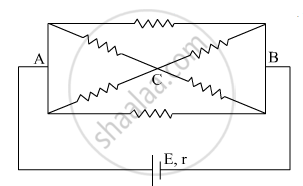
Concept: undefined >> undefined
Why should the objective of a telescope have large focal length and large aperture? Justify your answer.
Concept: undefined >> undefined
A electron of mass me revolves around a nucleus of charge +Ze. Show that it behaves like a tiny magnetic dipole. Hence prove that the magnetic moment associated wit it is expressed as `vecμ =−e/(2 m_e)vecL `, where `vec L` is the orbital angular momentum of the electron. Give the significance of negative sign.
Concept: undefined >> undefined
Draw a ray diagram depicting the formation of the image by an astronomical telescope in normal adjustment.
Concept: undefined >> undefined
You are given the following three lenses. Which two lenses will you use as an eyepiece and as an objective to construct an astronomical telescope ? Give reason
| Lenses | Power (D) | Aperture (cm) |
| L1 | 3 | 8 |
| L2 | 6 | 1 |
| L3 | 10 | 1 |
Concept: undefined >> undefined
Write two important advantages of reflecting telescope over a refracting telescope.
Concept: undefined >> undefined
What is the value of refractive index of a medium of polarising angle 60°?
Concept: undefined >> undefined
You are given three lenses of power 0.5 D, 4 D, and 10 D to design a telescope.
1) Which lenses should be used as objective and eyepiece? Justify your answer.
2) Why is the aperture of the objective preferred to be large?
Concept: undefined >> undefined
