Advertisements
Advertisements
An object is placed in front of a converging lens. Obtain the conditions under which the magnification produced by the lens is
- negative and
- positive.
Concept: undefined >> undefined
A point object is placed at O in front of a glass sphere as shown in figure.

Show the formation of the image by the sphere.
Concept: undefined >> undefined
Advertisements
Depict the orientation of an electric dipole in (a) stable and (b) unstable equilibrium in an external uniform electric field. Write the potential energy of the dipole in each case.
Concept: undefined >> undefined
A galvanometer shows full-scale deflection for current Ig. A resistance R1 is required to convert it into a voltmeter of range (0 - V) and a resistance R2 to convert it into a voltmeter of range (0 - 2V). Find the resistance of the galvanometer.
Concept: undefined >> undefined
How is current sensitivity increased?
Concept: undefined >> undefined
State the two Kirchhoff’s rules used in electric networks. How are there rules justified?
Concept: undefined >> undefined
State the two Kirchhoff’s rules used in electric networks. How are there rules justified?
Concept: undefined >> undefined
Use Kirchhoff's rules to obtain conditions for the balance condition in a Wheatstone bridge.
Concept: undefined >> undefined
Use Kirchhoff's rules to obtain conditions for the balance condition in a Wheatstone bridge.
Concept: undefined >> undefined
Deduce the expression for the torque acting on a dipole of dipole moment `vecp` in the presence of a uniform electric field `vecE`
Concept: undefined >> undefined
An electric dipole with dipole moment 4 × 10⁻⁹ C m is aligned at 30° with the direction of a uniform electric field of magnitude 5 × 10⁴ N C−1. Calculate the magnitude of the torque acting on the dipole.
Concept: undefined >> undefined
In a certain region of space, electric field is along the z-direction throughout. The magnitude of electric field is, however, not constant but increases uniformly along the positive z-direction, at the rate of 105 NC−1 per metre. What are the force and torque experienced by a system having a total dipole moment equal to 10−7 Cm in the negative z-direction?
Concept: undefined >> undefined
A spherical conductor of radius 12 cm has a charge of 1.6 × 10⁻⁷ C distributed uniformly on its surface. What is the electric field
- inside the sphere
- just outside the sphere
- at a point 18 cm from the centre of the sphere?
Concept: undefined >> undefined
A spherical conducting shell of inner radius r1 and outer radius r2 has a charge Q.
(a) A charge q is placed at the centre of the shell. What is the surface charge density on the inner and outer surfaces of the shell?
(b) Is the electric field inside a cavity (with no charge) zero, even if the shell is not spherical, but has any irregular shape? Explain.
Concept: undefined >> undefined
(a) Show that the normal component of electrostatic field has a discontinuity from one side of a charged surface to another given by
`(vec"E"_2 - vec"E"_1).hat"n" = sigma/in_0`
Where `hat"n"` is a unit vector normal to the surface at a point and σ is the surface charge density at that point. (The direction of `hat"n"` is from side 1 to side 2.) Hence show that just outside a conductor, the electric field is σ `hat"n"/in_0`
(b) Show that the tangential component of electrostatic field is continuous from one side of a charged surface to another.
[Hint: For (a), use Gauss’s law. For, (b) use the fact that work done by electrostatic field on a closed loop is zero.]
Concept: undefined >> undefined
A 4 µF capacitor is charged by a 200 V supply. It is then disconnected from the supply and is connected to another uncharged 2 µF capacitors. How much electrostatic energy of the first capacitor is lost in the form of heat and electromagnetic radiation?
Concept: undefined >> undefined
If Coulomb’s law involved 1/r3 dependence (instead of 1/r2), would Gauss’s law be still true?
Concept: undefined >> undefined
Determine the current in each branch of the network shown in figure.
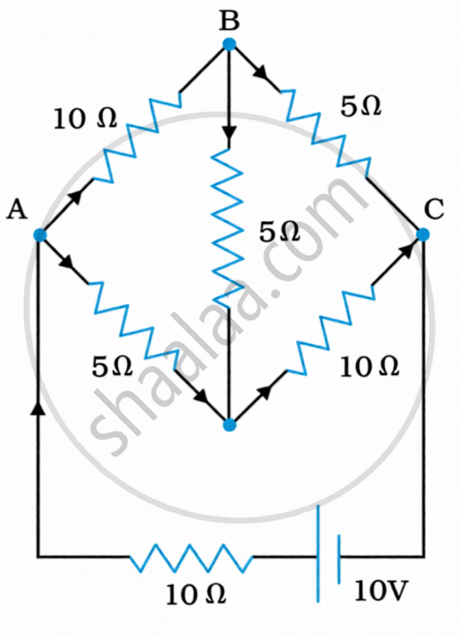
Concept: undefined >> undefined
Determine the current in each branch of the network shown in figure.
Concept: undefined >> undefined
Given n resistors each of resistance R, how will you combine them to get the (i) maximum (ii) minimum effective resistance? What is the ratio of the maximum to minimum resistance?
Concept: undefined >> undefined
