Please select a subject first
Advertisements
Advertisements
A source emits 31.4 W of radiant flux distributed uniformly in all directions. The luminous efficiency is 60 lumen watt−1. What is the luminous intensity of the source?
Concept: undefined >> undefined
A point source emitting 628 lumen of luminous flux uniformly in all directions is placed at the origin. Calculate the illuminance on a small area placed at (1.0 m, 0, 0) in such a way that the normal to the area makes an angle of 37° with the X-axis.
Concept: undefined >> undefined
Advertisements
The illuminance of a small area changes from 900 lumen m−2 to 400 lumen m−2 when it is shifted along its normal by 10 cm. Assuming that it is illuminated by a point source placed on the normal, find the distance between the source and the area in the original position.
Concept: undefined >> undefined
A point source emitting light uniformly in all directions is placed 60 cm above a table-top. The illuminance at a point on the table-top, directly below the source, is 15 lux. Find the illuminance at a point on the table-top 80 cm away from the first point.
Concept: undefined >> undefined
Light from a point source falls on a small area placed perpendicular to the incident light. If the area is rotated about the incident light by an angle of 60°, by what fraction will the illuminance change?
Concept: undefined >> undefined
A student is studying a book placed near the edge of a circular table of radius R. A point source of light is suspended directly above the centre of the table. What should be the height of the source above the table so as to produce maximum illuminance at the position of the book?
Concept: undefined >> undefined
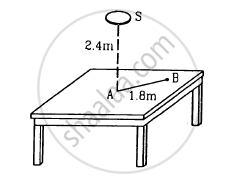
Figure shows a small diffused plane source S placed over a horizontal table-top at a distance of 2.4 m with its plane parallel to the table-top. The illuminance at the point Adirectly below the source is 25 lux. Find the illuminance at a point B of the table at a distance of 1.8 m from A.
Concept: undefined >> undefined
An electric lamp and a candle produce equal illuminance at a photometer screen when they are placed at 80 cm and 20 cm from the screen respectively. The lamp is now covered with a thin paper which transmits 49% of the luminous flux. By what distance should the lamp be moved to balance the intensities at the screen again?
Concept: undefined >> undefined
Two light sources of intensities 8 cd and 12 cd are placed on the same side of a photometer screen at a distance of 40 cm from it. Where should a 80 cd source be placed to balance the illuminance?
Concept: undefined >> undefined
Photo diodes are used to detect ______.
Concept: undefined >> undefined
Light rays from a point object ______.
Concept: undefined >> undefined
Light travels through a glass plate of thickness t and having a refractive index μ. If c is the velocity of light in vacuum, the time taken by the light to travel this thickness of glass is ______.
Concept: undefined >> undefined
Interference effects of light from two sources can be observed if the sources are ______.
Concept: undefined >> undefined
If we have two coherent sources S1 and S2 vibrating in phase, then for an arbitrary point P destructive interference is observed whenever the path difference is ______.
Concept: undefined >> undefined
If we have two coherent sources S1 and S2 vibrating in phase with same amplitude, then for an arbitrary point P with path difference corresponding to ϕ, the resultant intensity if the intensity due to each is I0 would be ______.
Concept: undefined >> undefined
State two conditions for two light sources to be coherent.
Concept: undefined >> undefined
What happens to the interference pattern when two coherent sources are infinitely close?
Concept: undefined >> undefined
What happens to the interference pattern when two coherent sources are far apart from each other?
Concept: undefined >> undefined
The speed of sound in air is 332 m s−1. Is it advisable to define the length 1 m as the distance travelled by sound in 1/332 s?
Concept: undefined >> undefined
Consider Galileo's method of measuring the speed of light using two lanterns. To get an accuracy of about 10%, the time taken by the experimenter in closing or opening the shutter should be about one tenth of the time taken by the light in going from one experimenter to the other. Assume that it takes 1/100 second for an experimenter to close or open the shutter. How far should the two experimenters be to get a 10% accuracy? What are the difficulties in having this separation?
Concept: undefined >> undefined
