Please select a subject first
Advertisements
Advertisements
State with reason, how the linear width of the central maximum will be affected if
(i) monochromatic yellow light is replaced with red light, and
(ii) distance between the slit and the screen is increased.
Concept: undefined >> undefined
An electric dipole of dipole moment `vecP` is placed in a uniform electric field `vecE` with its axis inclined to the field. Write an expression for the torque `vecT` experienced by the dipole in vector form. Show diagrammatically how the dipole should be kept in the electric field so that the torque acting on it is:
- maximum
- Zero
Concept: undefined >> undefined
Advertisements
Answer the following question.
Two bulbs are rated (P1, V) and (P2, V). If they are connected (i) in series and (ii) in parallel across a supply V, find the power dissipated in the two combinations in terms of P1 and P2.
Concept: undefined >> undefined
Answer the following question.
A small town with a demand of 1200 kW of electric power at 220 V is situated 20 km away from an electric plant generating power at 440 V. The resistance of the two wirelines carrying power is 0.5 Ω per km. The town gets the power from the line through a 4000-220 V step-down transformer at a sub-station in the town. Estimate the line power loss in the form of heat.
Concept: undefined >> undefined
Answer the following question.
In the diffraction due to a single slit experiment, the aperture of the slit is 3 mm. If monochromatic light of wavelength 620 nm is incident normally on the slit, calculate the separation between the first order minima and the 3rd order maxima on one side of the screen. The distance between the slit and the screen is 1.5 m.
Concept: undefined >> undefined
Answer the following question.
Obtain the expression for the ratio of the de-Broglie wavelengths associated with the electron orbiting in the second and third excited states of the hydrogen atom.
Concept: undefined >> undefined
(a) Can the interference pattern be produced by two independent monochromatic sources of light? Explain.
(b) The intensity at the central maximum (O) in Young's double-slit experimental set-up shown in the figure is IO. If the distance OP equals one-third of the fringe width of the pattern, show that the intensity at point P, would `"I"_°/4`
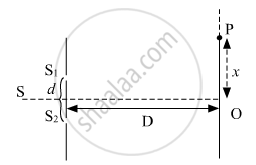
(c) In Young's double-slit experiment, the slits are separated by 0⋅5 mm and the screen is placed 1⋅0 m away from the slit. It is found that the 5th bright fringe is at a distance of 4⋅13 mm from the 2nd dark fringe. Find the wavelength of light used.
Concept: undefined >> undefined
Using the monochromatic light of the wavelength in the experimental set-up of the diffraction pattern as well as in the interference pattern where the slit separation is 1 mm, 10 interference fringes are found to be within the central maximum of the diffraction pattern. Determine the width of the single slit, if the screen is kept at the same distance from the slit in the two cases.
Concept: undefined >> undefined
Deduce the expression for the torque `vec"τ"` acting on a planar loop of area `vec"A"` acting on a planar loop of area `vec"B"`. If the loop is free to rotate, what would be its orientation in stable equilibrium?
Concept: undefined >> undefined
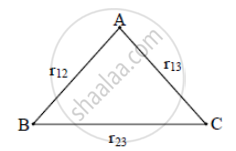
Define electrostatic potential at a point. Write its S.I. unit. Three-point charges q1, q2 and q3 are kept respectively at points A, B, and C as shown in the figure, Derive the expression for the electrostatic potential energy of the system.
Concept: undefined >> undefined
A point charge is placed at the centre of a hollow conducting sphere of internal radius ‘r’ and outer radius ‘2r’. The ratio of the surface charge density of the inner surface to that of the outer surface will be ______.
Concept: undefined >> undefined
Derive the expression for the torque acting on an electric dipole, when it is held in a uniform electric field. identify the orientation of the dipole in the electric field, in which it attains a stable equilibrium.
Concept: undefined >> undefined
Explain about the compound microscope and obtain the equation for magnification.
Concept: undefined >> undefined
A short bar magnet of magnetic moment m = 0.32 J T–1 is placed in a uniform magnetic field of 0.15 T. If the bar is free to rotate in the plane of the field, which orientation would correspond to its
- stable, and
- unstable equilibrium?
What is the potential energy of the magnet in each case?
Concept: undefined >> undefined
If the solenoid is free to turn about the vertical direction and a uniform horizontal magnetic field of 0.25 T is applied, what is the magnitude of torque on the solenoid when its axis makes an angle of 30° with the direction of applied field?
Concept: undefined >> undefined
A circular coil of 16 turns and radius 10 cm carrying a current of 0.75 A rests with its plane normal to an external field of magnitude 5.0 × 10⁻² T. The coil is free to turn about an axis in its plane perpendicular to the field direction. When the coil is turned slightly and released, it oscillates about its stable equilibrium with a frequency of 2.0 s−1. What is the moment of inertia of the coil about its axis of rotation?
Concept: undefined >> undefined
The peak voltage of an ac supply is 300 V. What is the rms voltage?
Concept: undefined >> undefined
The rms value of current in an ac circuit is 10 A. What is the peak current?
Concept: undefined >> undefined
A circuit containing a 80 mH inductor and a 60 µF capacitor in series is connected to a 230 V, 50 Hz supply. The resistance of the circuit is negligible.
(a) Obtain the current amplitude and rms values.
(b) Obtain the rms values of potential drops across each element.
(c) What is the average power transferred to the inductor?
(d) What is the average power transferred to the capacitor?
(e) What is the total average power absorbed by the circuit?
[‘Average’ implies ‘averaged over one cycle’.]
Concept: undefined >> undefined
A small town with a demand of 800 kW of electric power at 220 V is situated 15 km away from an electric plant generating power at 440 V. The resistance of the two wire line carrying power is 0.5 Ω per km. The town gets power from the line through a 4000-220 V step-down transformer at a sub-station in the town.
(a) Estimate the line power loss in the form of heat.
(b) How much power must the plant supply, assuming there is negligible power loss due to leakage?
(c) Characterise the step up transformer at the plant.
Concept: undefined >> undefined
