Advertisements
Advertisements
Question
(a) Can the interference pattern be produced by two independent monochromatic sources of light? Explain.
(b) The intensity at the central maximum (O) in Young's double-slit experimental set-up shown in the figure is IO. If the distance OP equals one-third of the fringe width of the pattern, show that the intensity at point P, would `"I"_°/4`
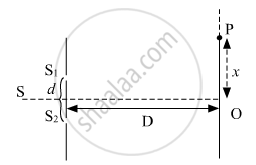
(c) In Young's double-slit experiment, the slits are separated by 0⋅5 mm and the screen is placed 1⋅0 m away from the slit. It is found that the 5th bright fringe is at a distance of 4⋅13 mm from the 2nd dark fringe. Find the wavelength of light used.
Advertisements
Solution
(a) Two independent monochromatic sources cannot produce a sustained interference pattern. This is because the phase difference of two independent sources cannot be strictly constant throughout. A constant phase difference is essential to produce a distinguishable interference pattern. [Each of the sources produces their own diffraction pattern which interacts with each other. This interaction may or may not result in the interference pattern in case of 2 different sources but produces a clear pattern in case of coherent sources if d
(b) Fringe width, `beta = lambda"D"/"d"`
Here,
`"OP" ="x" = beta/3 = (lambda"D")/(3"d")`
`"x" = (lambda"D")/(3"d")` ..................(1)
∴ Δ X (Path difference) `= "x""d"/"D"`
∵ `"x""d"/"d" = lambda/3`......(From eq. 1)
⇒ Δ X ` = "x""d"/"D"`
φ (Phase difference) `= (2pi)/(lambda)(Delta "X")`
`= (2pi)/lambda xx lambda / 3 = (2pi)/3`
⇒ φ `= (2pi)/3`
If intensity at point O is IO, then intensity at point P will be,`"I"_"P" = "I"_"O" cos^2 (φ/2)`
`"I"_"P" = "I"_"O" cos^2 (φ/2) = "I"_"O" cos^2(pi/3)`
`= "I"_"O"(1/2)^2 = "I"_"O"/4`
⇒ `"I"_"P" = "I"_"O"/4`
(c) For Young's double slit experiment, Position of 5th bright fringe `=5xx (lambda"D")/"d"`
The position of 2th dark fringe = `(2 xx 2 xx -1) xx (lambda"D")/(2"d") = 1.5 ((lambda"D")/"d")`
Where D is the distance of the screen from the slits and d is the separation between the slits.
According to the given information,
`5 xx ((lambda"D")/"d") - 1.5 xx ((lambda"d")/"d") = 4.13 xx 10^-3 "m"`
⇒ `3.5 xx ((lambda"D")/"d") = 4.13 xx 10^-3 "m"`
⇒ `lambda = (4.13 xx 10^-3 xx 0.5 xx 10^-3)/(3.5xx1) = 0.59 xx 1^-6 "m"`
⇒ `lambda = 590 "nm"`
APPEARS IN
RELATED QUESTIONS
When monochromatic light travels from a rarer to a denser medium, explain the following, giving reasons:
(i) Is the frequency of reflected and refracted light same as the frequency of incident light?
(ii) Does the decrease in speed imply a reduction in the energy carried by light wave?
Obtain the conditions for the bright and dark fringes in diffraction pattern due to a single narrow slit illuminated by a monochromatic source.
Explain clearly why the secondary maxima go on becoming weaker with increasing.
If a monochromatic source of light is replaced by white light, what change would you observe in the diffraction pattern?
Which of the following sources provides the best monochromatic light?
The following figure shows three equidistant slits being illuminated by a monochromatic parallel beam of light. Let \[B P_0 - A P_0 = \lambda/3\text{ and }D > > \lambda.\] (a) Show that in this case \[d = \sqrt{2\lambda D/3}.\] (b) Show that the intensity at P0 is three times the intensity due to any of the three slits individually.

State with reason, how the linear width of the central maximum will be affected if
(i) monochromatic yellow light is replaced with red light, and
(ii) distance between the slit and the screen is increased.
Using the monochromatic light of the wavelength in the experimental set-up of the diffraction pattern as well as in the interference pattern where the slit separation is 1 mm, 10 interference fringes are found to be within the central maximum of the diffraction pattern. Determine the width of the single slit, if the screen is kept at the same distance from the slit in the two cases.
A monochromatic ray of light falls on a regular prism under minimum deviation condition. What is the relation between angle of incidence and angle of emergence?
Assertion(A): The photoelectrons produced by a monochromatic light beam incident on a metal surface have a spread in their kinetic energies.
Reason(R): The energy of electrons emitted from inside the metal surface, is lost in collision with the other atoms in the metal.
A narrow slit is illuminated by a parallel beam of monochromatic light of wavelength λ equal to 6000 Å and the angular width of the central maximum in the resulting diffraction pattern is measured. When the slit is next illuminated by light of wavelength λ’, the angular width decreases by 30%. Calculate the value of the wavelength λ’.
