Advertisements
Advertisements
Question
Derive the relation a sin θ = λ for the first minimum of the diffraction pattern produced due to a single slit of width 'a' using light of wavelength λ.
Advertisements
Solution
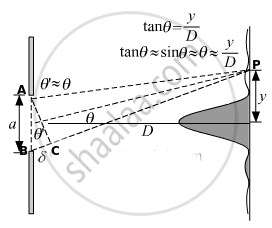
As we can see from the figure, rays AP and BP reach to the screen from the two ends of a single slit. The ray BP travels an extra distance of BC as compared to ray AP.
Hence the path difference produced, Δx = BC ..........(1)
The ray reaching to screen at point P from point O makes the angle θ with the horizontal.
∵ ∠POQ = θ
∴∠BAC = θ
In ΔABC,
BC = a sin θ
Using equation (1), Δx = BC
⇒ Δx = a sin θ .............(2)
For diffraction pattern produced due to a single slit of width, 'a' using the light of wavelength 'λ''λ', path difference for destructive interference is given by, Δx = mλ (where m = 1, -1, 2, -2, 3, -3, 4..............)
Using equation (2), we can write, a sin θ = mλ
For the first minimum,
m = 1,
∴ a sin θ = λ
APPEARS IN
RELATED QUESTIONS
In deriving the single slit diffraction pattern, it was stated that the intensity is zero at angles of nλ/a. Justify this by suitably dividing the slit to bring out the cancellation.
(i) State the essential conditions for diffraction of light.
(ii) Explain diffraction of light due to a narrow single slit and the formation of pattern of fringes on the screen.
(iii) Find the relation for width of central maximum in terms of wavelength 'λ', width of slit 'a', and separation between slit and screen 'D'.
(iv) If the width of the slit is made double the original width, how does it affect the size and intensity of the central band?
Which electric bulb is required for the observation?
How should the slit be oriented relative to the filament of the lit glass bulb?
What should be done while slowly adjusting the width of the slit?
What pattern appears when the bulb filament is viewed through the slit?
What appears when the slit is aligned parallel to the filament?
What happens when the slit is not parallel to the filament?
What happens to the bands when the slit width is narrowed?
What is visible with white light and no filter?
