Advertisements
Advertisements
प्रश्न
Derive the relation a sin θ = λ for the first minimum of the diffraction pattern produced due to a single slit of width 'a' using light of wavelength λ.
Advertisements
उत्तर
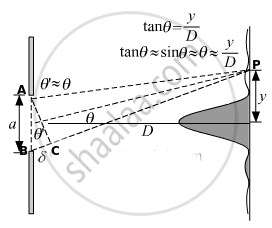
As we can see from the figure, rays AP and BP reach to the screen from the two ends of a single slit. The ray BP travels an extra distance of BC as compared to ray AP.
Hence the path difference produced, Δx = BC ..........(1)
The ray reaching to screen at point P from point O makes the angle θ with the horizontal.
∵ ∠POQ = θ
∴∠BAC = θ
In ΔABC,
BC = a sin θ
Using equation (1), Δx = BC
⇒ Δx = a sin θ .............(2)
For diffraction pattern produced due to a single slit of width, 'a' using the light of wavelength 'λ''λ', path difference for destructive interference is given by, Δx = mλ (where m = 1, -1, 2, -2, 3, -3, 4..............)
Using equation (2), we can write, a sin θ = mλ
For the first minimum,
m = 1,
∴ a sin θ = λ
APPEARS IN
संबंधित प्रश्न
A parallel beam of light of wavelength 500 nm falls on a narrow slit and the resulting diffraction pattern is observed on a screen 1 m away. It is observed that the first minimum is at a distance of 2.5 mm from the centre of the screen. Find the width of the slit.
State differences between interference and diffraction patterns.
Why cannot two independent monochromatic sources produce sustained interference pattern?
Deduce, with the help of Young's arrangement to produce interference pattern, an expression for the fringe width.
Derive the relation a sin θ = λ for the first minimum of the diffraction pattern produced due to a single slit of width ‘a’ using light of wavelength λ.
Which electric bulb is required for the observation?
What should be done while slowly adjusting the width of the slit?
What pattern appears when the bulb filament is viewed through the slit?
What fringe pattern is observed through a red colour filter?
Why is the fringe pattern narrower with a blue colour filter?
Why do coloured fringes appear with white light and no filter?
