Advertisements
Advertisements
Question
Deduce the expression for the torque `vec"τ"` acting on a planar loop of area `vec"A"` acting on a planar loop of area `vec"B"`. If the loop is free to rotate, what would be its orientation in stable equilibrium?
Advertisements
Solution
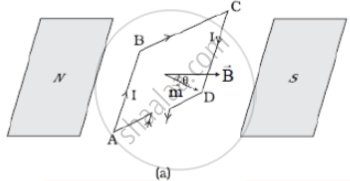

(a) The area vector of the loop ABCD makes an arbitrary angle θ with the magnetic field.
(b) Top view of the loop. The forces F1 and F2 acting on the arms AB and CD are indicated.
We consider the case when the plane of the loop, is not along the magnetic field but makes an angle θ with it. Fig. (a) illustrates this general case. The forces on the arms BC and DA are equal, opposite, and act along the axis of the coil, which connects the centers of mass of BC and DA. Being collinear along the axis they cancel each other, resulting in no net force or torque. The forces on arms AB and CD are F1and F2. They too are equal and opposite, with magnitude,
F1 = F2 = I b B
But they are not collinear! This results in a couple of Fig. (b) is a view of the arrangement from the AD end and it illustrates these two forces constituting a couple. The magnitude of the torque on the loop is,
`"τ" = "F"_1 "a"/(2) sin θ + "F"_2 "a"/(2) sin θ`
= I ab B sin θ
= I A B sin θ ....(i)
As θ → 0, the perpendicular distance between the forces of the couple also approaches zero. This makes the forces collinear and the net force and torque zero. The torques in the above equation can be expressed as vector products of the magnetic moment of the coil and the magnetic field. We define the magnetic moment of the current loop as,
m = I A
where the direction of the area vector A is given by the right-hand thumb rule and is directed into the plane of the paper in Fig. (a). Then as the angle between m and B is `theta`, equation (i) can be expressed by one expression
`vec"τ" = vec"m" xx vec"B"`
we see that the torque `vec"τ" "vanishes when" vec"m"` is either parallel or antiparallel to the magnetic field `vec"B"` This indicates a state of equilibrium as there is no torque on the coil (this also applies to any object with a magnetic moment `vec"m").`
When `vec"m" and vec"B"` re parallel the equilibrium is a stable one.
APPEARS IN
RELATED QUESTIONS
Derive the expression for the torque acting on an electric dipole, when it is held in a uniform electric field. identify the orientation of the dipole in the electric field, in which it attains a stable equilibrium.
Assertion: The poles of magnet can not be separated by breaking into two pieces.
Reason: The magnetic moment will be reduced to half when a magnet is broken into two equal pieces.
Let the magnetic field on earth be modelled by that of a point magnetic dipole at the centre of earth. The angle of dip at a point on the geographical equator is ______.
In vector form, how is the torque on an electric dipole in a uniform electric field expressed?
Using the right-hand screw rule, determine the direction of torque when a dipole moment \[\vec{p}\] is rotated toward an electric field \[\vec{E}\].
At what angle θ between the dipole moment and the electric field is the torque on the dipole maximum?
When the dipole moment is parallel to the electric field (θ = 0°), what is the magnitude of torque?
What distinguishes the behavior of a dipole in a non-uniform electric field from its behavior in a uniform field?
In a non-uniform electric field, why does the net force on a dipole become non-zero?
