Advertisements
Advertisements
Match the following rules with their statements :
| Rules | Statements |
| (i) Hund's Rule | (a) No two electrons in an atom can have the same set of four quantum numbers. |
| (ii) Aufbau Principle | (b) Half-filled and completely filled orbitals have extra stability. |
| (iii) Pauli Exclusion Principle | (c) Pairing of electrons in the orbitals belonging to the same subshell does not take place until each orbital is singly occupied. |
| (d) It is impossible to determine the exact position and exact momentum of a subatomic particle simultaneously. |
|
| (iv) Heisenberg's Uncertainty Principle |
(e) In the ground state of atoms, orbitals are filled in the order of their increasing energies. |
Concept: undefined >> undefined
Assertion (A): It is impossible to determine the exact position and exact momentum of an electron simultaneously.
Reason (R): The path of an electron in an atom is clearly defined.
Concept: undefined >> undefined
Advertisements
Give reasons for the following:
Covalent bonds are directional bonds while ionic bonds are nondirectional.
Concept: undefined >> undefined
What is an ionic bond? With two suitable examples explain the difference between an ionic and a covalent bond?
Concept: undefined >> undefined
Atmospheric pressures recorded in different cities are as follows:
| Cities | Shimla | Bangalore | Delhi | Mumbai |
| p in N/m2 | 1.01 × 10⁵ | 1.2 × 10⁵ | 1.02 × 10⁵ | 1.21 × 10⁵ |
Consider the above data and mark the place at which liquid will boil first.
Concept: undefined >> undefined
Which of the following changes decrease the vapour pressure of water kept in a sealed vessel?
(i) Decreasing the quantity of water
(ii) Adding salt to water
(iii) Decreasing the volume of the vessel to one-half
(iv) Decreasing the temperature of water
Concept: undefined >> undefined
Pressure exerted by saturated water vapour is called aqueous tension. What correction term will you apply to the total pressure to obtain pressure of dry gas?
Concept: undefined >> undefined
The variation of vapour pressure of different liquids with temperature is shown in figure.
(i) Calculate graphically boiling points of liquids A and B.
(ii) If we take liquid C in a closed vessel and heat it continuously. At what temperature will it boil?
(iii) At high altitude, atmospheric pressure is low (say 60 mm Hg). At what temperature liquid D boils?
(iv) Pressure cooker is used for cooking food at hill station. Explain in terms of vapour pressure why is it so?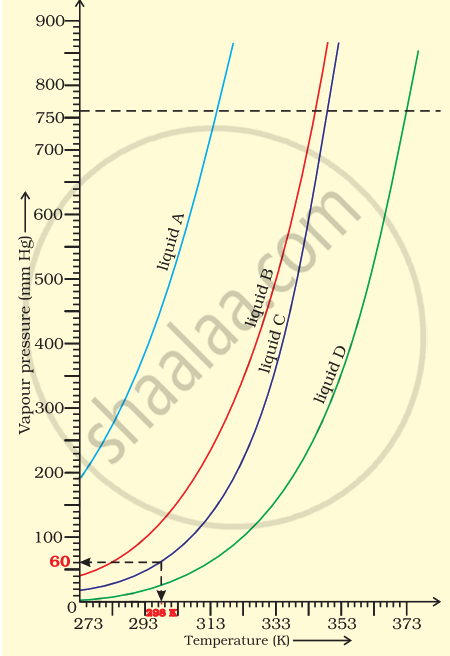
Concept: undefined >> undefined
Assertion (A): For any chemical reaction at a particular temperature, the equilibrium constant is fixed and is a characteristic property.
Reason (R): Equilibrium constant is independent of temperature.
Concept: undefined >> undefined
Electrophilic addition reactions proceed in two steps. The first step involves the addition of an electrophile. Name the type of intermediate formed in the first step of the following addition reaction.
\[\ce{H3C - HC = CH2 + H+ ->?}\]
Concept: undefined >> undefined
The addition of HCl to an alkene proceeds in two steps. The first step is the attack of H+ ion to  portion which can be shown as:
Concept: undefined >> undefined
Calculate the mass percent of different elements present in sodium sulphate (Na2SO4).
Concept: undefined >> undefined
Determine the empirical formula of an oxide of iron which has 69.9% iron and 30.1% dioxygen by mass.
Concept: undefined >> undefined
Determine the molecular formula of an oxide of iron in which the mass percent of iron and oxygen are 69.9 and 30.1, respectively.
Concept: undefined >> undefined
Using s, p, d notations, describe the orbital with the following quantum numbers n = 1, l = 0.
Concept: undefined >> undefined
Using s, p, d notations, describe the orbital with the following quantum numbers n = 3; l =1.
Concept: undefined >> undefined
Using s, p, d notations, describe the orbital with the following quantum numbers n = 4; l = 2.
Concept: undefined >> undefined
Using s, p, d notations, describe the orbital with the following quantum numbers n = 4; l =3.
Concept: undefined >> undefined
The equilibrium constant expression for a gas reaction is,
`"K"_"c" = (["NH"_3]^4["O"_2]^5)/(["NO"]^4["H"_2"O"]^6)`
Write the balanced chemical equation corresponding to this expression.
Concept: undefined >> undefined
Arrange benzene, n-hexane and ethyne in decreasing order of acidic behaviour. Also give reason for this behaviour.
Concept: undefined >> undefined
