Advertisements
Advertisements
Name the part of a seed which contains stored food.
Concept: undefined >> undefined
Name the part of a seed which grows into root.
Concept: undefined >> undefined
Advertisements
Name the part of a seed which grows into shoot.
Concept: undefined >> undefined
In tobacco plant, the male gametes have 24 chromosomes.
What is the number of chromosomes in the female gamete?
Concept: undefined >> undefined
In tobacco plant, the male gametes have 24 chromosomes.
What is the number of chromosomes in the zygote?
Concept: undefined >> undefined
What is meant by ‘unisexual flowers’?
Concept: undefined >> undefined
How does pollination occur?
Concept: undefined >> undefined
Describe the process of fertilisation in a flower with the help of labelled diagrams.
Concept: undefined >> undefined
What changes take place in the flower after fertilisation which lead to the formation of seeds and fruit?
Concept: undefined >> undefined
Draw a neat diagram of a flower showing its various parts. In this diagram mark stem, receptacle, sepals, petals, stamen and carpel.
Concept: undefined >> undefined
Which of the following is the correct sequence of events of sexual reproduction in a flower?
(a) pollination, fertilisation, seed, embryo
(b) seed, embryo, fertilisation, pollination
(c) pollination, fertilisation, embryo, seed
(d) embryo, seed, pollination, fertilisation
Concept: undefined >> undefined
The length of pollen tube depends on the distance between :
(a) pollen grain and upper surface of stigma
(b) pollen grain on upper surface of stigma and ovule
(c) pollen grain in anther and upper surface of stigma
(d) upper surface of stigma and lower part of style
Concept: undefined >> undefined
Which of the following statements are true for flowers?
(i) Flowers are always bisexual.
(ii) They contain sexual reproductive organs.
(iii) They are produced in all groups of plants.
(iv) after fertilization they give rise to fruits.
Concept: undefined >> undefined
One of the following occurs in the reproductive system of flowering plants as well as that of humans. This is :
(a) vas deferens
(b) anther
(c) ovary
(d) style
Concept: undefined >> undefined
Which among the following statements are true for unisexual flowers?
(i) They possess both stamen and pistil
(ii) They possess either stamen or pistil
(iii) They exhibit cross pollination
(iv) Unisexual flower possessing only stamens cannot produce fruits
(a) (i) and (iv)
(b) (ii), (iii) and (iv)
(c) (ii) and (iii)
(d) (i), (iii) and (iv)
Concept: undefined >> undefined
Which of the following statements are true for sexual reproduction in flowering plants?
(i) it requires two types of gametes
(ii) fertilisation is a compulsory event
(iii) it always results in the formation of zygote
(iv) offsprings formed are clones
(a) (i) and (iv)
(b) (i), (ii) and (iv)
(c) (i), (ii) and (iii)
(d) (ii), (iii) and (iv)
Concept: undefined >> undefined
In the figure given alongside, the parts marked A, B and C are sequentially:
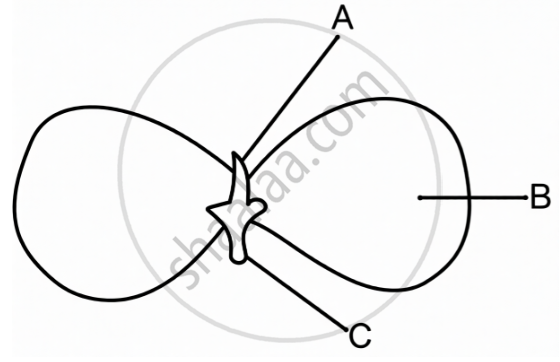
Concept: undefined >> undefined
The correct sequence of reproductive stages occurring in flowering plants is ______.
Concept: undefined >> undefined
The part of a seed which grows and develops into root on germination is :
(a) cotyledon
(b) plumule
(c) follicle
(d) radicle
Concept: undefined >> undefined
The flask-shaped organ A at the centre of a flower is surrounded by a number of little stalks B having swollen tops which lie just inside the ring of petals.
(a) Name A. What are the various parts of A?
(b) Which part of A contains gametes?
(c) Name B. What is the swollen top of B known as?
(d) What does the swollen top of b contain?
(e) Out of A and B, which one is (i) male part, and (ii) female part of the flower?
Concept: undefined >> undefined
