Please select a subject first
Advertisements
Advertisements
A coil of 100 turns, each of area 0.02m2 is kept in a uniform field of induction 3.5 x10⁻⁵ T. If the coil rotates with a speed of 6000 r.p.m. about an axis in the plane of the coil and perpendicular to the magnetic induction, calculate peak value of e.m.f. induced in the coil.
Concept: Coil Rotating in Uniform Magnetic Induction
Six capacitors of capacities 5, 5. 5, 5, 10 and X μ F are connected as shown in the network in the diagram.
Find :
- The value of X if the network is balanced, and
- The resultant capacitance between A and C.
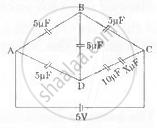
Concept: Inductance and Capacitance
An A.C. circuit consists of inductor of inductance 125 mH connected in parallel with a capacitor of capacity 50 μF. Determine the resonant frequency.
Concept: Resonant Circuits
A solenoid of length 1.5 m and 4 cm in diameter possesses 10 turns per metre. A current of 5 A is flowing through it. The magnetic induction at a point inside the solenoid along the axis is ............................. .
(μ0 = 4π × 10-7 Wb/Am)
- π × 10-5 T
- 2π × 10-5 T
- 3π × 10-5 T
- 4π × 10-5 T
Concept: Introduction to Electromagnetic Induction
Colour of light emitted by LED depends upon__________________ .
- its forward bias
- its reverse bias
- the band gap of the material of semiconductor
- its size
Concept: Special Purpose P-n Junction Diodes
Explain the phenomenon of self induction
Concept: Inductance >> Self Inductance
Reactance of a coil is 157 Ω. On connecting the coil across a source of frequency 100 Hz, the current lags behind e.m.f. by 45°. The inductance of the coil is ...........
(a) 0·25 H
(b) 0·5 H
(c) 4 H
(d) 314H
Concept: Reactance and Impedance
A metal rod `1/sqrtpi `m long rotates about one of its ends perpendicular to a plane whose magnetic induction is 4 x 10⁻³ T. Calculate the number of revolutions made by the rod per second if the e.m.f. induced between the ends of the rod is 16 mV.
Concept: Introduction to Electromagnetic Induction
If A.C. voltage is applied to a pure capacitor, then voltage across the capacitor _____________.
Concept: Inductance and Capacitance
The magnetic flux through a loop is varying according to a relation `phi = 6t^2 + 7t + 1` where `phi` is in milliweber and t is in second. What is the e.m.f. induced in the loop at t = 2 second?
Concept: Introduction to Electromagnetic Induction
Explain self induction and mutual induction
Concept: Inductance >> Mutual Inductance
Three capacitors of capacities 8 μF, 8 μF and 4 μF are connected in a series and potential difference of 120 volt is maintained across the combination. Calculate the charge on capacitor of capacity 4 μF.
Concept: Reactance and Impedance
Derive an expression for e.m.f. and current in terms of turns ratio
Concept: Transformers
In series LCR circuit at resonance, phase difference between current and e.m.f. of source is ______.
(A) `pi` rad
(B) `pi/2` rad
(C) `pi/4` rad
(D) zero rad
Concept: Resonant Circuits
Prove theoretically (electromagnetic induction) `e = (dphi)/(dt)`
Concept: Introduction to Electromagnetic Induction
Obtain an expression for the induced e.m.f. in a coil rotating with uniform angular velocity in
uniform magnetic field. Plot a graph of variation of induced e.m.f. against phase (Θ = ωt) over one cycle.
Concept: Coil Rotating in Uniform Magnetic Induction
If ‘R’ is the radius of dees and ‘B’ be the magnetic field of induction in which positive charges (q) of mass (m) escape from the cyclotron, then its maximum speed (vmax) is _______.
A) `(qR)/(Bm)`
B)`(qm)/(Br)`
C) `(qBR)/m`
D) `m/(qBR)`
Concept: Introduction to Electromagnetic Induction
The width of depletion region of p-n junction diode is _______.
(A) 0.5 nm to 1 nm
(B) 5 nm to 10 nm
(C) 50 nm to 500 nm
(D) 500 nm to 1000 nm
Concept: Special Purpose P-n Junction Diodes
A transformer converts 240 V AC to 60 V AC. The secondary has 75 turns. The number of turns in primary are _______.
(A) 600
(B) 500
(C) 400
(D) 300
Concept: Transformers
State its any ‘two’ uses of photodiode.
Concept: Special Purpose P-n Junction Diodes
