Advertisements
Advertisements
Define the term 'amplitude modulation'
Concept: Amplitude Modulation (AM)
Explain any two factors which justify the need for modulating a low frequency base-band signal.
Concept: Amplitude Modulation (AM)
(a) Derive an expression for the electric field E due to a dipole of length '2a' at a point distant r from the centre of the dipole on the axial line.
(b) Draw a graph of E versus r for r >> a.
(c) If this dipole were kept in a uniform external electric field E0, diagrammatically represent the position of the dipole in stable and unstable equilibrium and write the expressions for the torque acting on the dipole in both the cases.
Concept: Electric Lines of Force
An infinitely large thin plane sheet has a uniform surface charge density +σ. Obtain the expression for the amount of work done in bringing a point charge q from infinity to a point, distant r, in front of the charged plane sheet.
Concept: Uniformly Charged Infinite Plane Sheet and Uniformly Charged Thin Spherical Shell (Field Inside and Outside)
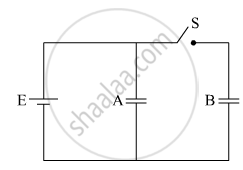
Two identical parallel plate capacitors A and B are connected to a battery of V volts with the switch S closed. The switch is now opened and the free space between the plates of the capacitors is filled with a dielectric of dielectric constant K. Find the ratio of the total electrostatic energy stored in both capacitors before and after the introduction of the dielectric.
Concept: Capacitors and Capacitance
Draw a plot of potential energy of a pair of nucleons as a function of their separation.
what is the significance of negative potential energy in the graph drawn?
Concept: Conductors and Insulators Related to Electric Field
Find the condition under which the charged particles moving with different speeds in the presence of electric and magnetic field vectors can be used to select charged particles of a particular speed.
Concept: Motion in a Magnetic Field
Two identical circular coils, P and Q each of radius R, carrying currents 1 A and √3A respectively, are placed concentrically and perpendicular to each other lying in the XY and YZ planes. Find the magnitude and direction of the net magnetic field at the centre of the coils.
Concept: Magnetic Field on the Axis of a Circular Current Loop
Can a galvanometer as such be used for measuring the current? Explain.
Concept: Moving Coil Galvanometer
A circular coil of cross-sectional area 200 cm2 and 20 turns is rotated about the vertical diameter with angular speed of 50 rad s−1 in a uniform magnetic field of magnitude 3.0 × 10⁻²T. Calculate the maximum value of the current in the coil.
Concept: Electromagnetic Induction
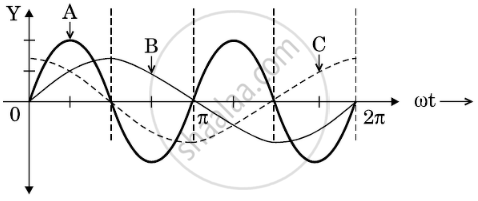
A device 'X' is connected to an ac source V = V0 sin ωt. The variation of voltage, current and power in one cycle is shown in the following graph:
(a) Identify the device 'X'.
(b) Which of the curves A, B and C represent the voltage , current and the power consumed in the circuit? Justify your answer.
(c) How does its impedance vary with frequency of the ac source? Show graphically.
(d) Obtain an expression for the current in the circuit and its phase relation with ac voltage.
Concept: Different Types of AC Circuits: AC Voltage Applied to a Resistor
Name the phenomenon which shows the quantum nature of electromagnetic radiation.
Concept: Electromagnetic Spectrum
A double convex lens is made of a glass of refractive index 1.55, with both faces of the same radius of curvature. Find the radius of curvature required, if the focal length is 20 cm.
Concept: Reflection of Light by Spherical Mirrors
Draw the intensity pattern for single slit diffraction.
Concept: Diffraction of Light >> Seeing the Single Slit Diffraction Pattern
Draw the intensity pattern for double slit interference.
Concept: Diffraction of Light >> Seeing the Single Slit Diffraction Pattern
State differences between interference and diffraction patterns.
Concept: Diffraction of Light >> Seeing the Single Slit Diffraction Pattern
Unpolarised light is passed through a polaroid P1. When this polarised beam passes through another polaroid P2 and if the pass axis of P2 makes angle θ with the pass axis of P1, then write the expression for the polarised beam passing through P2. Draw a plot showing the variation of intensity when θ varies from 0 to 2π.
Concept: Polarisation
Use Huygens' principle to verify the laws of refraction.
Concept: Huygens' Principle
How is linearly polarised light obtained by the process of scattering of light. Find the Brewster angle for air – glass interface, when the refractive index of glass = 1.5.
Concept: Plane Polarised Light
How does one explain the emission of electrons from a photosensitive surface with the help of Einstein's photoelectric equation?
Concept: Electron Emission
