Advertisements
Advertisements
An element X (molar mass = 60 g mol−1) has a density of 6.23 g cm−3. Identify the type of cubic unit cell, if the edge length of the unit cell is 4 ✕ 10−8 cm.
Concept: Oxidation Reduction
How would you account the following :
Transition metals and their compounds show catalytic properties.
Concept: Reactions of Haloarenes - Reaction with Metals
Account for the following :
Reducing character decreases from SO2 to TeO2.
Concept: Oxidation Reduction
Outline the principles behind the refining of metals by the following methods:
Zone refining method
Concept: Refining of Crude Metals
Outline the principles behind the refining of metals by the following methods:
Chromatographic method
Concept: Refining of Crude Metals
Write the principle behind the following methods of refining:
Vapour-phase refining
Concept: Refining of Crude Metals
Write the product formed on reaction of D-glucose with Br2 water.
Concept: Reactions of Haloarenes - Nucleophilic Substitution
Write the principles of the following methods :
Froth floatation method
Concept: Types of Separation or Concentration of an Ore >> Froth Floatation Method
Write down the reaction taking place in blast furnace related to the metallurgy of iron in the temperature rnge 500 K – 800 K. What is the role of limestone in the metallurgy of iron?
Concept: Refining of Crude Metals
What happens when Copper matte is charged into silica lined converter and hot air blast is blown?
Concept: Refining of Crude Metals
Write chemical equation in support of your answer.
Out of  Cl and
  CH2- Cl, which one is more reactive towards nucleophilic substitution reaction and why?
Concept: Reactions of Haloarenes - Nucleophilic Substitution
Name the method of refining which is Used to obtain semiconductor of high purity.
Concept: Refining of Crude Metals
Name the method of refining which is Used to obtain low boiling metal.
Concept: Refining of Crude Metals
Write chemical reactions taking place in the extraction of copper from Cu2 S.
Concept: Application of Thermodynamic Principles of Metallurgy
Why dextro and laevorotatory isomers of Butan-2-ol are difficult to separate by fractional distillation?
Concept: Physical Properties of Haloalkanes and Haloarenes
complete the following reaction:
\[\ce{(C6H5CH2)2Cd + 2CH3COCl}\]
Concept: Nomenclature of Haloalkanes and Haloarenes
Answer the following question.
Write one stereochemical difference between SN1 and SN2 reactions.
Concept: Reactions of Haloalkanes - Nucleophilic Substitution Reactions
How will you convert the following:
Zinc blende to Zinc metal
Concept: Application of Thermodynamic Principles of Metallurgy
How will you convert the following:
[Ag(CN)2]− to Ag
Concept: Occurrence of Metals
Write the structure of main compounds A and B in the following reaction: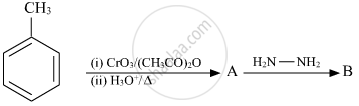
Concept: Reactions of Haloalkanes - Reaction with Metals
