Please select a subject first
Advertisements
Advertisements
Read the following passage and answer the questions given below.
|
A shopkeeper sells three types of flower seeds A1, A2, A3. They are sold is the form of a mixture, where the proportions of these seeds are 4:4:2 respectively. The germination rates of the three types of seeds are 45%, 60% and 35% respectively.
|

Based on the above information:
- Calculate the probability that a randomly chosen seed will germinate.
- Calculate the probability that the seed is of type A2, given that a randomly chosen seed germinates.
Concept: Bayes’ Theorem
If the sum of numbers obtained on throwing a pair of dice is 9, then the probability that number obtained on one of the dice is 4, is ______.
Concept: Conditional Probability
If for any two events A and B, P(A) = `4/5` and P(A ∩ B) = `7/10`, then `P(B/A)` is equal to ______.
Concept: Conditional Probability
Read the following passage:
|
Recent studies suggest the roughly 12% of the world population is left-handed.
Assuming that P(A) = P(B) = P(C) = P(D) = `1/4` and L denotes the event that child is left-handed. |

Based on the above information, answer the following questions:
- Find `P(L/C)` (1)
- Find `P(overlineL/A)` (1)
- (a) Find `P(A/L)` (2)
OR
(b) Find the probability that a randomly selected child is left-handed given that exactly one of the parents is left-handed. (2)
Concept: Conditional Probability
In answering a question on a multiple choice test, a student either knows the answer or guesses. Let `3/5` be the probability that he knows the answer and `2/5` be the probability that he guesses. Assuming that a student who guesses at the answer will be correct with probability `1/3`. What is the probability that the student knows the answer, given that he answered it correctly?
Concept: Bayes’ Theorem
What is the purpose of Rikli and Jones fitness test? Explain the procedure of any two test items in detail.
Concept: Rikli and Jones Senior Citizen Fitness Test
Elucidate any four types of fractures.
Concept: Causes, Prevention, and Treatment of Hard Tissue Injuries
With the help of suitable examples, discuss the application of Newton’s Laws of Motion in sports.
Concept: Application of Newton's First Law of Motion (Law of Inertia) in Sports
Assertion (A): Aggression is part of human behaviour and is necessary for an individual to live and struggle for higher achievements.
Reason (R): Aggression is inevitable and inseparable in sport activities.
In the context of the above two statements, which one of the following is correct?
Concept: Aggression in Sports
Define strength.
Concept: Strength and Its Classification
List down the types of flexibility.
Concept: Types of Flexibility
What is the electric flux through a cube of side 1 cm which encloses an electric dipole?
Concept: Electric Flux
An electric dipole of dipole moment`vecp` consists of point charges +q and −q separated by a distance 2a apart. Deduce the expression for the electric field `vecE` due to the dipole at a distance x from the centre of the dipole on its axial line in terms of the dipole moment `vecp`. Hence show that in the limit x>> a, `vecE->2vecp"/"(4piepsilon_0x^3)`
Concept: Electric Dipole
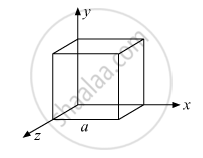
Given the electric field in the region `vecE=2xhati`, find the net electric flux through the cube and the charge enclosed by it.
Concept: Electric Flux
Deduce the expression for the torque acting on a dipole of dipole moment `vecp` in the presence of a uniform electric field `vecE`
Concept: Dipole in a Uniform External Field
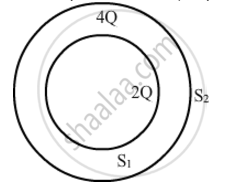
Consider two hollow concentric spheres, S1 and S2, enclosing charges 2Q and 4Q respectively as shown in the figure. (i) Find out the ratio of the electric flux through them. (ii) How will the electric flux through the sphere S1 change if a medium of dielectric constant 'εr' is introduced in the space inside S1 in place of air ? Deduce the necessary expression
Concept: Electric Flux
Define electric dipole moment. Is it a scalar or a vector? Derive the expression for the electric field of a dipole at a point on the equatorial plane of the dipole.
Concept: Electric Dipole
Define capacitor reactance. Write its S.I units.
Concept: Capacitors and Capacitance
Two capacitors of unknown capacitances C1 and C2 are connected first in series and then in parallel across a battery of 100 V. If the energy stored in the two combinations is 0.045 J and 0.25 J respectively, determine the value of C1 and C2. Also calculate the charge on each capacitor in parallel combination.
Concept: Combination of Capacitors
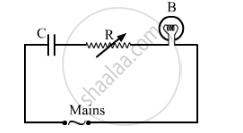
A capacitor 'C', a variable resistor 'R' and a bulb 'B' are connected in series to the ac mains in circuit as shown. The bulb glows with some brightness. How will the glow of the bulb change if (i) a dielectric slab is introduced between the plates of the capacitor, keeping resistance R to be the same; (ii) the resistance R is increased keeping the same capacitance?
Concept: Combination of Capacitors
