CBSE Science (English Medium) Class 12 Important Questions for Physics - Wave Optics
Advertisements
Advertisements
Chapter wise important questions with answers and solutions for Physics in CBSE Science (English Medium) Class 12.
How does an unpolarized light incident on a polaroid get polarized? Describe briefly, with the help of a necessary diagram, the polarization of light by reflection from a transparent medium.
Chapter: [10] Wave Optics
Two polaroids ‘A’ and ‘B’ are kept in crossed position. How should a third polaroid ‘C’ be placed between them so that the intensity of polarized light transmitted by polaroid B reduces to 1/8th of the intensity of unpolarized light incident on A?
Chapter: [10] Wave Optics
What is the effect on the interference fringes to a Young’s double slit experiment when
(i) the separation between the two slits is decreased?
(ii) the width of a source slit is increased?
(iii) the monochromatic source is replaced by a source of white light?
Justify your answer in each case.
Chapter: [10] Wave Optics
The intensity at the central maxima in Young’s double slit experimental set-up is I0. Show that the intensity at a point where the path difference is λ/3 is I0/4.
Chapter: [10] Wave Optics
Write the conditions on path difference under which constructive interference occurs in Young’s double-slit experiment.
Chapter: [10] Wave Optics
In a single slit diffraction experiment, the width of the slit is increased. How will the
- size and
- intensity
of central bright band be affected? Justify your answer.
Chapter: [10] Wave Optics
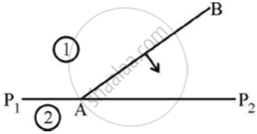
A plane wave front AB propagating from denser medium (1) into a rarer medium (2) is incident on the surface P1P2 separating the two media as shown in fig.
Using Huygen’s principle, draw the secondary wavelets and obtain the refracted wave front in the diagram.
Chapter: [10] Wave Optics
In Young's double slit experiment using light of wavelength 600 nm, the slit separation is 0.8 mm and the screen is kept 1.6 m from the plane of the slits. Calculate
- the fringe width
- the distance of (a) third minimum and (b) fifth maximum, from the central maximum.
Chapter: [10] Wave Optics
According to Huygens’s principle, the amplitude of secondary wavelets is ______.
Chapter: [10] Wave Optics
Draw the sketches to differentiate between plane wavefront and spherical wavefront.
Chapter: [10] Wave Optics
The intensity at the central maxima in Young’s double slit experiment is I0. Find out the intensity at a point where the path difference is` lambda/6,lambda/4 and lambda/3.`
Chapter: [10] Wave Optics
In young’s double slit experiment, deduce the conditions for obtaining constructive and destructive interference fringes. Hence, deduce the expression for the fringe width.
Chapter: [10] Wave Optics
Show that the fringe pattern on the screen is actually a superposition of slit diffraction from each slit.
Chapter: [10] Wave Optics
Monochromatic light of wavelength 589 nm is incident from air on a water surface. What are the wavelength, frequency and speed of (a) reflected and (b) refracted light? Refractive index of water is 1.33.
Chapter: [10] Wave Optics
Consider a plane wave front incident on a thin convex lens. Draw a proper diagram to show how the incident wave front traverses through the lens and after refraction focusses on the focal point of the lens, giving the shape of the emergent wave front.
Chapter: [10] Wave Optics
Find the intensity at a point on a screen in Young's double slit experiment where the interfering waves have a path difference of (i) λ/6, and (ii) λ/2.
Chapter: [10] Wave Optics
(i) State the essential conditions for diffraction of light.
(ii) Explain diffraction of light due to a narrow single slit and the formation of pattern of fringes on the screen.
(iii) Find the relation for width of central maximum in terms of wavelength 'λ', width of slit 'a', and separation between slit and screen 'D'.
(iv) If the width of the slit is made double the original width, how does it affect the size and intensity of the central band?
Chapter: [10] Wave Optics
How does the refractive index of a transparent medium depend on the wavelength of incident light used ?
Chapter: [10] Wave Optics
Why cannot two independent monochromatic sources produce sustained interference pattern?
Deduce, with the help of Young's arrangement to produce interference pattern, an expression for the fringe width.
Chapter: [10] Wave Optics
A parallel beam of light of wavelength 500 nm falls on a narrow slit and the resulting diffraction pattern is observed on a screen 1 m away. It is observed that the first minimum is a distance of 2.5 mm away from the centre. Find the width of the slit.
