Advertisements
Advertisements
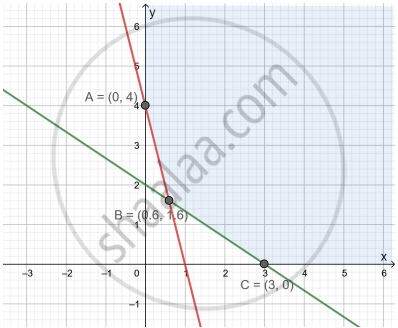
The corner points of the shaded unbounded feasible region of an LPP are (0, 4), (0.6, 1.6) and (3, 0) as shown in the figure. The minimum value of the objective function Z = 4x + 6y occurs at ______.
Concept: Methods to Solve LPP (Graphical / Corner Point Method)
Solve the following Linear Programming Problem graphically:
Maximize Z = 400x + 300y subject to x + y ≤ 200, x ≤ 40, x ≥ 20, y ≥ 0
Concept: Methods to Solve LPP (Graphical / Corner Point Method)
Solve the following linear programming problem graphically:
Minimize: Z = 5x + 10y
Subject to constraints:
x + 2y ≤ 120, x + y ≥ 60, x – 2y ≥ 0, x ≥ 0, y ≥ 0.
Concept: Methods to Solve LPP (Graphical / Corner Point Method)
Solve the following linear programming problem graphically:
Maximize: Z = x + 2y
Subject to constraints:
x + 2y ≥ 100,
2x – y ≤ 0
2x + y ≤ 200,
x ≥ 0, y ≥ 0.
Concept: Methods to Solve LPP (Graphical / Corner Point Method)
Solve the following Linear Programming problem graphically:
Maximize: Z = 3x + 3.5y
Subject to constraints:
x + 2y ≥ 240,
3x + 1.5y ≥ 270,
1.5x + 2y ≤ 310,
x ≥ 0, y ≥ 0.
Concept: Methods to Solve LPP (Graphical / Corner Point Method)
Solve the following Linear Programming Problem graphically:
Minimize: Z = 60x + 80y
Subject to constraints:
3x + 4y ≥ 8
5x + 2y ≥ 11
x, y ≥ 0
Concept: Methods to Solve LPP (Graphical / Corner Point Method)
The feasible region corresponding to the linear constraints of a Linear Programming Problem is given below.

Which of the following is not a constraint to the given Linear Programming Problem?
Concept: Methods to Solve LPP (Graphical / Corner Point Method)
Solve the following Linear Programming Problem graphically:
Minimize: z = x + 2y,
Subject to the constraints: x + 2y ≥ 100, 2x – y ≤ 0, 2x + y ≤ 200, x, y ≥ 0.
Concept: Methods to Solve LPP (Graphical / Corner Point Method)
Solve the following Linear Programming Problem graphically:
Maximize: z = – x + 2y,
Subject to the constraints: x ≥ 3, x + y ≥ 5, x + 2y ≥ 6, y ≥ 0.
Concept: Methods to Solve LPP (Graphical / Corner Point Method)
A speaks truth in 60% of the cases, while B in 90% of the cases. In what percent of cases are they likely to contradict each other in stating the same fact? In the cases of contradiction do you think, the statement of B will carry more weight as he speaks truth in more number of cases than A?
Concept: Independent Events
Assume that the chances of a patient having a heart attack is 40%. Assuming that a meditation and yoga course reduces the risk of heart attack by 30% and prescription of certain drug reduces its chance by 25%. At a time a patient can choose any one of the two options with equal probabilities. It is given that after going through one of the two options, the patient selected at random suffers a heart attack. Find the probability that the patient followed a course of meditation and yoga. Interpret the result and state which of the above stated methods is more beneficial for the patient.
Concept: Conditional Probability
In a game, a man wins Rs 5 for getting a number greater than 4 and loses Rs 1 otherwise, when a fair die is thrown. The man decided to thrown a die thrice but to quit as and when he gets a number greater than 4. Find the expected value of the amount he wins/loses
Concept: Conditional Probability
A bag contains 4 balls. Two balls are drawn at random (without replacement) and are found to be white. What is the probability that all balls in the bag are white?
Concept: Independent Events
A die is thrown three times. Events A and B are defined as below:
A : 5 on the first and 6 on the second throw.
B: 3 or 4 on the third throw.
Find the probability of B, given that A has already occurred.
Concept: Conditional Probability
40% students of a college reside in hostel and the remaining reside outside. At the end of the year, 50% of the hostelers got A grade while from outside students, only 30% got A grade in the examination. At the end of the year, a student of the college was chosen at random and was found to have gotten A grade. What is the probability that the selected student was a hosteler ?
Concept: Conditional Probability
A bag X contains 4 white balls and 2 black balls, while another bag Y contains 3 white balls and 3 black balls. Two balls are drawn (without replacement) at random from one of the bags and were found to be one white and one black. Find the probability that the balls were drawn from bag Y.
Concept: Conditional Probability
Evaluate P(A ∪ B), if 2P(A) = P(B) = `5/13` and P(A | B) = `2/5`
Concept: Conditional Probability
A fair coin and an unbiased die are tossed. Let A be the event ‘head appears on the coin’ and B be the event ‘3 on the die’. Check whether A and B are independent events or not.
Concept: Independent Events
A manufacturer has three machine operators A, B and C. The first operator A produces 1% defective items, where as the other two operators B and C produce 5% and 7% defective items respectively. A is on the job for 50% of the time, B is on the job for 30% of the time and C is on the job for 20% of the time. A defective item is produced, what is the probability that was produced by A?
Concept: Bayes’ Theorem
The probabilities of solving a specific problem independently by A and B are `1/3` and `1/5` respectively. If both try to solve the problem independently, find the probability that the problem is solved.
Concept: Independent Events
