Please select a subject first
Advertisements
Advertisements
Calculate Autonomous Consumption Expenditure from the following data about an economy which is in equilibrium:
National income = 500
Marginal propensity to save = 0.30
Investment expenditure = 100
Concept: Classification of Expenditure
What is meant by 'excess supply' of a good in a market?
Concept: Market Equilibrium
Explain its chain of effects on the market of that good. Use diagram
Concept: Market Equilibrium
What is the difference between revenue expenditure and capital expenditure? Explain how taxes and government expenditure can be used to influence.
Concept: Classification of Expenditure
Equilibrium price of an essential medicine is too high. Explain what possible steps can be taken to bring down the equilibrium price but only through the market forces. Also explain the series of changes that will occur in the market.
Concept: Equilibrium Price
Answer the following question.
Explain the meaning and implications of the maximum price ceiling and minimum price ceiling.
Concept: Price Ceiling
State whether the following statement is true or false. Give reasons for your answer :
When the equilibrium price is greater than the market price there will be excess supply in the market.
Concept: Equilibrium Price
Answer the following question.
How are capital expenditure different from Revenue expenditure? Discuss briefly.
Concept: Classification of Expenditure
Answer the following question:
The market for a good is in equilibrium. How would an increase in an input price affect the equilibrium price and equilibrium quantity, keeping other factors constant? Explain using a diagram.
Concept: Equilibrium Price
Define "Trade surplus" and "Trade Deficit".
Concept: Types of Budget
Compare the trends depicted in the figures given below:
| Figure 1: Trends in Fiscal deficit and Primary deficit |
Figure 2: Fiscal deficit as a percent of Budget estimate |
 |
 |
Concept: Measures of Government Deficit
‘Under the Ayushmaan Bharat Scheme, the Government provides free medicines to the economically backward section of the society’.
Identify and discuss the nature of the government expenditure indicated in the given statement.
Concept: Classification of Expenditure
On the basis of the given information, calculate the value of:
- Fiscal deficit
- Primary deficit
| S.No. | Items | 2021-22 (₹ in crore) |
| (i) | Revenue Receipts | 20 |
| (ii) | Capital Expenditure | 15 |
| (iii) | Revenue Deficit | 10 |
| (iv) | Non-debt creating capital receipts | 50% of revenue receipts |
| (v) | Interest Payments | 4 |
Concept: Measures of Government Deficit
State any two features of public goods.
Concept: Objectives of Government Budget
Read the following statements carefully:
Statement 1: Export of financial services by India will be recorded on credit side of current account.
Statement 2: Foreign Direct Investments in India will be recorded on credit side of capital account.
In the light of the given statements, choose the correct alternative:
Concept: Concept of Balance of Payments >> Current Account
As per the Reserve Bank of India (RBI) press report, dated 29th December, 2022:
"Net external commercial borrowings to India recorded an outflow of US$ 0.4 billion in the second quarter (2022-23)"
The above transaction will be recorded in the _______ account on ______ side of Balance of payments account of India.
Concept: Concept of Balance of Payments >> Capital Account
Read the following chart carefully and choose the correct alternative:
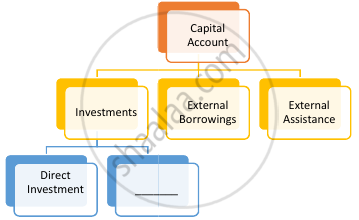
Concept: Concept of Balance of Payments >> Capital Account
‘Current account deficit in an economy must be financed by a corresponding capital account surplus’.
Do you agree with the given statement? Give valid reason(s) in support of your answer.
Concept: Concept of Balance of Payments >> Balance of Payments Surplus and Deficit
Identify the correct reason(s) that may affect the demand for foreign exchange in an economy.
- Imports of visibles
- Exports of invisibles
- Remittances by residents working abroad
- Purchase of assets abroad
Concept: Foreign Exchange Rate
The Last Lesson shows that people suddenly realised how precious their language was to them.
Comment.
Concept: The Last Lesson
