Definitions [7]
An equation of the form ax² + 2hxy + by² = 0 in which the sum of powers of x and y in every term is the same (here 2) is called a homogeneous equation of the second degree.
e.g. 2x² − xy − y² = 0 and 6x² + 5xy − 4y² = 0
Equation of the form ax² + 2hxy + by² + 2gx + 2fy + c = 0 is called a general second-degree equation.
- The necessary conditions for a general second-degree equation to represent a pair of lines are: (i) abc + 2fgh − af² − bg² − ch² = 0, (ii) h² − ab ≥ 0
The sum of the indices of all variables in a term is called the degree of the term.
For \[ax^2+2hxy+by^2=0\]
Slopes of lines are roots of: \[bm^2+2hm+a=0\]
This equation is called the Auxiliary Equation.
An equation representing two lines together is called the combined (joint) equation of the lines.
An equation in which the degree of every term is the same is called a homogeneous equation.
Homogeneous equation of degree 2:
\[ax^2+2hxy+by^2=0\]
Equation of the form \[ax^2+2hxy+by^2+2gx+2fy+c=0\], where at least one of a,b,h is not zero, is called a general second degree equation in x and y.
The expression\[abc+2fgh-af^{2}-bg^{2}-ch^{2}\] is the expansion of the determinant \[\begin{vmatrix}
a & h & g \\
h & b & f \\
g & f & c
\end{vmatrix}\]
Formulae [5]
\[m_1+m_2=-\frac{2h}{b}\]
\[m_1m_2=\frac{a}{b}\]
For equation: ax² + 2hxy + by² = 0
\[\Theta=\tan^{-1}\left\{\frac{2\sqrt{(h^{2}-ab)}}{\mid a+b\mid}\right\}\]
or \[\Theta=\sin^{-1}\left\{\frac{2\sqrt{h^{2}-ab}}{\sqrt{\left(a-b\right)^{2}+4h^{2}}}\right\}\]
or \[\Theta=\cos^{-1}\left\{\frac{|a+b|}{\sqrt{\left(a-b\right)^{2}+4h^{2}}}\right\}\]
\[\frac{x^2-y^2}{a-b}=\frac{xy}{h}\]
\[\tan\theta=\frac{2\sqrt{h^2-ab}}{a+b}\]
If \[ax^2+2hxy+by^2=0\]
Then slopes are:
\[m_1=\frac{-h-\sqrt{h^2-ab}}{b}\]
\[m_2=\frac{-h+\sqrt{h^2-ab}}{b}\]
Their sum is m1 + m2 = \[-\frac{2h}{b}\]
product is m1 m2 = \[\frac{a}{b}\]
Theorems and Laws [1]
Prove that the acute angle θ between the lines represented by the equation ax2 + 2hxy+ by2 = 0 is tanθ = `|(2sqrt(h^2 - ab))/(a + b)|` Hence find the condition that the lines are coincident.
Let m1 and m2 be slopes of lines represented by the equation
ax2 + 2hxy + by2 = 0.
∴ `m_1 + m_2 = (-2h)/b and m_1 m_2 = a/b`
∴ `(m_1 - m_2)^2 = (m_1 + m_2)^2 - 4m_1 m_2`
= `((2h)/b)^2 - 4(a/b)`
= `(4h^2)/b^2 - (4a)/b`
= `(4h^2 - 4ab)/b^2`
= `(4(h^2 - ab))/b^2`
∴ `m_1 - m_2 = ± (2sqrt(h^2 - ab))/b`
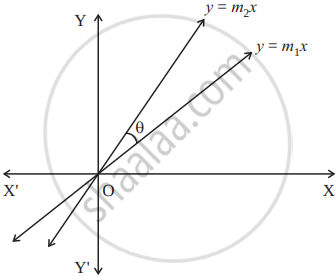
As θ is the acute angle between the lines, then:
`tan theta = |(m_1 - m_2)/(1 + m_1m_2)|`
`= |((2sqrt(h^2 - ab))/(b))/(1 + a/b)|`
`tan theta = |(2sqrt(h^2 - ab))/(a + b)|`
Now, if the lines are coincident,
then θ = 0
tan θ = 0
Lines represented by ax2 + 2hxy + by2 = 0 are coincident if and only if m1 = m2
∴ m1 - m2 = 0
∴ `(2sqrt(h^2 - ab))/b = 0`
∴ `h^2 - ab = 0`
∴ `h^2 = ab`
Lines represented by ax2 + 2hxy + by2 = 0 are coincident if and only if h2 = ab.
Key Points
| General Equation | Combined equation of a pair of lines through the origin | Combined equation of a pair of lines not passing through the origin |
|---|---|---|
| ax² + 2hxy + by² = 0 | ax² + 2hxy + by² + 2gx + 2fy + c = 0 | |
| Necessary Conditions for Real Lines | h² − ab ≥ 0 | \[\begin{vmatrix} \mathrm{a} & \mathrm{h} & \mathrm{g} \\ \mathrm{h} & \mathrm{b} & \mathrm{f} \\ \mathrm{g} & \mathrm{f} & \mathrm{c} \end{vmatrix}=0,\] h² − ab ≥ 0 |
| Point of intersection | (0, 0) | \[\left(\frac{\mathrm{hf-bg}}{\mathrm{ab-h^2}},\frac{\mathrm{gh-af}}{\mathrm{ab-h^2}}\right)\] |
| Angle between the lines | \[\tan\theta=\left|\frac{2\sqrt{\mathrm{h}^2-\mathrm{ab}}}{\mathrm{a}+\mathrm{b}}\right|\] | \[\tan\theta=\left|\frac{2\sqrt{\mathrm{h}^{2}-\mathrm{ab}}}{\mathrm{a}+\mathrm{b}}\right|\] |
| For parallel (coincident) lines | h² − ab = 0 | h² − ab = 0, bg² = af², \[\frac{\mathrm{a}}{\mathrm{h}}=\frac{\mathrm{h}}{\mathrm{b}}=\frac{\mathrm{g}}{\mathrm{f}}\] |
| For perpendicular lines | a + b = 0 | a + b = 0 |
| Condition | Nature |
|---|---|
| h² − ab > 0 | Real and distinct lines |
| h² − ab = 0 | Coincident lines |
| h² − ab < 0 | Imaginary lines |
Lines are perpendicular if: a + b = 0
Lines are parallel (coincident) if: h² = ab
Perpendicular Pair:
- Equation: bx² − 2hxy + ay² = 0
Parallel Lines through (x₁, y₁):
- Equation: a(x − x₁)² + 2h(x − x₁)(y − y₁) + b(y − y₁)² = 0
| Condition | Type of Lines |
|---|---|
| \[\Delta=0,h^2>ab\] | Intersecting lines |
| \[\Delta=0,h^2 = ab\] | Coincident lines |
| \[\Delta=0,h^2<ab\] | Imaginary lines |
| (\[\Delta=0,h^2=ab\] and \[bg^{2}=af^{2}\] | Parallel lines |
| Condition | Nature |
|---|---|
| \[h^2-ab>0\] | Distinct lines |
| \[h^2-ab=0\] | Coincident lines |
| \[h^2-ab<0\] | Not a pair of lines |
| Sr. No. | Condition Type | Mathematical Condition | Additional Result |
|---|---|---|---|
| 1 | Perpendicular Lines | a + b = 0 | Lines are perpendicular |
| 2 | Parallel Lines | \[h^2-ab=0\] | Lines are parallel |
| 3 | Intersecting Lines | \[h^2-ab\geq0\] | Point of intersection is \[\left(\frac{hf-bg}{ab-h^2},\frac{gh-af}{ab-h^2}\right)\] |
Important Questions [16]
- Write the separate equations of lines represented by the equation 5x2 – 9y2 = 0
- Find the combined equation of the following pair of lines: 2x + y = 0 and 3x − y = 0
- Write the joint equation of co-ordinate axes.
- Find the joint equation of the line passing through the origin having slopes 2 and 3.
- If one of the lines given by ax2 + 2hxy + by2 = 0 bisects an angle between the coordinate axes, then show that (a + b)2 = 4h2.
- Find the value of k. if 2x + y = 0 is one of the lines represented by 3x2 + kxy + 2y2 = 0
- Find k, if the sum of the slopes of the lines represented by x^2 + kxy – 3y^2 = 0 is twice their product.
- Prove that the acute angle θ between the lines represented by the equation ax2 + 2hxy+ by2 = 0 is tanθ = |2h2-aba+b| Hence find the condition that the lines are coincident.
- Find the value of k if the lines represented by kx2 + 4xy – 4y2 = 0 are perpendicular to each other.
- Show that the difference between the slopes of the lines given by (tan2θ + cos2θ)x2 - 2xy tan θ + (sin2θ)y2 = 0 is two.
- If the angle between the lines represented by ax2 + 2hxy + by2 = 0 is equal to the angle between the lines 2x2 − 5xy + 3y2 = 0, then show that 100(h2 − ab) = (a + b)2
- If ax2 + 2hxy + by2 = 0 represents a pair of lines and h2 = ab ≠ 0 then find the ratio of their slopes.
- If θ is the acute angle between the lines represented by ax2 + 2hxy + by2 = 0 then prove that tan θ = |2h2-aba+b|
- Find p and q if the equation px2 – 8xy + 3y2 + 14x + 2y + q = 0 represents a pair of prependicular lines.
- Equation of line passing through the points (0, 0, 0) and (2, 1, –3) is ______.
- Find the coordinates of the points of intersection of the lines represented by x2 − y2 − 2x + 1 = 0
