Definitions [33]
When we have the values of f near x to the right of a i.e.
\[\lim_{x\to a^{+}}f\left(x\right)\] is the expected value of f at x = a.
If f(x) approaches a real number l, when x approaches a, then l is called the limit of f(x).
Symbolically, \[\lim_{x\to a}f\left(x\right)=l\]
When we have the values of f near x to the left of a, i.e.
\[\lim_{x\to a^{-}}f\left(x\right)\] is the expected value of f at x = a.
A real-valued function \[f\] is said to be continuous at \[x = c\] if
\[ \boxed{\lim_{x \to c} f(x) = f(c)} \]
In terms of one-sided limits,
\[ \boxed{\lim_{x \to c^-} f(x) = \lim_{x \to c^+} f(x) = f(c)} \]
Thus, for continuity at \[x = c\]:
- \[f(c)\] must be defined.
- Left-hand limit must exist.
- Right-hand limit must exist.
- Both limits must be equal to \[f(c)\]
If any of these conditions fails, \[f\] is discontinuous at \[x = c\].
A real function \[f\] is said to be a continuous function if it is continuous at every point in its domain.
\[ \boxed{\lim_{x \to c} f(x) = f(c)} \] for every \[c\] in the domain of \[f\].
Continuity at End Points
If \[f\] is defined on a closed interval \[[a, b]\]:
At the left endpoint \[a\], \[ \boxed{\lim_{x \to a^+} f(x) = f(a)} \]
At the right endpoint \[b\], \[ \boxed{\lim_{x \to b^-} f(x) = f(b)} \]
Only the appropriate one-sided limit is considered at an endpoint.
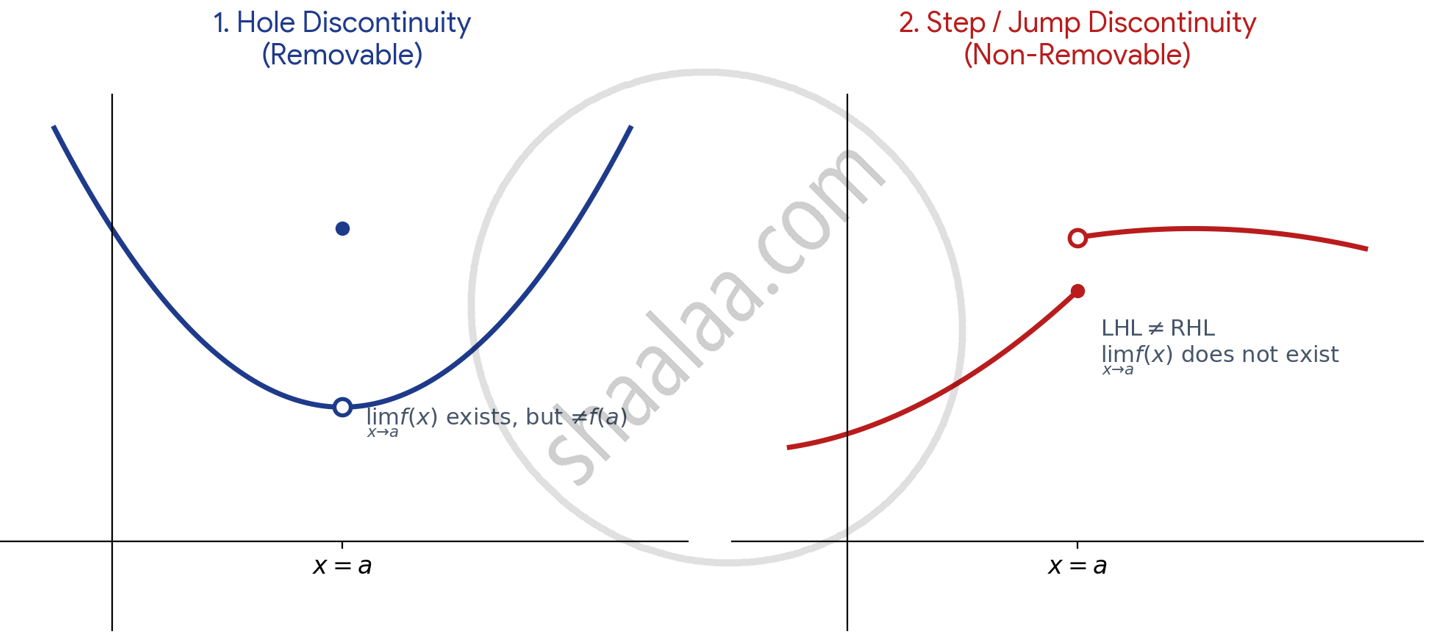
A function f(x) is said to be discontinuous at x = a if it is not continuous at x = a, i.e.
- \[\lim_{x\to a}f\left(a\right)\] does not exist.
- The left-hand limit and the right-hand limit are not equal.
- \[\lim_{x\to a}f\left(x\right)\neq f\left(a\right)\].
Removable Discontinuity:
If \[\lim_{x\to a^{-}}f\left(x\right)=\lim_{x\to a^{+}}f\left(x\right)\neq f\left(a\right),\] then f(x) is said to be removable discontinuous.
Non Removable Discontinuity:
If \[\lim_{x\to a^{+}}f\left(x\right)\neq\lim_{x\to a^{-}}f\left(x\right),\] then f(x) is said to be non-removable discontinuous.
A function is differentiable on an open interval (a,b) if it is differentiable at every point of (a,b).
For a closed interval [a,b][a,b]:
- at a, the right-hand derivative is considered
- at b, the left-hand derivative is considered
The derivative of a real function f at a point c in its domain is defined as:
\[f'(c) = \lim_{h \to 0} \frac{f(c+h) - f(c)}{h}\]
Let \[f\] be a real-valued function which is a composite of two functions \[u\] and \[v\]; i.e., \[f = v \circ u\]. Suppose \[t = u(x)\] and if both \[\frac{dt}{dx}\]and \[\frac{dv}{dt}\]exist, we have
\[ \boxed{\dfrac{df}{dx} = \dfrac{dv}{dt} \cdot \dfrac{dt}{dx}} \]
For example, if \[ f = w \circ v \circ u, \]
then the derivative is obtained by multiplying the successive derivatives.
\[ \boxed{\dfrac{df}{dx} = \dfrac{dw}{ds} \cdot \dfrac{ds}{dt} \cdot \dfrac{dt}{dx}} \]
where the intermediate variables represent the nested functions.
If \(u = g(x)\) and \(y = f(u)\), then \(y = f(g(x))\) is called a composite function. Here, \(g(x)\) is the inner function and \(f(u)\) is the outer function.
If a function reverses the action of another function, it is called its inverse function. For example, if \[y = \sin^{-1} x\], then \[x = \sin y\], which means the inverse function converts a trigonometric value back into an angle.
If a function reverses the action of another function, it is called its inverse function. For example, if \[y = \sin^{-1} x\], then \[x = \sin y\], which means the inverse function converts a trigonometric value back into an angle.
A function of the form \[y = b^x\], where b > 0 and \[b \neq 1\], is called an exponential function.
Exponential Growth
For positive values of xx, an exponential function grows much faster than a polynomial function when xx becomes sufficiently large.
For example,
\[ 10^x \] grows faster than \[ x^n \]
for any fixed positive integer n, when x is sufficiently large.
Derivatives of Exponential
\[ \boxed{\dfrac{d}{dx}(e^x) = e^x} \]
If b > 0, \[b \neq 1\], and a > 0, then
This means a logarithm tells the exponent to which the base must be raised to obtain the number.
Derivatives of Logarithmic Functions
\[ \boxed{\dfrac{d}{dx}(\log x) = \dfrac{1}{x}, \qquad x > 0} \]
If b > 0, \[b \neq 1\], and a > 0, then
This means a logarithm tells the exponent to which the base must be raised to obtain the number.
Derivatives of Logarithmic Functions
\[ \boxed{\dfrac{d}{dx}(\log x) = \dfrac{1}{x}, \qquad x > 0} \]
A function of the form \[y = b^x\], where b > 0 and \[b \neq 1\], is called an exponential function.
Exponential Growth
For positive values of xx, an exponential function grows much faster than a polynomial function when xx becomes sufficiently large.
For example,
\[ 10^x \] grows faster than \[ x^n \]
for any fixed positive integer n, when x is sufficiently large.
Derivatives of Exponential
\[ \boxed{\dfrac{d}{dx}(e^x) = e^x} \]
Let \[f\] be a real-valued function which is a composite of two functions \[u\] and \[v\]; i.e., \[f = v \circ u\]. Suppose \[t = u(x)\] and if both \[\frac{dt}{dx}\]and \[\frac{dv}{dt}\]exist, we have
\[ \boxed{\dfrac{df}{dx} = \dfrac{dv}{dt} \cdot \dfrac{dt}{dx}} \]
For example, if \[ f = w \circ v \circ u, \]
then the derivative is obtained by multiplying the successive derivatives.
\[ \boxed{\dfrac{df}{dx} = \dfrac{dw}{ds} \cdot \dfrac{ds}{dt} \cdot \dfrac{dt}{dx}} \]
where the intermediate variables represent the nested functions.
If \(u = g(x)\) and \(y = f(u)\), then \(y = f(g(x))\) is called a composite function. Here, \(g(x)\) is the inner function and \(f(u)\) is the outer function.
Implicit Function
Implicit differentiation means differentiating both sides of an equation with respect to x, while remembering that y depends on x. Therefore, whenever a term containing y is differentiated, the factor \[\frac{dy}{dx}\] appears by the chain rule.
Explicit Function
If a relation between x and y can be easily solved for y and written as \[ y = f(x), \] then y is given as an explicit function of x.
When x and y are expressed separately as functions of the same third variable t, i.e. \[ x = f(t), \qquad y = g(t), \] the equations are called parametric equations, and t is called the parameter.
The parameter may also be denoted by \[\theta, u,\] etc.
Important Condition
The formula \[ \frac{dy}{dx} = \frac{dy/dt}{dx/dt} \] is directly applicable when
\[ \boxed{\frac{dx}{dt} \neq 0.} \]
If \[ \frac{dx}{dt} = 0, \] the point must be examined separately. It may correspond to a point where the tangent is vertical.
Let \[ y = f(x) \]
Then the first derivative of y with respect to x is \[ \frac{dy}{dx} = f'(x) \]
If f'(x) is differentiable, we differentiate it again with respect to x. Thus,
\[ \boxed{\frac{d^2y}{dx^2} = \frac{d}{dx}\left(\frac{dy}{dx}\right)} \]
This is called the second order derivative of y with respect to x.
The second derivative of f(x) may also be written as
\[ \boxed{f''(x), \quad y'', \quad y_2, \quad D^2y} \]
Higher order derivatives are obtained by differentiating successively.
Evaluating the derivative at a specific point, \[\left.\frac{dy}{dx}\right|_{x=x_0}\], gives the instantaneous rate of change at exactly \[x = x_0\].
If a quantity y varies with another quantity x based on a rule y = f(x), then the derivative \[\frac{dy}{dx}\] (or f'(x)) represents the rate of change of y with respect to x.
If two variables x and y both vary with respect to a third variable t (like time), you can find the rate of change of y with respect to x using:
(Note: This is only valid if \[\frac{dx}{dt} \neq 0\]).
A function f is said to be monotonic in an interval if it is either increasing or decreasing in that interval.
A function f is said to be constant on I if f(x) = c for every x ∈ I, where c is a constant.
Let x₀ be a point in the domain of a real-valued function f.
The function f is said to be increasing at x₀ if there exists an open interval containing x₀ in which f is increasing.
Similarly, f is said to be decreasing at x₀ if there exists an open interval containing x₀ in which f is decreasing.
A function f(x) is said to be an increasing function on (a, b) if x₁ < x₂ ⇒ f(x₁) ≤ f(x₂)
Strictly Increasing Function:
- If x₁ < x₂ ⇒ f(x₁) < f(x₂)
A function f(x) is said to be a decreasing function on (a, b) if x₁ < x₂ ⇒ f(x₁) ≥ f(x₂)
Strictly Decreasing Function:
- If x₁ < x₂ ⇒ f(x₁) > f(x₂)
Let f be a function defined on an interval I.
Maximum value: f has a maximum value at c ∈ I if \[ \boxed{f(c) \geq f(x) \quad \text{for all } x \in I} \]
The value f(c) is called the maximum value and c is called a point of maximum.
Minimum value: f has a minimum value at c ∈ I if \[ \boxed{f(c) \leq f(x) \quad \text{for all } x \in I} \]
The value f(c) is called the minimum value and c is called a point of minimum.
Extreme value: A maximum or minimum value of f is called an extreme value.
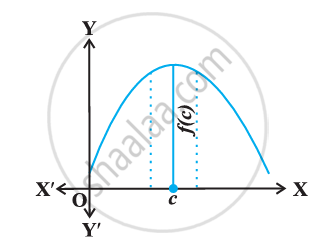
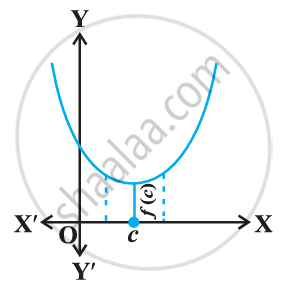
Maximum value Minimum value
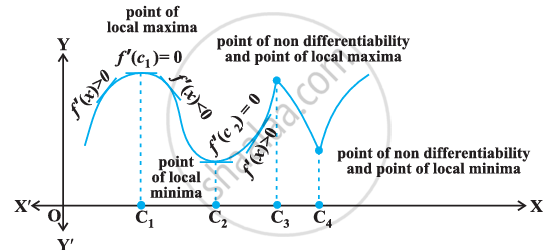
A point in the domain of a function is called a critical point if either the derivative is zero there or the derivative does not exist there. Critical points are checked while locating possible maxima or minima.
The points where a function changes from decreasing to increasing or from increasing to decreasing are called turning points.
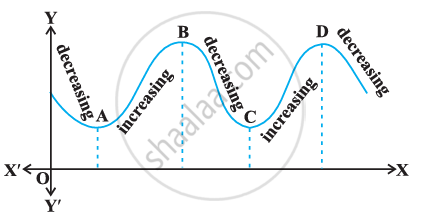
Formulae [6]
1. \[\lim_{x\to0}\frac{\sin x}{x}=1=\lim_{x\to0}\frac{x}{\sin x}\]
2. $$\lim_{x\to0}\frac{\tan x}{x}=1=\lim_{x\to0}\frac{x}{\tan x}$$
3. \[\lim_{x\to0}\frac{\sin^{-1}x}{x}=1=\lim_{x\to0}\frac{x}{\sin^{-1}x}\]
4. \[\lim_{x\to0}\frac{\tan^{-1}x}{x}=1=\lim_{x\to0}\frac{x}{\tan^{-1}x}\]
5. \[\lim_{x\to0}\frac{\sin x^{\circ}}{x}=\frac{\pi}{180}\]
6. \[\lim_{x\to0}\cos x=1\]
7. \[\lim_{x\to0}\frac{\sin\mathrm{k}x}{x}=\lim_{x\to0}\frac{\tan\mathrm{k}x}{x}=\mathrm{k}\]
8. \[\lim_{x\to\infty}\frac{\sin x}{x}=\lim_{x\to\infty}\frac{\cos x}{x}=0\]
9. \[\lim_{x\to\infty}\frac{\sin\left(\frac{1}{x}\right)}{\frac{1}{x}}=1=\lim_{x\to\infty}\frac{\tan\left(\frac{1}{x}\right)}{\frac{1}{x}}\]
10. \[\lim_{x\to a}\frac{\sin\left(x-a\right)}{x-a}=1=\lim_{x\to a}\frac{\tan\left(x-a\right)}{x-a}\]
| Function | Derivative |
|---|---|
| [f(x)]ⁿ | n[f(x)]ⁿ⁻¹ · f′(x) |
| \[\sqrt{\mathrm{f}(x)}\] | \[\frac{1}{2\sqrt{\mathrm{f}(x)}}\cdot\mathrm{f}^{\prime}(x)\] |
| \[\frac{1}{\mathrm{f}(x)}\] | \[-\frac{1}{\left[\mathrm{f}(x)\right]^{2}}\cdot\mathrm{f}^{\prime}(x)\] |
| sin(f(x)) | cos(f(x)) · f′(x) |
| cos(f(x)) | −sin(f(x)) · f′(x) |
| tan(f(x)) | sec²(f(x)) · f′(x) |
| cot(f(x)) | −cosec²(f(x)) · f′(x) |
| sec(f(x)) | sec(f(x)) tan(f(x)) · f′(x) |
| cosec(f(x)) | −cosec(f(x)) cot(f(x)) · f′(x) |
| \[\mathbf{a}^{\mathbf{f}(x)}\] | \[a^{f(x)}\log a\cdot f^{\prime}(x)\] |
| \[\mathrm{e}^{\mathrm{f}(x)}\] | \[ e^{f(x)} f'(x) \] |
| log(f(x)) | \[\frac{1}{\mathrm{f}(x)}\cdot\mathrm{f}^{\prime}(x)\] |
| logₐ(f(x)) | \[\frac{1}{\mathrm{f}(x)\mathrm{loga}}\cdot\mathrm{f}^{\prime}(x)\] |
| Function | Derivative | Condition |
|---|---|---|
| sin⁻¹x | \[\frac{1}{\sqrt{1-x^{2}}}\] | |x| < 1 |
| sin⁻¹(f(x)) | \[\frac{1}{\sqrt{1-\{f\left(x\right)\}^{2}}}\frac{d}{dx}f\left(x\right)\] | |f(x)| < 1 |
| cos⁻¹x | \[-\frac{1}{\sqrt{1-x^{2}}}\] | x| < 1 |
| cos⁻¹(f(x)) | \[-\frac{1}{\sqrt{1-\left\{f\left(x\right)\right\}^{2}}}\frac{d}{dx}f(x)\] | |f(x)| < 1 |
| tan⁻¹x | \[\left(\frac{1}{1+x^{2}}\right)\] | x ∈ R |
| tan⁻¹(f(x)) | \[\frac{1}{1+\left\{f\left(x\right)\right\}^{2}}\frac{d}{dx}f(x)\] | f(x) ∈ R |
| cot⁻¹x | \[-\left(\frac{1}{1+x^{2}}\right)\] | x ∈ R |
| cot⁻¹(f(x)) | \[-\frac{1}{1+\{f(x)\}^{2}}\frac{d}{dx}f(x)\] | f(x) ∈ R |
| sec⁻¹x | \[\frac{1}{|x|\sqrt{x^{2}-1}}\] | |x| > 1 |
| sec⁻¹(f(x)) | \[\frac{1}{|f(x)|\sqrt{\{f(x)\}^{2}-1}}\frac{d}{dx}f(x)\] | |f(x)| > 1 |
| cosec⁻¹x | \[-\left(\frac{1}{|x|\sqrt{x^{2}-1}}\right)\] |
|x| > 1 |
| cosec⁻¹(f(x)) | \[-\frac{1}{|f(x)|\sqrt{\{f(x)\}^{2}-1}}\frac{d}{dx}f(x)\] | |f(x)| > 1 |
| Function | Derivative | Condition |
|---|---|---|
| sin⁻¹x | \[\frac{1}{\sqrt{1-x^{2}}}\] | |x| < 1 |
| sin⁻¹(f(x)) | \[\frac{1}{\sqrt{1-\{f\left(x\right)\}^{2}}}\frac{d}{dx}f\left(x\right)\] | |f(x)| < 1 |
| cos⁻¹x | \[-\frac{1}{\sqrt{1-x^{2}}}\] | x| < 1 |
| cos⁻¹(f(x)) | \[-\frac{1}{\sqrt{1-\left\{f\left(x\right)\right\}^{2}}}\frac{d}{dx}f(x)\] | |f(x)| < 1 |
| tan⁻¹x | \[\left(\frac{1}{1+x^{2}}\right)\] | x ∈ R |
| tan⁻¹(f(x)) | \[\frac{1}{1+\left\{f\left(x\right)\right\}^{2}}\frac{d}{dx}f(x)\] | f(x) ∈ R |
| cot⁻¹x | \[-\left(\frac{1}{1+x^{2}}\right)\] | x ∈ R |
| cot⁻¹(f(x)) | \[-\frac{1}{1+\{f(x)\}^{2}}\frac{d}{dx}f(x)\] | f(x) ∈ R |
| sec⁻¹x | \[\frac{1}{|x|\sqrt{x^{2}-1}}\] | |x| > 1 |
| sec⁻¹(f(x)) | \[\frac{1}{|f(x)|\sqrt{\{f(x)\}^{2}-1}}\frac{d}{dx}f(x)\] | |f(x)| > 1 |
| cosec⁻¹x | \[-\left(\frac{1}{|x|\sqrt{x^{2}-1}}\right)\] |
|x| > 1 |
| cosec⁻¹(f(x)) | \[-\frac{1}{|f(x)|\sqrt{\{f(x)\}^{2}-1}}\frac{d}{dx}f(x)\] | |f(x)| > 1 |
| Function | Derivative |
|---|---|
| [f(x)]ⁿ | n[f(x)]ⁿ⁻¹ · f′(x) |
| \[\sqrt{\mathrm{f}(x)}\] | \[\frac{1}{2\sqrt{\mathrm{f}(x)}}\cdot\mathrm{f}^{\prime}(x)\] |
| \[\frac{1}{\mathrm{f}(x)}\] | \[-\frac{1}{\left[\mathrm{f}(x)\right]^{2}}\cdot\mathrm{f}^{\prime}(x)\] |
| sin(f(x)) | cos(f(x)) · f′(x) |
| cos(f(x)) | −sin(f(x)) · f′(x) |
| tan(f(x)) | sec²(f(x)) · f′(x) |
| cot(f(x)) | −cosec²(f(x)) · f′(x) |
| sec(f(x)) | sec(f(x)) tan(f(x)) · f′(x) |
| cosec(f(x)) | −cosec(f(x)) cot(f(x)) · f′(x) |
| \[\mathbf{a}^{\mathbf{f}(x)}\] | \[a^{f(x)}\log a\cdot f^{\prime}(x)\] |
| \[\mathrm{e}^{\mathrm{f}(x)}\] | \[ e^{f(x)} f'(x) \] |
| log(f(x)) | \[\frac{1}{\mathrm{f}(x)}\cdot\mathrm{f}^{\prime}(x)\] |
| logₐ(f(x)) | \[\frac{1}{\mathrm{f}(x)\mathrm{loga}}\cdot\mathrm{f}^{\prime}(x)\] |
\[\mathrm{f(a+h)\approx f(a)+h~f^{\prime}(a)}\]
Theorems and Laws [14]
If f(x) ≤ g(x) ≤ h(x) and \[\lim_{x\to a}\mathrm{f}(x)=l=\lim_{x\to a}\mathrm{h}(x)\]
\[\therefore\lim_{x\to a}g(x)=l\]
Prove that the function f given by f(x) = |x − 1|, x ∈ R is not differentiable at x = 1.
Any function will not be differentiable if the left-hand limit and the right-hand limit are not equal.
f(x) = |x − 1|, x ∈ R
f(x) = (x − 1), if x − 1 > 0
= −(x − 1), if x − 1 < 0
At x = 1
f(1) = 1 − 1 = 0
left-side limit:
`lim_(h -> 0^-) (f(1 - h) - f(1))/ -h`
= `lim_(h -> 0^-) (1 - (1 - h) - 0)/ (- h)`
= `lim_(h -> 0^-) (+ h)/(- h)`
= −1
Right-side limit:
= `lim_(h -> 0^+) (f(1 + h) - f(1))/h`
= `lim_(h -> 0^+) ((1 + h) - 1 - 0)/ h`
= `lim_(h -> 0^+) h/h`
= 1
Left-side limit and the right-side limit are not equal.
Hence, f(x) is not differentiable at x = 1.
If y = `[(f(x), g(x), h(x)),(l, m,n),(a,b,c)]`, prove that `dy/dx = |(f'(x), g'(x), h'(x)),(l,m, n),(a,b,c)|`.
y = `|(f(x), g(x), h(x)),(l, m, n),(a, b, c)|`
`dy/dx= |(d/dx (f(x)), d/dx (g(x)), d/dx (h(x))), (l, m, n), (a, b, c)| + |(f(x), g(x), h(x)),(0, 0, 0),(a, b, c)| + |(f(x), g(x), h(x)),(l, m, n),(0, 0, 0)|`
`= |(f'(x), g'(x), h'(x)),(l, m, n),(a, b, c)|`
If (x – a)2 + (y – b)2 = c2, for some c > 0, prove that `[1+ (dy/dx)^2]^(3/2)/((d^2y)/dx^2)` is a constant independent of a and b.
Given, (x – a)2 + (y – b)2 = c2 ...(1)
On differentiating with respect to x,
`=> 2 (x - a) + 2(y - b) dy/dx = 0`
`=> (x - a) + (y - b) dy/dx = 0` ...(2)
Differentiating again with respect to x,
`1 + dy/dx * dy/dx + (y - b) (d^2 y)/dx^2` = 0
`1 + (dy/dx)^2 + (y - b) (d^2y)/dx^2` = 0
`=> (y - b) = - {(1 + (dy/dx)^2)/((d^2y)/dx^2)}` ...(3)
Putting the value of (y – b) in (2),
`(x - a) = {(1 + (dy/dx)^2)/((d^2y)/dx^2)}(dy/dx)` ...(4)
Putting the values of (x − a) and (y − b) from (3) and (4) in (1),
`{1 + (dy/dx)^2}^2/((d^2y)/dx^2)^2 * (dy/dx)^2 + {(1 + (dy/dx)^2)/((d^2y)/dx^2)} = c^2`
On multiplying by `((d^2y)/dx^2)^2`,
`[1 + (dy/dx)^2]^2 (dy/dx)^2 + [1 + (dy/dx)^2]^2 = c^2 ((d^2y)/dx)^2`
`=> [1 + (dy/dx)^2]^2 [(dy/dx)^2 + 1] = c^2 ((d^2y)/dx^2)^2`
`=> {1 + (dy/dx)^2}^3 = c^2 ((d^2y)/dx^2)^2`
On taking the square root,
`therefore {1 + (dy/dx)^2}^(3//2)/((d^2y)/dx^2)` = c ...(a constant independent of a and b.)
If a function \[f\] is differentiable at a point \[c\], then it is also continuous at that point.
Proof: Since \[f\] is differentiable at \[c\], we have
But for \[x \neq c\], we have
Therefore \[\lim_{x \to c} [f(x) - f(c)] = \lim_{x \to c} \left[ \frac{f(x) - f(c)}{x - c} \cdot (x - c) \right]\]
or \[\lim_{x \to c} [f(x)] - \lim_{x \to c} [f(c)] = \lim_{x \to c} \left[ \frac{f(x) - f(c)}{x - c} \right] \cdot \lim_{x \to c} [(x - c)]\]
\[= f'(c) \cdot 0 = 0\]
\[ \boxed{\lim_{x \to c} f(x) = f(c)} \]
Hence \[f\] is continuous at \[x = c\].
Converse is Not True
A continuous function need not be differentiable.
Consider \[ f(x) = |x|. \]
At \[x = 0\], \[ \text{LHD} = \lim_{h \to 0^-} \frac{|h| - 0}{h} = -1 \]
while \[ \text{RHD} = \lim_{h \to 0^+} \frac{|h| - 0}{h} = 1. \]
Since \[ -1 \neq 1, \]
\[ \boxed{|x|\ \text{is not differentiable at}\ x = 0} \]
although it is continuous there.
Prove that the greatest integer function defined by f(x) = [x], 0 < x < 3 is not differentiable at x = 1 and x = 2.
Any function will not be differentiable if the left-hand limit and the right-hand limit are not equal.
f(x) = [x], 0 < x < 3
(i) At x = 1
Left-side limit:
`lim_(h -> 0) ([1 - h] - [1])/-h`
= `lim_(h -> 0) (0 - 1)/-h`
= `lim_(h -> 0) 1/h`
= Infinite (∞)
Right-hand limit:
`lim_(h -> 0) ([1 + h] - [1])/h`
= `lim_(h -> 0) (1 - 1)/h`
= 0
Left-side limit and right-side limit are not equal.
Hence, f(x) is not differentiable at x = 1.
(ii) At x = 2
Left-side limit:
`lim_(h -> 0) (f(2 + h) - f(2))/h`
= `lim_(h -> 0) ([2 + h]-2)/h`
= `lim_(h -> 0) (2 -2)/h`
= 0
Right-hand limit:
`lim_(h -> 0) (f(2 - h) - f (2))/h`
= `lim_(h -> 0) ([2 - h] - [2])/-h`
= `lim_(h -> 0) (1 - 2)/-h`
= Infinite (∞)
Left-side limit and right-side limit are not equal.
Hence, f(x) is not differentiable at x = 2.
If x = `e^(x/y)`, then prove that `dy/dx = (x - y)/(xlogx)`.
Given: x = `e^(x/y)`
Taking log on both the sides,
log x = `log e^(x/y)`
⇒ log x = `x/y log e`
⇒ log x = `x/y` ...[∵ log e = 1] ...(i)
Differentiating both sides w.r.t. x:
`d/dx log x = d/dx (x/y)`
⇒ `1/x = (y xx 1 - x xx dy/dx)/y^2`
⇒ `y^2 = xy - x^2 xx dy/dx`
⇒ `x^2 xx dy/dx = xy - y^2`
⇒ `dy/dx = (y(x - y))/x^2`
⇒ `dy/d = y/x xx ((x - y)/x)`
⇒ `dy/dx = 1/logx xx ((x - y)/x) ...[∵ log x = x/y "from equation (i)"]`
`dy/dx = (x - y)/(xlogx)`
Hence proved.
If x = `e^(x/y)`, then prove that `dy/dx = (x - y)/(xlogx)`.
Given: x = `e^(x/y)`
Taking log on both the sides,
log x = `log e^(x/y)`
⇒ log x = `x/y log e`
⇒ log x = `x/y` ...[∵ log e = 1] ...(i)
Differentiating both sides w.r.t. x:
`d/dx log x = d/dx (x/y)`
⇒ `1/x = (y xx 1 - x xx dy/dx)/y^2`
⇒ `y^2 = xy - x^2 xx dy/dx`
⇒ `x^2 xx dy/dx = xy - y^2`
⇒ `dy/dx = (y(x - y))/x^2`
⇒ `dy/d = y/x xx ((x - y)/x)`
⇒ `dy/dx = 1/logx xx ((x - y)/x) ...[∵ log x = x/y "from equation (i)"]`
`dy/dx = (x - y)/(xlogx)`
Hence proved.
If y = 5 cos x – 3 sin x, prove that `(d^2y)/(dx^2) + y = 0`.
Given, y = 5 cos x – 3 sin x
Differentiating both sides with respect to x,
`dy/dx = 5 d/dx cos x - 3 d/dx sin x`
= 5 (−sin x) − 3 cos x
= −5 sin x − 3 cos x
Differentiating both sides again with respect to x,
`(d^2 y)/dx = - 5 d/dx sin x - 3 d/dx cos x`
= −5 cos x − 3 (−sin x)
= 3 sin x − 5 cos x
Hence, `(d^2 y)/dx^2 + y` = 0
(3 sin x − 5 cos x) + (5 cos x − 3 sin x) = 0 ...(On substituting the value of y)
If y `sqrt(x^2 + 1) = log sqrt(x^2 + 1) - x`, show that `(x^2 + 1)(dy)/(dx) + xy + 1 = 0.`
Given:
y `sqrt(x^2 + 1) = log (sqrt(x^2 + 1) - x)`
Differentiate the Left-Hand Side:
Using the product rule (uv)′ = u′v + uv′:
Let u = y and v = `sqrt(x^2 + 1)`
`d/dx (y sqrt(x^2 + 1)) = (dy)/(dx) . sqrt(x^2 + 1) + y . d/dx (sqrt(x^2 + 1))`
= `sqrt(x^2 + 1) (dy)/(dx) + y . (1/(2sqrt(x^2 + 1)) . 2x)`
= `sqrt(x^2 + 1) (dy)/(dx) + (xy)/sqrt(x^2 + 1)` ...(i)
Differentiate the Right-Hand Side:
Using the chain rule for log(u):
`d/dx [log (sqrt(x^2 + 1) - x)] = 1/(sqrt(x^2 + 1) - x) . d/dx (sqrt(x^2 + 1) - x)`
= `1/(sqrt(x^2 + 1) - x) . (x/sqrt(x^2 + 1) - 1)`
Take the LCM in the bracket:
= `1/(sqrt(x^2 + 1) - x) . ((x - sqrt(x^2 + 1))/sqrt(x^2 + 1))`
= `1/(sqrt(x^2 + 1) - x) . ((-sqrt(x^2 + 1) - x)/sqrt(x^2 + 1))`
= `-1/(sqrt(x^2 + 1)` ...(ii)
Equate LHS and RHS
`sqrt(x^2 + 1) (dy)/(dx) + (xy)/sqrt(x^2 + 1) = -1/(sqrt(x^2 + 1)`
Multiply the entire equation by `sqrt(x^2 + 1)` to clear the denominators:
`(sqrt(x^2 + 1) . sqrt(x^2 + 1)) (dy)/(dx) + xy = -1`
`(x^2 + 1) (dy)/(dx) + xy = -1`
`(x^2 + 1) (dy)/(dx) + xy + 1 = 0`
Hence proved
Assume f'(c) = 0 and the second derivative exists at c:
-
Local Maximum: f''(c) < 0
-
Local Minimum: f''(c) > 0
-
Test Fails: f''(c) = 0. If this happens, you must go back and use the First Derivative Test to check if it is a maxima, minima, or point of inflection.
Let c be a critical point of a continuous function f:
-
Local Maximum: If f'(x) changes sign from positive to negative as x passes through c, then cc is a point of local maximum.
-
Local Minimum: If f'(x) changes sign from negative to positive then c is a point of local minimum.
-
Point of Inflection: f'(x) does not change sign as x passes through c (it is neither a maxima nor a minima).
Statement:
If a function f(x):
-
Is continuous on the closed interval [a,b]
-
Is differentiable on the open interval (a,b)
-
Satisfies f(a) = f(b)
Then there exists at least one c∈(a,b)c \in (a,b) such that:
\[f^{\prime}(c)=0\]
Statement:
If a function f(x):
-
Is continuous on the closed interval [a,b]
-
Is differentiable on the open interval (a,b)
Then there exists at least one number c ∈ (a,b) such that:
\[f^{\prime}(c)=\frac{f(b)-f(a)}{b-a}\]
Key Points
| No. | Rule | Limit Law |
|---|---|---|
| i | Sum | \[\lim_{x\to a}\left(f+g\right)x=\lim_{x\to a}f\left(x\right)+\lim_{x\to a}g\left(x\right)\] |
| ii | Difference | \[\lim_{x\to a}\left(f-g\right)x=\lim_{x\to a}f\left(x\right)-\lim_{x\to a}g\left(x\right)\] |
| iii | Product |
\[\lim_{x\to a}\left[f(x)\cdot g(x)\right]=\lim_{x\to a}f(x)\cdot\lim_{x\to a}g(x)\] |
| iv | Constant multiple | \[\lim_{x\to a}[c\cdot f(x)]=c\cdot\lim_{x\to a}f(x)\] |
| v | Quotient |
\[\lim_{x\to a}\frac{f\left(x\right)}{g\left(x\right)}=\frac{\lim_{x\to a}f\left(x\right)}{\lim_{x\to a}g\left(x\right)}\] where \[\lim_{x\to a}g\left(x\right)\neq0\] |
| vi | Function of function | \[\lim_{x\to a}\mathrm{f}\left[\mathrm{g}(x)\right]=\mathrm{f}\left[\lim_{x\to a}\mathrm{g}\left(x\right)\right]=\mathrm{f}(\mathrm{m})\] |
| vii | Sum with constant | (\lim [f(x)+k] = \lim f(x) + k = l + k) |
| viii | Logarithmic | \[\lim_{x\to a}\log\left[\mathrm{f}(x)\right]=\log\left[\lim_{x\to a}\mathrm{f}(x)\right]=\log l\] |
| ix | Power | \[\lim_{x\to a}[\mathrm{f}(x)]^{\mathrm{g}(x)}=\left[\lim_{x\to a}\mathrm{f}(x)\right]^{\lim_{x\to a}\mathrm{g}(x)}=l^{\mathrm{m}}\] |
- Continuity at \[x = c\]: \[ \boxed{\lim_{x \to c} f(x) = f(c)} \]
- Practical test: \[ \boxed{\text{LHL} = \text{RHL} = f(c)} \]
If this condition fails, the function is discontinuous at \[c\]. - A function is continuous if it is continuous at every point in its domain.
- Constant, identity and polynomial functions are continuous on their domains.
- \[\dfrac{1}{x}\] is continuous for \[x \neq 0\].
- For a piecewise function, check continuity particularly at the point where the rule changes.
- The greatest integer function \[[x]\] is discontinuous at every integer.
-
Derivative exists only when the defining limit exists.
-
Differentiability at a point means the function has a valid derivative there.
-
Every differentiable function is continuous at that point.
-
Every continuous function is not necessarily differentiable.
-
A composite function has one function inside another function.
-
The chain rule formula is \[\frac{df}{dx} = \frac{dv}{dt} \cdot \frac{dt}{dx}\]
-
First differentiate the outer function, then multiply by the derivative of the inner function.
If y = f(x) is a differentiable function of x such that the inverse function x = f⁻¹(y) exists, then x is a differentiable function of y and
\[\frac{\mathrm{d}x}{\mathrm{d}y}=\frac{1}{\left(\frac{\mathrm{d}y}{\mathrm{d}x}\right)}\], where \[\frac{\mathrm{d}y}{\mathrm{d}x}\neq0\].
-
The derivative of an inverse function is usually found using implicit differentiation.
-
For \[\sin^{-1} x\] and \[\cos^{-1} x\], the denominator is \[\sqrt{1 - x^2}\].
-
For \[\tan^{-1} x\] and \[\cot^{-1} x\], the denominator is \[1 + x^2\].
-
For \[\sec^{-1} x\] and \[\csc^{-1} x\], the denominator involves \[|x|\sqrt{x^2 - 1}\].
-
Negative signs are especially important in \[\cos^{-1} x\], \[\cot^{-1} x\], and \[\csc^{-1} x\].
-
Domain restrictions must be checked before applying formulas.
If y = f(x) is a differentiable function of x such that the inverse function x = f⁻¹(y) exists, then x is a differentiable function of y and
\[\frac{\mathrm{d}x}{\mathrm{d}y}=\frac{1}{\left(\frac{\mathrm{d}y}{\mathrm{d}x}\right)}\], where \[\frac{\mathrm{d}y}{\mathrm{d}x}\neq0\].
-
The derivative of an inverse function is usually found using implicit differentiation.
-
For \[\sin^{-1} x\] and \[\cos^{-1} x\], the denominator is \[\sqrt{1 - x^2}\].
-
For \[\tan^{-1} x\] and \[\cot^{-1} x\], the denominator is \[1 + x^2\].
-
For \[\sec^{-1} x\] and \[\csc^{-1} x\], the denominator involves \[|x|\sqrt{x^2 - 1}\].
-
Negative signs are especially important in \[\cos^{-1} x\], \[\cot^{-1} x\], and \[\csc^{-1} x\].
-
Domain restrictions must be checked before applying formulas.
-
Exponential function: \[y = b^x\], domain = all real numbers, range = positive real numbers.
-
Logarithmic function: \[y = \log_b x\], domain = positive real numbers, range = all real numbers.
-
Exponential and logarithmic functions are inverses of each other.
-
\[e^x\] and log x are especially important in calculus.
-
Main log laws: product, quotient, power, and change of base.
-
Standard derivatives: \[\frac{d}{dx}(e^x) = e^x\],
\[\frac{d}{dx}(\log x) = \frac{1}{x}\].
-
Exponential function: \[y = b^x\], domain = all real numbers, range = positive real numbers.
-
Logarithmic function: \[y = \log_b x\], domain = positive real numbers, range = all real numbers.
-
Exponential and logarithmic functions are inverses of each other.
-
\[e^x\] and log x are especially important in calculus.
-
Main log laws: product, quotient, power, and change of base.
-
Standard derivatives: \[\frac{d}{dx}(e^x) = e^x\],
\[\frac{d}{dx}(\log x) = \frac{1}{x}\].
-
A composite function has one function inside another function.
-
The chain rule formula is \[\frac{df}{dx} = \frac{dv}{dt} \cdot \frac{dt}{dx}\]
-
First differentiate the outer function, then multiply by the derivative of the inner function.
- If an equation contains both x and y and cannot be solved directly for y, it is called an implicit function.
- Implicit functions are generally written in the form:
f(x, y) = 0 - To differentiate an implicit function, differentiate both sides with respect to x, treating y as a function of x.
-
Parametric form means both x and y are written in terms of a third variable.
-
The third variable is called the parameter.
-
The main formula is:
\[\frac{dy}{dx} = \frac{\frac{dy}{dt}}{\frac{dx}{dt}}\] -
This formula is based on the chain rule.
-
Always check that \[\frac{dx}{dt} \neq 0\].
-
The final answer may remain in terms of the parameter unless the question asks for conversion.
-
Second derivative means differentiating the function twice with respect to the same variable.
-
It is defined only when the first derivative is differentiable.
-
Common notations are \[\frac{d^2y}{dx^2}\], f''(x), y'', \[D^2y\], and \[y_2\].
-
Higher order derivatives can be defined similarly.
-
Derivative gives instantaneous rate of change.
-
Positive derivative means the quantity is increasing.
-
Negative derivative means the quantity is decreasing.
-
In related rates, first connect the variables by an equation, then differentiate.
-
Always substitute the given value only after differentiation.
-
Do not forget units in the final answer.
-
Marginal cost and marginal revenue are applications of derivatives in economics.
- Increasing means output does not decrease as input increases.
- Strictly increasing means output always increases.
- Decreasing means output does not increase as input increases.
- Monotonic means either increasing or decreasing on an interval.
- f′(x) > 0 implies increasing, f′(x) < 0 implies decreasing, and f′(x) = 0 on an interval implies constant behaviour.
- If \[ f'(x) = 0 \] throughout an interval, the function is constant on that interval.
- A single point where \[ f'(x) = 0 \] does not necessarily make the function constant.
- To find intervals of increase or decrease, find the zeros of f'(x), divide the domain into intervals, and check the sign of f'(x).
- A function that is increasing or decreasing on an interval is called monotonic on that interval.
- A function may be increasing on one interval and decreasing on another; in that case it is not monotonic on its entire domain.
-
Maxima and minima are extreme values of a function.
-
Critical points occur where \(f'(x)=0\) or \(f'(x)\) is not defined.
-
If \(f'(x)\) changes from positive to negative, the function has a local maximum.
-
If \(f'(x)\) changes from negative to positive, the function has a local minimum.
-
If \(f''(c) < 0\), there is a local maximum at \(x=c\).
-
If \(f''(c) > 0\), there is a local minimum at \(x=c\).
-
For absolute extrema on \([a,b]\), compare values at critical points and endpoints.
-
Not every critical point gives a maximum or minimum.
-
The second derivative test is quick, but the first derivative test is often more reliable in detailed reasoning.
Concepts [36]
- Concept of Limits
- Limits by Factorisation, Substitution and Rationalisation
- Algebra of Limits
- Limits of Polynomials and Rational Functions
- Limits of Logarithmic Functions
- Limits of Exponential Functions
- Limits of Trigonometric Functions
- Inverse Functions
- Graphs of Simple Functions
- Continuous and Discontinuous Functions
- Concept of Differentiability
- Differentiation of the Sum, Difference, Product, and Quotient of Two Functions
- Derivatives of Composite Functions
- Derivative of Inverse Trigonometric Function
- Derivative of Inverse Trigonometric Function
- Exponential and Logarithmic Functions
- Exponential and Logarithmic Functions
- Derivatives of Composite Functions
- Differentiation of Implicit Functions
- Derivatives of Functions in Parametric Forms
- Second Order Derivative
- Mean Value Theorem
- Simple Problems on Applications of Derivatives
- Rate of Change of Quantities
- Increasing and Decreasing Functions
- Maxima and Minima
- Tangents and Normals
- Limits Using L-hospital's Rule
- Evaluation of Limits
- Infinite Series
- Successive Differentiation
- nth Derivative of Standard Functions
- Algebra of Derivative (Leibnitz or Product Rule)
- Rolle's Theorem
- Lagrange's Mean Value Theorem (LMVT)
- Approximations
