Definitions [8]
A determinant is a single real number associated with a square matrix only.
- Denoted by det A or ∣A∣ or Δ
To find the determinant, multiply each element of your chosen row (or column) by its corresponding sign multiplier \[(-1)^{i+j}\] and the \[2 \times 2\] determinant that remains after deleting that element's row and column.
Consistent Solution: A system is consistent if it has at least one solution.
Inconsistent Solution: A system is inconsistent if it has no solution.
Let A = [aij] be a square matrix of order n. Then, the cofactor Cij (or Aij) of aij in A is (−1)i+j times Mij, where Mij is the minor of aij in A.
∴ Cij = (−1)i+j Mij
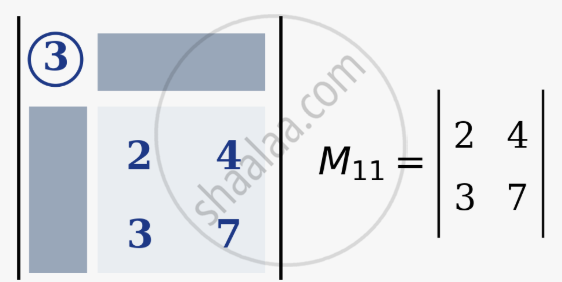
Let A = [aij] be a square matrix of order n. Then, the minor Mij of aij in A is the determinant obtained by deleting the ith row and the jth column in which element aij lies. It is denoted by Mij of A.
If A and B are non-singular square matrices of the same order such that AB = BA = I (where I is the identity matrix of the same order as A and B), then A and B are called inverses of each other.
We write A⁻¹ = B and B⁻¹ = A.
i.e. AA⁻¹ = A⁻¹A = I.
- If |A| ≠ 0, then A⁻¹ exists.
- If the inverse of a square matrix exists, then it is unique. A matrix can not have more than one distinct inverse.
The adjoint of A is defined as the transpose (i.e. interchange rows and columns) of the cofactor matrix, and it is denoted by adj (A).
Consistent Solution: A system is consistent if it has at least one solution.
Inconsistent Solution: A system is inconsistent if it has no solution.
Formulae [3]
Order 1 (1×1 matrix):
∣A∣ = a
Order 2 (2×2 matrix):
∣A∣ = ad − bc
Order 3 (3×3 matrix):
\[A= \begin{bmatrix} a_{11} & a_{12} & a_{13} \\ a_{21} & a_{22} & a_{23} \\ a_{31} & a_{32} & a_{33} \end{bmatrix}\]
\[|A|=a_{11}(a_{22}a_{33}-a_{32}a_{23})-a_{12}(a_{21}a_{33}-a_{31}a_{23})+a_{13}(a_{21}a_{32}-a_{31}a_{22})\]
- If |A| = 0
A matrix is called a Singular Matrix - If |A| ≠ 0
Matrix is called a Non-Singular Matrix
To expand along the first row, multiply each element of the first row by: \[ (-1)^{i+j} \] and by the second-order determinant obtained after deleting the row and column containing that element.
Thus,
\[ |A| = (-1)^{1+1}a_{11}\begin{vmatrix} a_{22} & a_{23} \\ a_{32} & a_{33} \end{vmatrix} + (-1)^{1+2}a_{12}\begin{vmatrix} a_{21} & a_{23} \\ a_{31} & a_{33} \end{vmatrix} + (-1)^{1+3}a_{13}\begin{vmatrix} a_{21} & a_{22} \\ a_{31} & a_{32} \end{vmatrix}. \]
Since the signs are \[+, -, +\],
\[ |A| = a_{11}\begin{vmatrix} a_{22} & a_{23} \\ a_{32} & a_{33} \end{vmatrix} - a_{12}\begin{vmatrix} a_{21} & a_{23} \\ a_{31} & a_{33} \end{vmatrix} + a_{13}\begin{vmatrix} a_{21} & a_{22} \\ a_{31} & a_{32} \end{vmatrix} \]
or,
\[ |A| = a_{11}(a_{22}a_{33} - a_{23}a_{32}) - a_{12}(a_{21}a_{33} - a_{23}a_{31}) + a_{13}(a_{21}a_{32} - a_{22}a_{31}) \]
Expansion Along the Second Row \[(R_2)\]
The sign pattern along the second row is \[ -, +, -. \]
Therefore,
\[ |A| = -a_{21}\begin{vmatrix} a_{12} & a_{13} \\ a_{32} & a_{33} \end{vmatrix} + a_{22}\begin{vmatrix} a_{11} & a_{13} \\ a_{31} & a_{33} \end{vmatrix} - a_{23}\begin{vmatrix} a_{11} & a_{12} \\ a_{31} & a_{32} \end{vmatrix}. \]
Expansion along \[R_2\] gives the same value as expansion along \[R_1\].
Expansion Along the First Column \[(C_1)\]
The signs down the first column are \[ +, -, +. \]
Thus,
\[ |A| = a_{11}\begin{vmatrix} a_{22} & a_{23} \\ a_{32} & a_{33} \end{vmatrix} - a_{21}\begin{vmatrix} a_{12} & a_{13} \\ a_{32} & a_{33} \end{vmatrix} + a_{31}\begin{vmatrix} a_{12} & a_{13} \\ a_{22} & a_{23} \end{vmatrix}. \]
Again, the final value is the same.
For \[ A = \begin{bmatrix} a & b \\ c & d \end{bmatrix}, \]
\[ \boxed{\text{adj } A = \begin{bmatrix} d & -b \\ -c & a \end{bmatrix}} \]
Shortcut
For a \[2 \times 2\] matrix:
- Interchange the diagonal elements.
- Change the signs of the off-diagonal elements.
Key Points
| Concept | Formula/Rule |
|---|---|
| Expansion along R₁ | a₁₁C₁₁ + a₁₂C₁₂ + a₁₃C₁₃ |
| Expansion along C₁ | a₁₁C₁₁ + a₂₁C₂₁ + a₃₁C₃₁ |
| Cofactor Sign | (-1)(i+j) → checkerboard: + - + / - + - / + - + |
| Zero Strategy | Expand along row/column with most zeros |
| Result Independence | Any row/column expansion gives same |
| Important Result | Order 3 determinant: 6 expansions (R1,R2,R3,C1,C2,C3),all give the same value |
| Concept | Key Point / Formula |
|---|---|
| Area of Triangle | \[ \boxed{\dfrac{1}{2}\begin{vmatrix} x_1 & y_1 & 1 \\ x_2 & y_2 & 1 \\ x_3 & y_3 & 1 \end{vmatrix}} \] |
| Collinearity | Three points are collinear if determinant =0=0 |
| Equation of Line | Line through two points can be written using a 3 × 3 determinant |
| Consistent System | Has at least one solution |
| Inconsistent System | Has no solution |
| Non-Singular Case | \[ |A| \neq 0 \] |
| Singular Case | ∣A∣=0 |
-
Minor \[M_{ij}\]: determinant of the matrix obtained by deleting row i and column j.
-
Cofactor \[C_{ij}\]: \[C_{ij} = (-1)^{i+j}M_{ij}\].
-
Determinant expansion along row i: \[|A| = \sum_{j=1}^{n} a_{ij}C_{ij}\].
-
Determinant expansion along column j: \[|A| = \sum_{i=1}^{n} a_{ij}C_{ij}\].
-
Determinant value is the same for any choice of row or column for expansion.
-
Mixed row/column property: \[\sum_{j=1}^{n} a_{ij}C_{kj} = 0\] for \[i \neq k\].
| Concept | Formula / Rule |
|---|---|
| Adjoint | adjA= transpose of cofactor matrix |
| 2×2 Adjoint | \[ \text{adj} \begin{bmatrix} a & b \\ c & d \end{bmatrix} = \begin{bmatrix} d & -b \\ -c & a \end{bmatrix} \] |
| Fundamental Property | \[ A(\text{adj } A) = (\text{adj } A)A = |A|I_n \] |
| Singular Matrix | if ∣A∣ = 0 |
| Non-Singular Matrix | if \[ |A| \neq 0 \] |
| For a square matrix A of order n | \[ |\text{adj } A| = |A|^{n-1} \] |
| Invertibility | A is invertible iff \[ |A| \neq 0 \] |
| Inverse | \[ A^{-1} = \frac{1}{|A|}\ \text{adj } A \] |
| Concept | Key Point / Formula |
|---|---|
| Area of Triangle | \[ \boxed{\dfrac{1}{2}\begin{vmatrix} x_1 & y_1 & 1 \\ x_2 & y_2 & 1 \\ x_3 & y_3 & 1 \end{vmatrix}} \] |
| Collinearity | Three points are collinear if determinant =0=0 |
| Equation of Line | Line through two points can be written using a 3 × 3 determinant |
| Consistent System | Has at least one solution |
| Inconsistent System | Has no solution |
| Non-Singular Case | \[ |A| \neq 0 \] |
| Singular Case | ∣A∣=0 |
System of linear equations: AX = B
Consistent / Inconsistent:
-
Consistent → one or more solutions
-
Inconsistent → no solution
Matrix method (Martin’s Rule):
If ∣A∣ ≠ 0, X = A−1B ⇒ unique solution
When ∣A∣ = 0:
-
→ infinitely many solutions
-
(adjA)B ≠ 0 → no solution
Homogeneous system:
AX = 0
-
Always consistent
-
∣A∣ ≠ 0 → trivial solution
-
∣A∣ = 0→ infinitely many solutions
Applicable ONLY for 3×3 determinants
Steps:
-
Rewrite the first two columns to the right
-
Add products of downward diagonals
-
Subtract products of upward diagonals
Important Questions [3]
- If a = Matrix ((2,3,10),(4,-6,5),(6,9,-20))`, Find `A Power (-1)`. Using `Apower(-1) Solve the System of Equation 2byx + 3byy +10/Z = 2`;`4by - 6byy + 5byz = 5`; 6byx + 9byy - 20byz = -4`
- If a = ⎡ ⎢ ⎣ 5 6 − 3 − 4 3 2 − 4 − 7 3 ⎤ ⎥ ⎦ , Then Write the Cofactor of the Element A21 of Its 2nd Row.
- If a = ⎡ ⎢ ⎣ 1 1 1 1 0 2 3 1 1 ⎤ ⎥ ⎦ , Find A-1. Hence, Solve the System of Equations X + Y + Z = 6, X + 2z = 7, 3x + Y + Z = 12.
