Definitions [8]
An inequality or inequation is said to be linear if each variable occurs in the first degree only and there is no term involving the product of the variables.
e.g. ax + b ≤ 0, ax + by + c > 0, x ≤ 4
An equation which contains two variables and the degree of each term containing a variable is one is called a linear equation in two variables.
General Form:
ax + by + c = 0
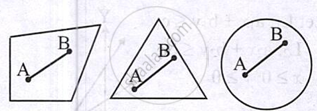
A set of points in a plane is called a convex set if the line segment joining any two points in the set lies entirely within the set.
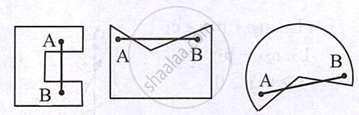
If the line segment joining any two points in the set does not completely lie in the set, then it is a non-convex set.
A linear inequality or inequation, which has only one variable, is called a linear inequality or inequation in one variable.
e.g. ax + b < 0, where a ≠ 0, 3x + 4 > 0
A Linear Programming Problem (LPP) is a problem in which a linear objective function is to be maximised or minimised subject to a set of linear constraints and non-negative conditions on the variables.
An optimisation problem is a problem in which the value of one quantity has to be made as large as possible or as small as possible under given restrictions. If the quantity and restrictions are linear, the problem becomes a Linear Programming Problem (LPP).
| Term | Definition |
| Feasible Solution | A feasible solution is any solution that satisfies all the constraints of the LPP, including non-negativity restrictions. |
| Feasible Region | The common region that satisfies all the constraints on the graph is called the feasible region. Every point inside or on this region represents a feasible solution. |
| Infeasible Solution | Any point that does not satisfy all the given constraints is an infeasible solution. |
| Optimal Solution | A feasible solution that gives the maximum or minimum value of the objective function is called the optimal solution. |
| Corner Point | A corner point is a vertex of the feasible region formed by the intersection of boundary lines. In the graphical method, these points are checked first to find the optimum value. |
| Bounded Region |
A feasible region that is enclosed within finite boundaries and does not extend indefinitely in any direction. |
| Unbounded Region |
A feasible region that extends indefinitely in one or more directions and is not completely enclosed by boundaries. |
Key Points
-
An LPP is solved graphically when there are two variables.
-
The feasible region is formed by the common solution of all constraints.
-
The optimum value is found by evaluating the objective function at corner points.
-
If two corner points give the same optimum value, then all points on the joining segment are also optimal.
-
In an unbounded region, the required maximum or minimum may fail to exist.
-
If no feasible region exists, the LPP has no feasible solution.
