Commerce (English Medium)
Science (English Medium)
Arts (English Medium)
Academic Year: 2024-2025
Date & Time: 22nd March 2025, 10:30 am
Duration: 3h
Advertisements
General Instructions:
Read the following instructions very carefully and follow them:
- This question paper contains 30 questions. All questions are compulsory.
- Question paper is divided into five Sections - Section A, B, C, D and E.
- Section A - Question Number 1 to 12 are Multiple Choice (MCQ) type questions. Each question carries 1 mark.
- Section B - Question Number 13 and 18 are Short answer type questions. Each question carries 2 marks. Write answer to each question in 50 to 60 words.
- Section C - Question Number 19 to 23 are Long Answer type-I questions. Each question carries 4 marks. Write answer to each question in 100 to 120 words.
- Section D - Question Number 24 to 26 are Passage, Cartoon and Map-based questions. Answer each question accordingly.
- Section E - Question Number 27 to 30 are Long Answer type-II questions. Each question carries 6 marks. Write answer to each question in 170 to 180 words.
- There is no overall choice in the question paper. However, an internal choice has been provided in few questions. Only one of the choices in such questions has to be attempted.
- In addition to this, note that a separate question has been provided for Visually Impaired candidates in lieu of questions having visual inputs, Map etc. Such questions are to be attempted by Visually Impaired candidates only.
Given below are two statements:
Statement-I: Mikhail Gorbachev who had become General Secretary of the Communist Party of the Soviet Union in 1985, sought to reform the Soviet System.
Statement-II: Gorbachev’s decision to normalise relations with the West and decomcratise and reform the Soviet Union had some other effects that neither he nor anyone else intended or anticipated.
Both Statement-I and Statement-II are true.
Both Statement-I and Statement-II are false.
Statement-I is true, but Statement-II is false.
Statement-I is false, but Statement-II is true.
Chapter:
Which one of the following symbolised the division between the Capitalist and the Communist world?
Gulf War
Berlin Wall
First World War
Second World War
Chapter:
Match the terms given in Column-A correctly with Column-B and choose the correct answer from the codes given below:
| Column-A | Column-B | ||
| (a) | Balance of Power | (i) | Giving up certain types of weapons |
| (b) | Disarmament | (ii) | Security |
| (c) | Migration | (iii) | Traditional security |
| (d) | Freedom of threats | (iv) | New source of threat |
(a) - (iii), (b) - (i), (c) - (iv), (d) - (ii)
(a) - (iv), (b) - (i), (c) - (iii), (d) - (ii)
(a) - (iv), (b) - (iii), (c) - (ii), (d) - (i)
(a) - (ii), (b) - (iv), (c) - (iii), (d) - (i)
Chapter:
Arrange the following in chronological order of their happening:
- India-China War
- India’s first-test of a nuclear device
- Terrorists attack on World Trade Centre in America
- The Anti-Ballistic Missile Treaty
Choose the correct option:
(i), (ii), (iii), (iv)
(ii), (iv), (iii), (i)
(iv), (i), (iii), (ii)
(i), (iv), (ii), (iii)
Chapter:
Which one among the following agreements was to cut the green house gas emissions?
Antarctic Treaty
Kyoto Protocol
Montreal Protocol
Antarctic Environmental Protocol
Chapter:
Assertion (A): The government suspended the freedom of press and implemented press censorship during emergency in 1975.
Reason (R): Newspapers protested against censorship by showing the cartoons only.
Both the Assertion (A) and the Reason (R) are correct, and the Reason (R) is the correct explanation of the Assertion (A).
Both the Assertion (A) and the Reason (R) are correct, but the Reason (R) is not the correct explanation of the Assertion (A).
The Assertion (A) is incorrect, but the Reason (R) is correct.
The Assertion (A) is correct, but the Reason (R) is incorrect.
Chapter:
Choose the correct statement about India’s nuclear policy from the statements given below:
India’s nuclear programme was started in 1952 under the guidance of Homi J. Bhabha.
India was in support of the NPT.
Now India has made it clear that the policy of ‘no first use’ can be reviewed.
Nehru was not against nuclear weapons.
Chapter:
Which political party of India wanted India to follow a pro-US foreign policy?
Bharatiya Jan Sangh
Communist Party
Socialist Party
Congress Party
Chapter:
Which political party won 16 Lok Sabha seats and was at second place in the first General Election of India?
Communist Party of India
Bharatiya Jan Sangh
Socialist Party
Swatantra Party
Chapter:
Choose the correct full form of the EVM.
Electric Voting Machine
Easy Voting Machine
Electronic Voting Machine
Election Voting Machine
Chapter:
On which one of the following basis was emergency declared in 1975?
Internal disturbances
External threat
Armed rebellion
External Aggression
Chapter:
In which country was an Australian Mining Company ‘WMC’ opposed?
Singapore
Thailand
Philippines
Japan
Chapter:
Advertisements
Mention any two objectives of ASEAN.
Chapter: [2] Contemporary Centres of Power
‘During the period of dominance of the Congress Party, its leaders never showed any desire to form new parties.’ Analyse any one reason for this.
Chapter:
Explain any two differences between the First Five Year Plan and Second Five Year Plan.
Chapter:
Explain any two reasons for the split in the Janata Party in 1979.
Chapter:
Suggest any two ways to reduce economic disparity between the poor and the rich countries at the global level.
Chapter:
State any two arms control treaties signed between the US and Soviet Union.
Chapter:
Analyse the basis of projecting China to overtake the US America to become the world’s largest economy.
Chapter:
“While the Chinese economy has improved, not everyone in China received the benefits of the reforms.” Analyse any two reasons for this.
Chapter:
“The 1960s were labelled as the ‘dangerous decade’ in India.” Explain any two reasons for this.
Chapter:
Describe the impact of globalisation on the Indian culture.
Chapter:
Explain any two reasons for the beginning of a long phase of coalition politics in India since 1989.
Chapter:
Explain the role of ‘Other Backward Classes’ in the Indian politics.
Chapter:
Advertisements
Highlight any four important features of the Nuclear Policy of India.
Chapter:
Read the passage given below carefully and answer the questions that follow:
| The Central Asian republics did not ask for independence and wanted to remain with the Soviet Federation. In December 1991, under the leadership of Yeltsin, Russia, Ukraine and Belarus declared that the Soviet Union was disbanded. The Communist Party of the Soviet Union was banned. Capitalism and democracy were adopted as the bases for the post-Soviet republics. The declaration on the disintegration of the USSR and the formation of the Commonwealth of Independent States (CIS) came as a surprise to the other republics, especially to the Central Asian ones. |
- Which ideology was adopted by the post-Soviet countries?
- Socialist
- Capitalist and Democratic
- Communist
- Democratic
- Which republic among the following became the successor of the Soviet Union?
- Belarus
- Ukraine
- Commonwealth of Independent States
- Russia
- Which one of the following is a Central Asian country?
- Chechnya
- Dagestan
- Tajikistan
- Czechoslovakia
- Which part of Soviet Union had vast hydrocarbon resources?
- Eastern Europe
- Central Asian Republics
- Yugoslavia
- Czechoslovakia
Chapter:
In the given political outline map of India, four states have been marked as (A), (B), (C) and (D). Identify the States on the basis of the information given below and write their correct names in the answer-book along with the respective serial numbers of the information used and the concerned alphabet as per the format that follows:
| Serial number for the information used | Alphabet concerned | Name of the States |
| (i) | ||
| (ii) | ||
| (iii) | ||
| (iv) |
- The state, where the assassination of Rajiv Gandhi took place.
- The state where Karpoori Thakur was a Chief Minister.
- The state where UPA won the majority of seats in Lok Sabha elections in 2004.
- The state where Bahujan Samaj Party (BSP) achieved a breakthrough in 1989 & 1991 elections.
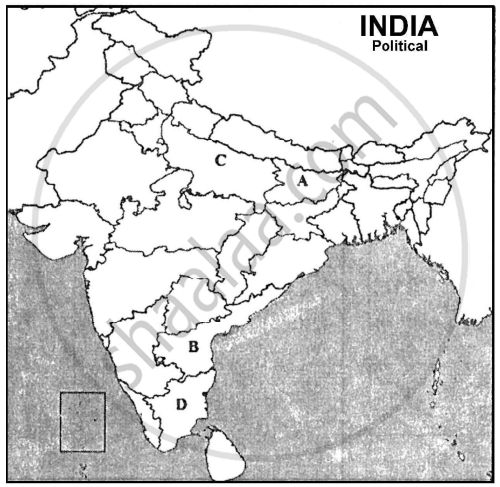
Chapter:
Study the given picture and answer the questions that follow:
(The given cartoon is about USA’s invasion on a Gulf Country.)
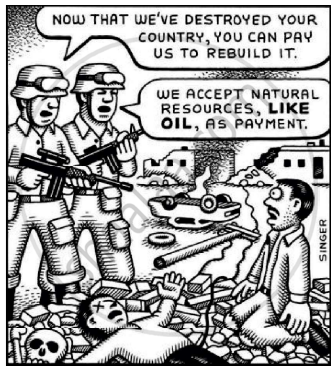
- Which one of the following is the most important resource in global strategy?
- Water
- Oil
- Land
- Automobile
- Which of the following regions accounts for about 30% of global oil production?
- Europe
- China
- Gulf Region
- Japan
- Which Gulf country was invaded by US America?
- Iraq
- Saudi Arabia
- Kuwait
- Iran
- What was the objective of the United States of America to attack the Gulf country?
- To get control on the oil resources
- To get the territory of country
- To establish its army headquarters
- To stop USSR from entering this region
Chapter:
Explain any two commonalities between Bangladesh and Pakistan in their democratic experiences.
Chapter:
Explain any two differences between Bangladesh and Pakistan in their democratic experiences.
Chapter:
Explain any two issues of cooperation between India and Bangladesh.
Chapter:
Explain any two issues of confrontation between India and Bangladesh.
Chapter:
Explain the importance of International organisations like the United Nations in the contemporary world.
Chapter:
Explain any four changes that have occurred after the Cold War and have affected the realities of the world politics.
Chapter:
“Regional demands from different parts of India show that India has adopted a democratic approach to accommodate diversity.” Justify the statement.
Chapter:
Examine any three problems related to the Jammu and Kashmir.
Chapter:
Describe any three circumstances under which the State Reorganisation Commission was constituted.
Chapter:
Describe the circumstances and events that led to Manipur’s accession to India in 1949.
Chapter:
Other Solutions
Submit Question Paper
Help us maintain new question papers on Shaalaa.com, so we can continue to help studentsonly jpg, png and pdf files
CBSE previous year question papers Class 12 Political Science with solutions 2024 - 2025
Previous year Question paper for CBSE Class 12 Political Science-2025 is solved by experts. Solved question papers gives you the chance to check yourself after your mock test.
By referring the question paper Solutions for Political Science, you can scale your preparation level and work on your weak areas. It will also help the candidates in developing the time-management skills. Practice makes perfect, and there is no better way to practice than to attempt previous year question paper solutions of CBSE Class 12.
How CBSE Class 12 Question Paper solutions Help Students ?
• Question paper solutions for Political Science will helps students to prepare for exam.
• Question paper with answer will boost students confidence in exam time and also give you an idea About the important questions and topics to be prepared for the board exam.
• For finding solution of question papers no need to refer so multiple sources like textbook or guides.
