Commerce (English Medium)
Science (English Medium)
Arts (English Medium)
Academic Year: 2025-2026
Date: March 2026
Advertisements
General Instructions:
- Question paper comprises five Sections - A, B, C, D and E. There are 34 questions in the question paper. All questions are compulsory.
- Section A - Question 1 to 21 are MCQs of 1 mark each.
- Section B - Question no. 22 to 27 are Short Answer Type Questions, carrying 3 marks each. Answers to each question should not exceed 60-80 words.
- Section C - Question no 28 to 30 are Long Answer Type Questions, carrying 8 marks each. Answer to each question should not exceed 300-350 words.
- Section D - Question no.31 to 33 are Source based questions with three sub questions and are of 4 marks each.
- Section E - Question no. 34 is Map based, carrying 5 marks that includes the identification and location of significant test items. Attach the map with the answer book.
- There is no overall choice in the question paper. However, an internal choice has been provided in a few questions. Only one of the choices in such questions have to be attempted.
- In addition to this, separate instructions are given with each section and question, wherever necessary.
Which of the following place of Harappan civilisation is associated with fire altars?
Harappa
Lothal
Mohenjodaro
Rakhigarhi
Chapter:
Archaeologists have been able to reconstruct dietary practices from finds of charred grains and seeds. These are studied by ______.
Agronomist
Palaeontologist
Archaeo-botanists
Anthologist
Chapter:
Which one of the following is not a correct statement about Mahajanapadas?
Most mahajanapadas were ruled by kings.
Some, known as ganas or sanghas, were oligarchies.
Each mahajanapada had a capital city, which was often fortified.
Panchala became the most powerful mahajanapada between 6-4 BCE.
Chapter:
Match the following and select the correct option:
| List I | List II |
| 1. Endogamy | a. It is the practice of a woman having several husbands. |
| 2. Exogamy | b. It refers to marriage within a unit – this could be a kin group, caste, or a group living in the same locality. |
| 3. Polygyny | c. It refers to marriage outside the unit. |
| 4. Polyandry | d. It is the practice of a man having several wives. |
1 - b, 2 - c, 3 - d, 4 - a
1 - a, 2 - d, 3 - c, 4 - b
1 - c, 2 - b, 3 - d, 4 - a
1 - d, 2 - a, 3 - b, 4 - c
Chapter:
Which of the following states that the paternal estate was to be divided equally amongst sons after the death of the parents, with a special share for the eldest?
Vishnusmriti
Vyasasmriti
Likhitasmriti
Manusmriti
Chapter:
Identify the given image from the following options.
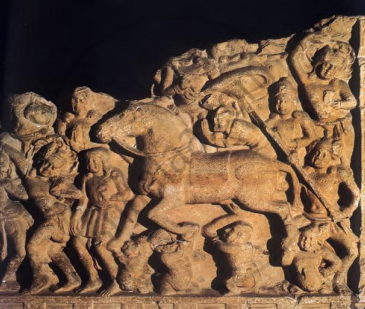
A terracotta sculpture depicting a scene from the Mahabharata.
A sculpture from Amaravati depicting Buddha leaving the palace.
A chief and his follower-stone sculpture.
Sandstone sculpture of a Kushana king.
Chapter:
According to which Buddhist text, Asoka distributed portions of the Buddha’s relics to every important town and ordered the construction of stupas over them?
Ashokavadana
Vinaya Pitaka
Sutta Pitaka
Dipavamsa
Chapter:
Which of the following statements is/are correct about François Bernier?
- A Frenchman, a doctor, political philosopher, and historian.
- He was closely associated with the Mughal court as a physician to Prince Dara Shukoh.
- He was in India for 14 years, from 1656 to 1670.
- He was also associated as an intellectual and scientist with Danishmand Khan, an Armenian noble at the Mughal court.
1, 2, 3, 4
1, 2, 3
1, 2, 4
2, 3, 4
Chapter:
These trees are among the most peculiar trees in kind and most astonishing in habit. They look exactly like date-palms, without any difference between them except that the one produces nut as its fruits and the other produces dates. Which of the following traveller gave this description?
Ibn Battuta
Al-Biruni
Duarte Barbosa
Megasthanese
Chapter:
Assertion (A): Lingayats did not practice funerary rites such as cremation, prescribed in the Dharmashastras.
Reason (R): Lingayats believe that on death, the devotee will be united with Shiva and will not return to this world.
Both (A) and (R) are correct, and (R) is the correct explanation of (A).
Both (A) and (R) are correct, and (R) is not the correct explanation of (A).
(A) is correct, but (R) is not correct.
(R) is correct, but (A) is not correct.
Chapter: [6] Bhakti - Sufi Traditions: Changes in Religious Beliefs and Devotional Texts
Which of the following was the first dynasty to rule over the Vijayanagara Empire?
Suluva dynasty
Aravidu dynasty
Tuluva dynasty
Sangama dynasty
Chapter:
Which of the following statements is correct regarding the Amara-nayaka system?
The Amara-nayakas belonged to Bijapur.
Amara is believed to be derived from the Hindi word samara.
The amara-nayakas were independent and never sent tribute to the king.
They were Military commanders who got territories to govern by the Raya.
Chapter:
The book deals with the fiscal side of the empire and provides rich quantitative information on revenue rates.
Manzil-abadi
Sipah-abadi
Mulk-abadi
Aam-abadi
Chapter:
Consider the following statements regarding the criteria of classification of lands under Akbar.
- Polaj is land which is annually cultivated for each crop in succession and is never allowed to lie fallow.
- Parauti is land left out of cultivation for a time that it may recover its strength.
- Chachar is land that has lain fallow for three or four years.
- Banjar land was also called jins-i-kamil.
Which of the following statements is/are correct?
1, 2, 3, 4
1, 2, 3
1, 2, 4
2, 3, 4
Chapter:
The zamindars defaulted on payments after the ‘Permanent Settlement’ was introduced in 1793. Which of the following was a reason behind it?
- The initial demands were very high.
- This high demand was imposed in the 1790s, a time when the prices of agricultural produce were depressed, making it difficult for the ryots to pay their dues to the zamindar.
- The revenue was invariable, regardless of the harvest, and had to be paid punctually.
- The Permanent Settlement initially limited the power of the zamindar to collect rent from the ryot and manage his zamindari.
1, 2, 3
1, 2, 4
2, 3, 4
1, 2, 3, 4
Chapter:
Advertisements
The ______ were most powerful in North Bengal, although rich peasants and village headmen were emerging as commanding figures in the countryside in other parts of Bengal as well.
Zamindars
Jotedars
Taluqdars
Ryots
Chapter:
Choose the correct chronological order of the events following events out of the options given below:
- The sepoys arrived at the gates of the Red Fort early in the morning.
- They first seized the bell of arms and plundered the treasury.
- Late in the afternoon of 10 May 1857, the sepoys in the cantonment of Meerut broke out in mutiny.
- Awadh was formally annexed to the British Empire.
1, 2, 3, 4
2, 1, 3, 4
3, 2, 1, 4
4, 3, 2, 1
Chapter:
Name the historian who remarked that South Africa was the making of the Mahatma.
Sumit Sarkar
Sekhar Bandyopadhyay
Chandran Devanesan
David Hardiman
Chapter:
Match the column I with column II and choose the correct option.
| Column I | Column II |
| (i) Mahatma Gandhi returns from South Africa | (a) 1917 |
| (ii) Champaran movement | (b) 1918 |
| (iii) Peasant movements in Kheda (Gujarat), and workers’ movement in Ahmedabad | (c) 1919 |
| (iv) Rowlatt Satyagraha | (d) 1915 |
i - b, ii - c, iii - a, iv - d
i - c, ii - a, iii - b, iv - d
i - c, ii - d, iii - b, iv - a
i - d, ii - a, iii - b, iv - c
Chapter:
Who proposed that the National Flag of India be a ‘horizontal tricolour of saffron, white and dark green in equal proportion’, with a wheel in navy blue at the centre?
J. B. Kripalani
Rajendra Prasad
Pandit Jawaharlal Nehru
Sardar Vallabhbhai Patel
Chapter:
One among the following group initially refused to join the Constituent Assembly, as they believed that it was a British creation. Choose the correct option:
Socialists
Tribals
Backward Classes
Anglo-Indian
Chapter:
“The archaeological records provide no immediate answer of the existence of centre of power”. Give suitable examples to prove the statement in the context of Harappa.
Chapter:
Prove that Harappans had access to different parts of the world.
Chapter:
Describe the various stages through which Mahabharata was compiled in the 20th century. Discuss any three points.
Chapter:
Explain the barriers that Al Biruni felt obstructed his understanding.
Chapter:
What was the condition of an average peasant of North India during the seventeenth century?
Chapter:
Discuss the policies adopted by the British towards the Paharias during the early 18th century in Bengal.
Chapter:
“Rumours and prophecies played a part in moving the people into action during the revolt of 1857.” Examine the statement with rumours and reasons for its beliefs.
Chapter:
Advertisements
‘A chain of grievances in Awadh linked the prince, taluqdars, peasants, and sepoy to join hands in the revolt of 1857 against the British.” Examine the statement by giving three points.
Chapter:
Enumerate the features of Mauryan administration.
Chapter:
How do modern historians explain the development and rise of Magadhan power? Explain briefly.
Chapter:
“Krishnadeva Raya’s rule was characterised by expansion and consolidation.” Substantiate the statement with suitable examples.
Chapter:
“Abdur Razzaq, an ambassador sent by the ruler of Persia to Calicut (present-day Kozhikode) in the fifteenth century, was greatly impressed by the fortifications, and mentioned seven lines of forts.” Substantiate the statement with suitable examples.
Chapter:
Discuss the point that private letters and autobiographies tell us about a great deal of information about an individual?
Chapter:
How are private letters and autobiographies as sources different from official accounts?
Chapter:
Explain why many scholars believe that the months after Independence were Gandhiji’s ‘finest hour.’
Chapter:
Read the given passage and answer the following questions: (4)
| How do we know about the Buddha’s teachings? These have been reconstructed by carefully editing, translating, and analysing the Buddhist texts mentioned earlier. Historians have also tried to reconstruct details of his life from hagiographies. Many of these were written down at least a century after the time of the Buddha, in an attempt to preserve memories of the great teacher. |
- What do you understand by the term ‘hagiographies? (1)
- Write any one teaching/philosophy of Buddha. (1)
- Why did art historians need to acquire familiarity with hagiographies? (2)
Chapter:
Read the given passage and answer the following questions: (4)
| Often associated with the goddess were forms of worship that were classified as ‘Tantra Vidya’. Tantric practices were widespread in several parts of the subcontinent – they were open to women and men, and practitioners often ignored differences of caste and class within the ritual context. Many of these ideas influenced Shaivism as well as Buddhism, especially in the eastern, northern, and southern parts of the subcontinent. |
- Is tantric tradition different from Vedic tradition? (2)
- “Tantric practices somewhat inculcated the notion of an egalitarian society.” Do you agree? (1)
- Whom did the tantric ideas influence? (1)
Chapter:
Read the given passage and answer the following questions: [4]
| Countering the demand for separate electorates, Govind Ballabh Pant declared that it was not only harmful for the nation but also for the minorities. He agreed with B. Pocker Bahadur that the success of a democracy was to be judged by the confidence it generated amongst different sections of people. He agreed too that every citizen in a free state should be treated in a manner that satisfied “not only his material wants but also his spiritual sense of self-respect”, and that the majority community had an obligation to try and understand the problems of minorities and empathise with their aspirations. Yet Pant opposed the idea of separate electorates. It was a suicidal demand, he argued, that would permanently isolate the minorities, make them vulnerable, and deprive them of any effective say within the government. |
- Why were the national leaders countering demand for separate electorates? (1)
- Imagine you were a member of the Constituent Assembly. Would you have supported the idea of separate electorates? Give reasons to justify your answer. (2)
- What was the argument given by B. Pocker Bahadur to which Govind Ballabh Pant agreed? (1)
Chapter:

- On the given political map of India, locate and label the following with appropriate symbols:
- Amaravati – A Stupa
- Magadha Mahajanapada
- Rakhigarhi- Harappan site
Or - Lothal-Harappan site
- On the same outline map, two places have been marked as ‘A’ and ‘B’ as the centres of the Revolt of 1857. Identify them and write their correct names on the lines drawn near them.
Chapter:
Other Solutions
Submit Question Paper
Help us maintain new question papers on Shaalaa.com, so we can continue to help studentsonly jpg, png and pdf files
CBSE previous year question papers Class 12 History with solutions 2025 - 2026
Previous year Question paper for CBSE Class 12 History-2026 is solved by experts. Solved question papers gives you the chance to check yourself after your mock test.
By referring the question paper Solutions for History, you can scale your preparation level and work on your weak areas. It will also help the candidates in developing the time-management skills. Practice makes perfect, and there is no better way to practice than to attempt previous year question paper solutions of CBSE Class 12.
How CBSE Class 12 Question Paper solutions Help Students ?
• Question paper solutions for History will helps students to prepare for exam.
• Question paper with answer will boost students confidence in exam time and also give you an idea About the important questions and topics to be prepared for the board exam.
• For finding solution of question papers no need to refer so multiple sources like textbook or guides.
