Advertisements
Advertisements
Question
You have been provided with a solenoid AB.
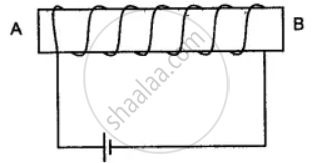
(i) What is the polarity at end A?
(ii) Give one advantage of an electromagnet over a permanent magnet.
Advertisements
Solution
(i) North pole.
(ii) The electromagnet is a very strong magnet as compared to a permanent magnet.
RELATED QUESTIONS
Write some of the important uses of electromagnets.
A conducting rod is moved with a constant velocity v in a magnetic field. A potential difference appears across the two ends _____________ .
A conducting square loop having edges of length 2.0 cm is rotated through 180° about a diagonal in 0.20 s. A magnetic field B exists in the region which is perpendicular to the loop in its initial position. If the average induced emf during the rotation is 20 mV, find the magnitude of the magnetic field.
Draw and label the diagram of a simple D.C. motor.
(a) Explain the rotation of the coil, giving a reason for your answer.
(b) How can you reverse the direction of rotation of the armature?
(c) How can you increase the speed of rotation of the motor?
State the condition at which we say the two coils kept close to each other are perfectly coupled with each other.
Using Ampere's law, obtain an expression for the magnetic induction near a current-carrying straight infinitely long wire.
Ansari Sir was demonstrating an experiment in his class with the setup as shown in the figure below.

A magnet is attached to a spring. The magnet can go in and out of the stationary coil. He lifted the Magnet and released it to make it oscillate through the coil.
Based on your understanding of the phenomenon, answer the following question.
Consider the situation where the Magnet goes in and out of the coil. State two changes which could be made to increase the deflection in the galvanometer.
Name some equipment that uses electromagnetism for functioning.
A conducting bar of length L is free to slide on two parallel conducting rails as shown in the figure

Two resistors R1 and R2 are connected across the ends of the rails. There is a uniform magnetic field `vec"B"` pointing into the page. An external agent pulls the bar to the left at a constant speed v. The correct statement about the directions of induced currents I1 and I2 flowing through R1 and R2 respectively is:
Which change in the current of a nearby solenoid coil can produce an induced current?
