Advertisements
Advertisements
Question
Write the molecular formulae of the following compound.
Sodium aluminate
Advertisements
Solution
Sodium aluminate- NaAlO2
APPEARS IN
RELATED QUESTIONS
Name the most abundant metal in the earth’s crust.
Write the composition of the alloy called bronze.
How is sodium metal extracted? Explain with the help of equation of the reaction involved.
Name three other metals which are extracted in a manner similar to sodium.
An important ore of zinc metal is ______.
During galvanisation, iron metal is given a thin coating of one of the following metals. This metal is:
Which metal can be extracted from the following ore?
bauxite
Give reasons, why aluminum is used in:
In making ships
Aluminum is used in thermite welding:
what is thermit?
Name the anode, the cathode and the electrolyte used in the electrolytic refining of impure copper.
What is meant by concentration of ores?
State the property of the metal being utilized in the following :
| Use of metal | Property |
| Zinc in Galvanization | |
| Aluminium in Thermite welding |
Which one of the following is not true of metal :
Metals are malleable and ductile
How is the method of extraction of metals high up in the reactivity series different from that for metals in the middle? Why can the same process not be applied for them? Name the process used for the extraction of these metals.
Explain concept with example/explain with the help of a balanced equation.
Ionic bond and ionic compounds
Explain concept with example/explain with the help of a balanced equation.
Calcination
Observe the following diagram and write answers.
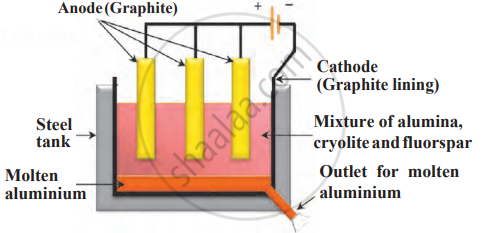
- Name the method.
- Write anode reaction and cathode reaction.
- Why fluorspar and cryolite are added in the mixture?
Answer the questions on the following passage.
The minerals from which the metal can be separated economically are called ores. Ores contain many types of impurities such as soil, sand and rocky substances along with metal compounds. These impurities are called gangue.
Metals can be extracted from their ores by means of various methods of separation. The process of extraction of metal in a pure state from the ores is also a part of metallurgy.
Ores are taken out from the mines and the gangue is usually separated from the ore at the site itself by various methods. Then the ores are carried out to the place where metals are produced. Here metals are extracted in pure form. Then metals are further purified by different methods of purification. This entire process is called metallurgy. Most metals being reactive do not occur in nature in the free state but are found in combined state as their salts such as oxides, carbonates, sulphides, and nitrates. however, the most unreactive metals that are not affected by air, water and other natural factors like silver, gold, platinum, generally occur in a free state. The compounds of metals that occur in nature along with the impurities are called minerals.
- What are ores?
- Which processes are involved in the branch of metallurgy? What is metallurgy?
- Which metals are found in a free state?
- In what forms are metals found in combined state?
- What is gangue?
Which of the following metals exist in their native state in nature?
(i) Cu
(ii) Au
(iii) Zn
(iv) Ag
Iqbal treated a lustrous, divalent element M with sodium hydroxide. He observed the formation of bubbles in reaction mixture. He made the same observations when this element was treated with hydrochloric acid. Suggest how can he identify the produced gas. Write chemical equations for both the reactions.
