Advertisements
Advertisements
Questions
Write the main products when n-butyl chloride is treated with alcoholic KOH.
What happens when n-butyl chloride is treated with alcoholic KOH?
Advertisements
Solution
When n-butyl chloride is treated with alcoholic KOH, but-1-ene forms. This reaction is an example of β-hydrogen elimination brought about by C2H5O−.
\[\ce{\underset{n-Butylchloride}{CH3 - CH2 - CH2 - CH2 - Cl}->[alc{.} KOH]\underset{But-1-ene}{CH3 - CH2 - CH = CH2}}\]
RELATED QUESTIONS
Identify the product ‘D’ in the following sequence of reactions:
\[\ce{H3C - CH2 - CH2 - Cl \underset{KOH}{\overset{Alc}{->}} 'B' \overset{HBr}{->} 'C' \underset{Elther}{\overset{Na}{->}}'D'}\]
Identify ‘A’ and ‘B’ in the following reaction :
\[\ce{CH3 - CH = CH2 ->[HBr]'A' ->[alc.KOH]'B'}\]
State and explain Markownikoff's rule with suitable example
How do you convert 2-bromobutane to but-2-ene?
Predict all the alkenes that would be formed by dehydrohalogenation of the following halide with sodium ethoxide in ethanol and identify the major alkene:
1-Bromo-1-methylcyclohexane
Predict all the alkenes that would be formed by dehydrohalogenation of the following halide with sodium ethoxide in ethanol and identify the major alkene:
2-Chloro-2-methylbutane
Write the structure of the major organic product in the following reaction:
\[\ce{(CH3)3CBr + KOH ->[ethanol][heat]}\]
How the following conversion can be carried out?
1-Bromopropane to 2-bromopropane
How the following conversion can be carried out?
2-Bromopropane to 1-bromopropane
Draw a neat, labelled energy profile diagram for SN1 reaction mechanism.
What are racemates?

'A' is:
Identify the major product formed when 2-cyclohexylchloroethane undergoes a dehydrohalogenation reaction. Name the reagent which is used to carry out the reaction.
The conversion of an alkyl halide into an alkene by alcoholic KOH is classified as ______.
Name the following halides according to IUPAC system and classify them as alkyl, allyl, benzyl (primary, secondary, tertiary), vinyl or aryl halides:
\[\ce{CH3 C(CI) (C2H5)CH2CH3 }\]
Reaction of trans-2-phenyl-1-bromocyclopentane with alcoholic KOH produces.
Which of the following alkyl halides will undergo SN1 reaction most readily?
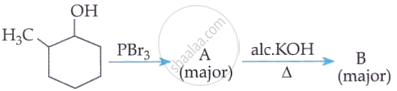
Major products A and B formed in the following reaction sequence are: