Advertisements
Advertisements
Question
Write short note
Occupational structure of India
Advertisements
Solution
1. In 1901, most of the population of India was engaged in primary sector. 2. With the development of various industries over time, greater working population engaged in secondary and tertiary sectors.
3. However, India being an agrarian economy, most of the people are still engaged in primary sector.
4. In 2011, the occupational structure was as follows:
- 48.96% working population engaged in primary sector.
- 23.52% working population engaged in secondary sector.
- 27.52% working population engaged in tertiary sector.
APPEARS IN
RELATED QUESTIONS
Answer in detail:
Explain the rural and urban population structure.
A person who can write, read and do mathematical calculations in the country is known as ______.
Identify the incorrect factor:
Regions having sex ratio more than one thousand.
Which state has the highest % of the rural population?
Which of the following programs sponsored by the central government aims at enabling the rural population to conserve water for drinking, irrigation, fisheries and afforestation?
Study the given graph carefully and answer the following question:
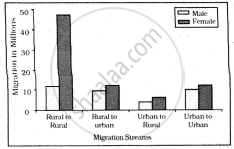
Intra-state Migration by place of Last Residence Indicating Migration Streams India, 2011
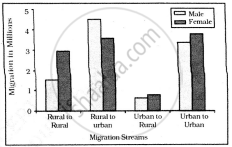
Inter-state Migration by Place of Last Residence Indicating Migration Streams India, 2011
What is the main cause of male migration from rural to urban?
Study the given graph carefully and answer the following question:
Intra-state Migration by place of Last Residence Indicating Migration Streams India, 2011
Inter-state Migration by Place of Last Residence Indicating Migration Streams India, 2011
Which stream of migration shows the lowest trend in intra-state migration?
The significance of age-structure is/are?
From which of the following do we get information regarding the population of our country?
Which one of the following is the largest linguistic group of India?
