Advertisements
Advertisements
Question
Answer in detail:
Explain the rural and urban population structure.
Advertisements
Solution
- The area where more people are engaged in primary activities is called a rural area, and the people living in rural areas are called rural populations.
- The area where more people are engaged in secondary and tertiary activities is called urban areas, and people living in urban areas are called urban populations.
- There is a difference in the density of the population, age structure, sex ratio, occupation structure, standard of living, lifestyle of people, sources of income, literacy rate, etc.
- There is a major difference in the level of economic development in rural and urban areas.
- There is more use of modern technology in urban areas compared to rural areas. Therefore, development in all fields is very fast.
- Due to more development of industries and infrastructure in urban areas, there is an increase in transportation and trade as compared to rural areas.
- The criteria to differentiate rural and urban populations vary from one country to another.
APPEARS IN
RELATED QUESTIONS
Which one of the following country has highest sex ratio in the world?
According to the UNO, how many countries have sex ratio favourable for females?
According to the UNO, how many countries have sex ratio unfavourable for females?
Which country’s population shows a constant population?
Study the given graph carefully and answer the following question:
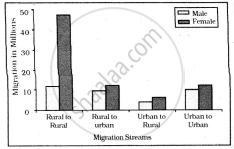
Intra-state Migration by place of Last Residence Indicating Migration Streams India, 2011
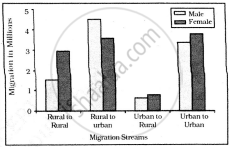
Inter-state Migration by Place of Last Residence Indicating Migration Streams India, 2011
Who dominates rural to rural migration in intra-state migration?
Population composition means
Which group is known as productive group?
A country having pyramid of population that has a wide base and sharply tapered top is characterised by which of the following?
Draw a neat, labelled diagram
Pyramids of underdeveloping countries.
Which one of the following is the largest linguistic group of India?
