Advertisements
Advertisements
प्रश्न
Write short note
Occupational structure of India
Advertisements
उत्तर
1. In 1901, most of the population of India was engaged in primary sector. 2. With the development of various industries over time, greater working population engaged in secondary and tertiary sectors.
3. However, India being an agrarian economy, most of the people are still engaged in primary sector.
4. In 2011, the occupational structure was as follows:
- 48.96% working population engaged in primary sector.
- 23.52% working population engaged in secondary sector.
- 27.52% working population engaged in tertiary sector.
APPEARS IN
संबंधित प्रश्न
A: Assertion: In the population pyramid, a broad base indicates a high number of children in a country.
R: Reasoning: Broad apex is an indicator of the high number of elderly in a country
Differentiate between:
Expansive population pyramid and Constrictive population pyramid.
State whether right or wrong:
Literacy ratio of population is indicator of economic and social development of a country.
Write short note
Rural-urban structure of population
Name the country where sex ratio is most unfavourable to women in the world.
Which of the following is the largest religious minority in India?
Which of the following programs sponsored by the central government aims at enabling the rural population to conserve water for drinking, irrigation, fisheries and afforestation?
Study the given graph carefully and answer the following question:
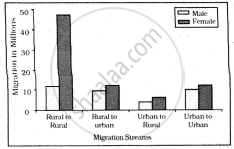
Intra-state Migration by place of Last Residence Indicating Migration Streams India, 2011
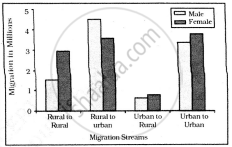
Inter-state Migration by Place of Last Residence Indicating Migration Streams India, 2011
Which stream of migration shows the lowest trend in intra-state migration?
The significance of age-structure is/are?
Mining is a ______.
