Advertisements
Advertisements
प्रश्न
Differentiate between:
Expansive population pyramid and Constrictive population pyramid.
Differentiate between:
Expansive pyramid and Constrictive pyramid.
Advertisements
उत्तर
| Sr. No. | Expansive pyramid |
Constrictive pyramid |
| 1. | The expansive pyramid is very broad at the base and becomes narrow at the apex. | A constrictive pyramid is narrow at the base and broader at the apex. |
| 2. | It shows a higher percentage of young people but a lower percentage of old-age people in the country. | It shows a high percentage of old people and a lower percentage of young people in the country. |
| 3. | It indicates a high birth rate, which makes the base broad, and a high death rate, which makes the apex narrow. | It indicates a low birth rate that narrows the base and a low death rate that makes the apex broad. |
| 4. | It represents a rapidly growing population, commonly seen in developing countries where birth rates are high and healthcare is still improving. | It indicates a declining or stable population, often found in developed countries, where advanced healthcare and lifestyle lead to longer life expectancy and lower birth rates. |
APPEARS IN
संबंधित प्रश्न
Identify the incorrect factor
Pull factors of migration:
What do you mean by an aging population?
Divide population based on the place of residence.
Why is sex ratio in some European countries recorded favourable to females? Give one reason.
What is the meaning of the Age Structure of population? Describe in brief four main characteristics of the age structure of the world population.
How many Million Plus towns are there in India (in 2001)?
Study the given graph carefully and answer the following question:
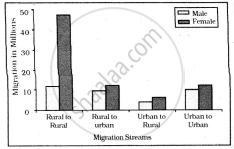
Intra-state Migration by place of Last Residence Indicating Migration Streams India, 2011
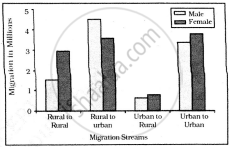
Inter-state Migration by Place of Last Residence Indicating Migration Streams India, 2011
Who dominates rural to rural migration in intra-state migration?
Population composition means
"India is a land of linguistic diversity." Support the statement.
Which one of the following is the largest linguistic group of India?
