Advertisements
Advertisements
Question
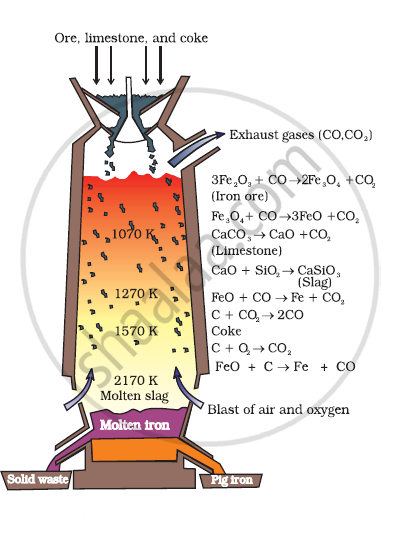
Write down the reactions taking place in different zones in the blast furnace during the extraction of iron.
Advertisements
Solution
During the extraction of iron, the reduction of iron oxides takes place in the blast furnace. In this process, hot air is blown from the bottom of the furnace, and coke is burnt to raise the temperature up to 2200 K in the lower portion itself. The temperature is lower in the upper part. Thus, it is the lower part where the reduction of iron oxides (Fe2O3 and Fe3O4) takes place.
The reactions taking place in the lower temperature range (500 − 800 K) in the blast furnace are:
\[\ce{3Fe2O3 + CO -> 2Fe3O4 + CO2}\]
\[\ce{Fe3O4 + 4CO -> 3Fe + 4CO2}\]
\[\ce{Fe2O3 + CO -> 2FeO + CO2}\]
The reactions taking place in the higher temperature range (900-1500 K) in the blast furnace are:
\[\ce{C + CO2 -> 2CO}\]
\[\ce{FeO + CO -> Fe + CO2}\]
The silicate impurity of the ore is removed as slag by calcium oxide (CaO), which is formed by the decomposition of limestone (CaCO3)
\[\ce{CaCO3 -> CaO + CO2}\]
\[\ce{CaO + SiO2 -> \underset{(Slag)}{\underset{Calcium silicate}{CaSiO3}}}\]
RELATED QUESTIONS
The reaction,
Cr2O3 + 2Al → Al2O3 + 2Cr
(ΔGθ = -421kJ) is thermodynamically feasible as is apparent from the Gibbs energy value. Why does it not take place at room temperature?
Is it true that under certain conditions, Mg can reduce SiO2 and Si can reduce MgO? What are those conditions?
Why is the extraction of copper from pyrites more difficult than that from its oxide ore through reduction?
State the role of silica in the metallurgy of copper.
How will you convert the following:
Zinc blende to Zinc metal
The impurity that is added externally to remove the impurity already present in the ore is known as ____________.
In the extraction of copper from its sulphide ore, the metal is formed by the reduction of \[\ce{Cu2O}\] with ______.
In the metallurgy of aluminium ______.
For the reduction of \[\ce{FeO}\] at the temperature corresponding to point D, which of the following statements is correct?
The mixture of compounds A and B is passed through a column of \[\ce{Al2O3}\] by using alcohol as eluant. Compound A is eluted in preference to compound B. Which of the compounds A or B, is more readily adsorbed on the column?
Why is sulphide ore of copper heated in a furnace after mixing with silica?
Explain the following:
\[\ce{CO2}\] is a better reducing agent below 710 K whereas \[\ce{CO}\] is a better reducing agent above 710 K.
Explain the following:
Silica is added to the sulphide ore of copper in the reverberatory furnace.
Heating of MgCl2 6H2O in absence of HCl gives ______.
Carbon deposition reaction taking place in ______.
Assertion: For the extraction of iron, haematite ore is used.
Reason: Haematite is a carbonate ore of iron.
